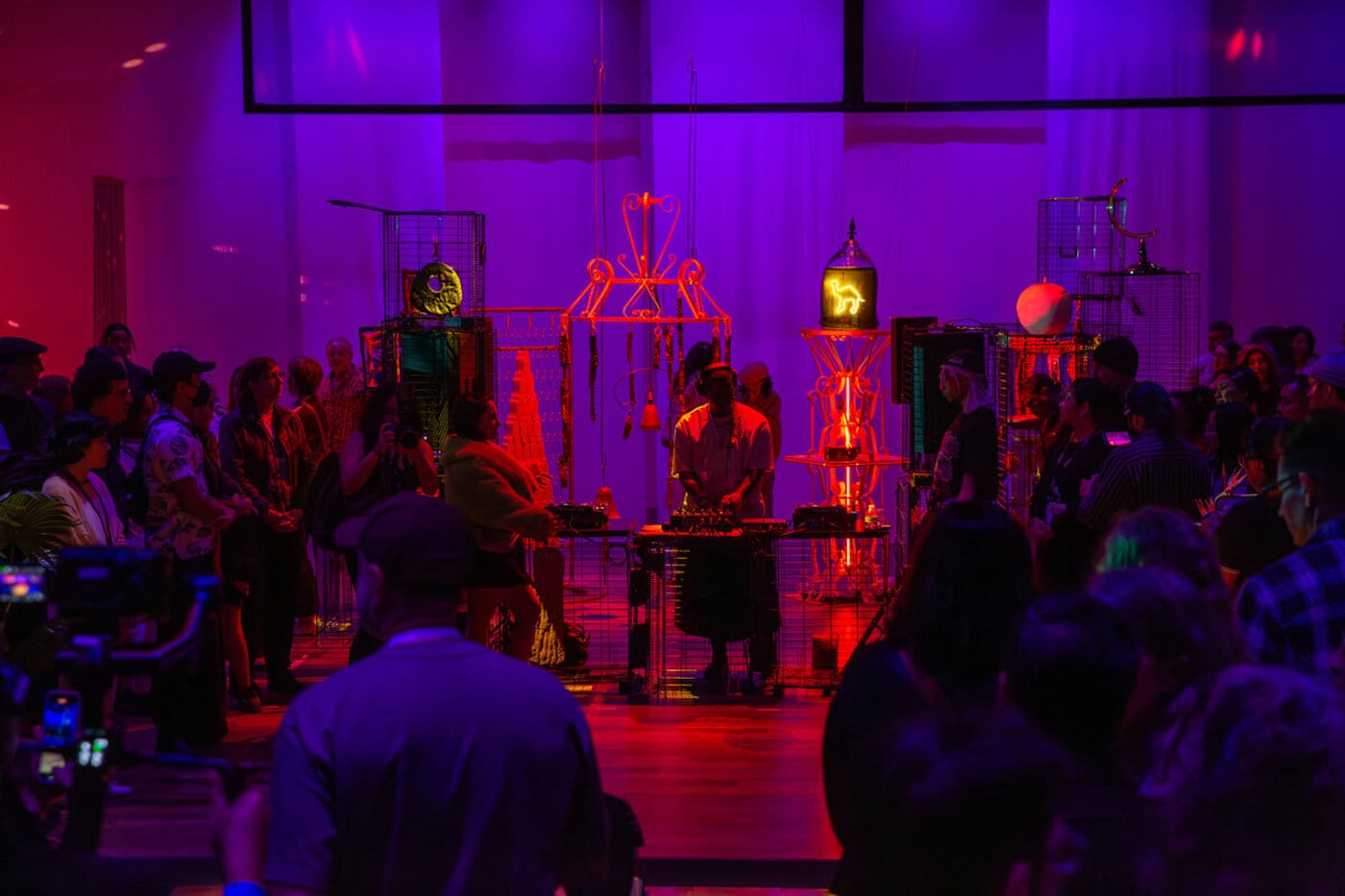
For decades, the dance floor was dismissed by the high-art establishment as a site of mere escapism — a hedonistic release from the rigors of political and social life. But a growing body of curatorial practice is reframing the rave not as a distraction, but as a sophisticated form of worldbuilding. In these spaces, the rigid hierarchies of the daylight world begin to dissolve, replaced by a collective rhythm that suggests a different social order. The shift marks a broader institutional reckoning with what counts as legitimate aesthetic experience — and who gets to define it.
This reappraisal is increasingly visible within the walls of major art institutions. At Dia Beacon in 2024, artist Steve McQueen utilized subterranean architecture to experiment with low-frequency vibrations and shifting light, deploying bass as a sculptural tool to alter the visitor's perception of space. From the "Elements of Vogue" exhibition in Madrid to contemporary installations elsewhere, curators are treating collective movement as a repository of knowledge produced by marginalized communities. The museum, in this framing, stops being a static archive and becomes a laboratory for social experimentation.
From White Cube to Bass Chamber
The institutional art world has long operated under the logic of the "white cube" — the neutral, silent gallery space theorized by critic Brian O'Doherty in the 1970s as the dominant container for modern art. In the white cube, the viewer is expected to be still, contemplative, and above all, quiet. Sound is incidental; the body is secondary to the eye. This model served a particular canon well, but it also encoded assumptions about who belongs in a museum and how they should behave.
The turn toward sonic and kinetic experience represents a direct challenge to that paradigm. When bass vibrations travel through a gallery floor, the boundary between artwork and audience collapses. The visitor is no longer observing a piece from a respectful distance but is physically inside it, subject to its frequencies. This is not entirely new territory — sound art has occupied gallery spaces since at least the mid-twentieth century, and artists from La Monte Young to Janet Cardiff have long explored the spatial properties of audio. What is new is the explicit institutional embrace of the dance floor as a curatorial format, not merely as a programming afterthought or a late-night fundraiser, but as a mode of knowledge production in its own right.
The distinction matters. When a museum stages a DJ set in its lobby, it is offering entertainment. When it curates movement and sound as a framework for understanding community formation, displacement, and resistance, it is making an argument about what art can do.
The Rave as Social Rehearsal
The intellectual lineage here draws from several traditions. Scholars of Black and queer nightlife — from the ballroom scene documented in Jennie Livingston's 1990 film Paris Is Burning to the Detroit techno movement that emerged from post-industrial decline — have long argued that the dance floor is a site of social invention, not retreat. In these contexts, collective movement generates its own codes of belonging, its own hierarchies, its own forms of care. The rave, in other words, is not an escape from politics but a rehearsal of alternative political arrangements.
Museums that take this seriously face a genuine tension. Institutional spaces are, by nature, controlled environments — climate-regulated, insured, governed by codes of conduct. The dance floor, historically, thrives in the absence of such controls: warehouses, basements, open fields. Translating one into the other risks domesticating the very energy that makes these gatherings generative. A rave inside a museum is not the same as a rave in an abandoned factory, and no amount of curatorial framing can fully bridge that gap.
Yet the attempt itself reveals something about where art institutions believe their relevance lies. As attendance models shift and younger audiences seek participatory rather than passive experiences, the museum's willingness to center the body — sweating, moving, vibrating — over the eye alone may prove to be more than a trend. Whether these experiments produce genuine new forms of civic imagination or merely aestheticize the energy of subcultures that flourished precisely because they existed outside institutional walls remains an open and uncomfortable question.
With reporting from Hyperallergic.
Source · Hyperallergic