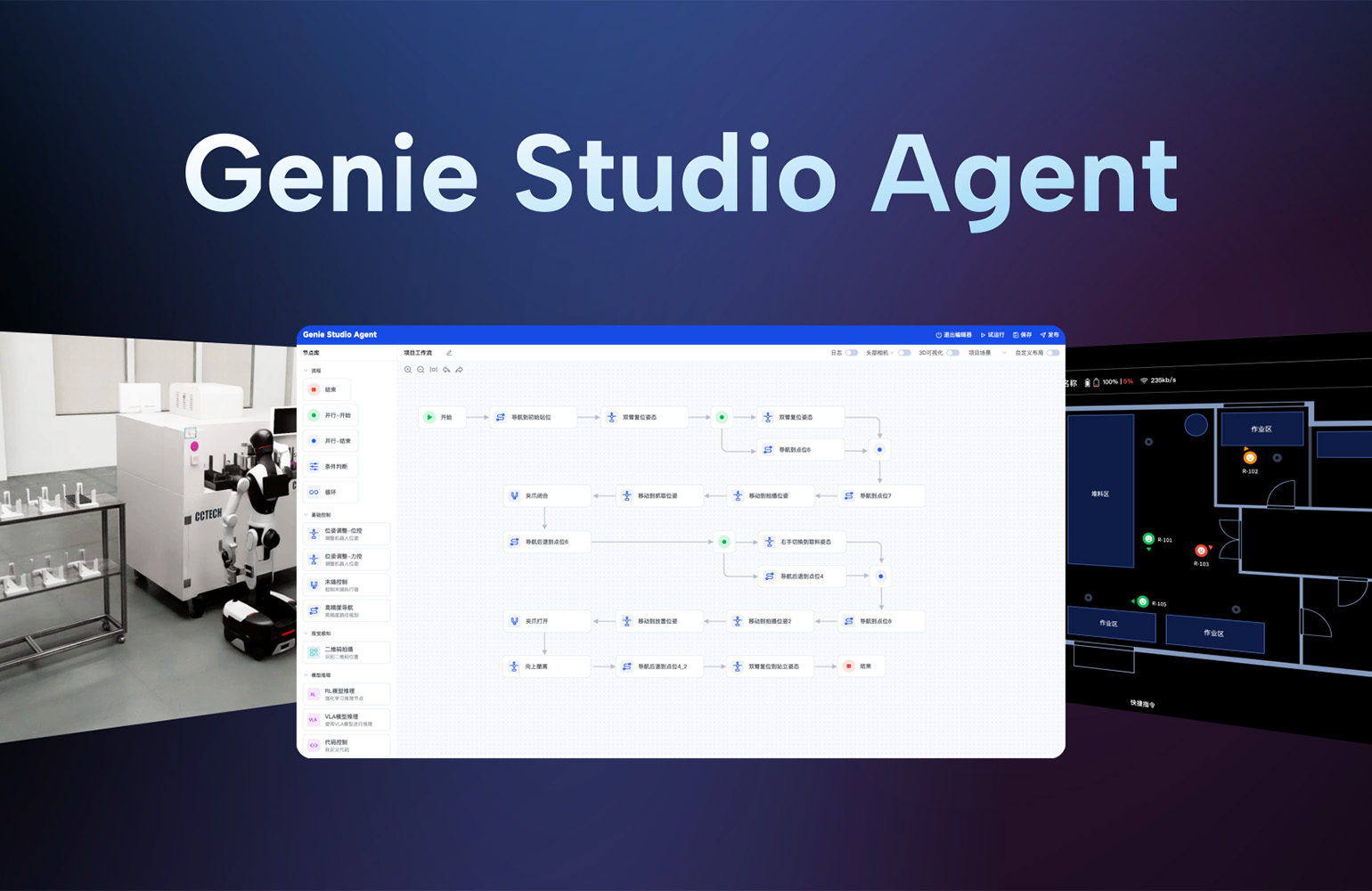
As embodied AI moves from experimental models to industrial reality, the primary hurdle is no longer just intelligence but implementation. Vision-Language-Action (VLA) models — systems that combine visual perception, natural language understanding, and physical manipulation into a single pipeline — have grown steadily more capable. Yet deploying them in complex environments like factories and workshops remains a friction-heavy process, often requiring months of custom engineering, domain-specific tuning, and significant operational risk. The gap between what a robot can do in a controlled lab and what it reliably does on a production line continues to define the pace of adoption.
To address that deployment bottleneck, AGIBOT has introduced Genie Studio Agent, a zero-code platform designed to turn robot application development into a modular exercise. Rather than writing bespoke software for each use case, users assemble robot functions from pre-built blocks — a design philosophy borrowed from the low-code and no-code movement that reshaped enterprise software over the past decade. The release follows the company's 2025 launch of Genie Studio, which focused on the back-end of robotics: data collection and model training. With the Agent layer, the focus shifts to the front-end — the actual orchestration of tasks on the factory floor.
From Bespoke Integration to Modular Deployment
The robotics industry has long operated on a project-by-project integration model. Each new deployment typically demands a systems integrator, weeks of on-site calibration, and custom code that ties perception, planning, and actuation together for a specific environment. That model works when volumes are low and margins are high, but it scales poorly. As manufacturers seek to automate a broader range of tasks — many of them in mixed or semi-structured settings — the cost and timeline of bespoke integration become prohibitive.
AGIBOT's bet is that modularity can break this cycle. By abstracting complex engineering into composable blocks, Genie Studio Agent attempts to compress the path from concept to functioning deployment. The approach mirrors what platforms like Zapier or Retool did for software workflows: reduce the need for specialized developers by giving domain experts — in this case, factory operators and process engineers — the tools to configure systems themselves. Whether the analogy holds in the physical world, where edge cases involve gravity, friction, and unpredictable human coworkers, remains an open question.
The broader context matters. Several robotics companies have pursued variations of this idea. Drag-and-drop programming interfaces for collaborative robots became a selling point for firms like Universal Robots years ago. What distinguishes the current generation of platforms is the underlying intelligence layer: rather than scripting fixed motion sequences, the modular blocks now sit atop foundation models capable of generalized reasoning about objects, scenes, and tasks. The abstraction, in other words, is not just of code — it is of cognition.
The Ecosystem Wager
By lowering the barrier to entry for non-engineers, AGIBOT is also making an implicit ecosystem play. Platforms that succeed in becoming the default development layer for a technology tend to capture value not through any single deployment but through network effects: more users generate more templates, more templates attract more users, and the platform becomes the path of least resistance. This dynamic powered the dominance of mobile app stores and cloud computing marketplaces alike.
For robotics, however, the ecosystem thesis faces a structural test. Physical tasks vary enormously across industries, and the tolerance for failure is far lower than in software. A misconfigured API call returns an error message; a misconfigured robotic arm can halt a production line or cause injury. The question is whether modular blocks can encode enough safety, reliability, and domain awareness to earn the trust of operations teams accustomed to rigorous validation cycles.
AGIBOT's two-stage rollout — back-end training tools first, front-end deployment tools second — suggests an awareness of this challenge. A platform that controls both the model pipeline and the application layer can, in principle, enforce consistency between what a robot learned and how it behaves. Whether that vertical integration proves to be an advantage or a constraint will depend on how open the ecosystem becomes to third-party models and hardware.
The tension at the heart of Genie Studio Agent is one the entire industry shares: the desire to move fast against the imperative to move safely. How AGIBOT and its competitors navigate that trade-off will shape not just which platforms win, but how quickly embodied AI becomes ordinary infrastructure rather than a showcase project.
With reporting from The Robot Report.
Source · The Robot Report