For more than seventy years, Lee Friedlander has operated as a cartographer of the American social landscape, mapping the friction between public architecture and private life. At ninety-one, his influence remains a cornerstone of the photographic medium — characterized by a restless, formal complexity that finds structure in the clutter of the everyday. His work does not merely document the world; it reveals a collective unconscious hidden within storefronts, street signage, and the jarring geometry of urban life.
His latest monograph, Life Still, marks his first collaboration with Aperture and interleaves rare, previously unpublished frames from the last six decades with contemporary work. The temporal layering highlights a career-long obsession with the act of seeing itself, reimagining his oeuvre not as a static archive but as a living, evolving inquiry into how we perceive the chaos of the modern environment.
A Visual Language Built on Contradiction
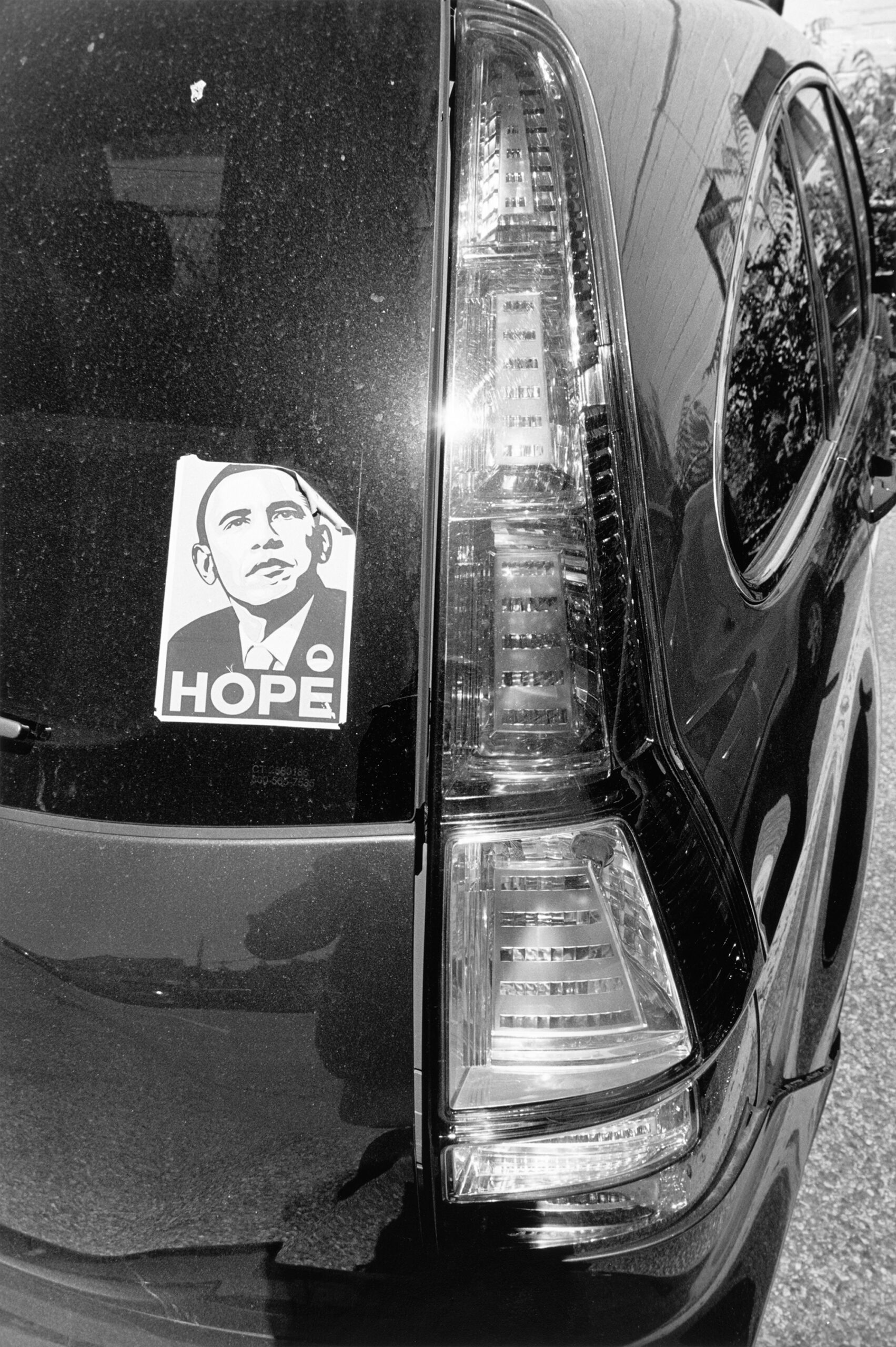
Friedlander's place in the photographic canon was cemented early. His inclusion in the 1967 Museum of Modern Art exhibition New Documents, alongside Diane Arbus and Garry Winogrand, signaled a decisive break from the documentary tradition that had dominated American photography since the Farm Security Administration era. Where predecessors like Walker Evans and Robert Frank used the street as a stage for social commentary — poverty, alienation, the open road — Friedlander treated it as a formal problem. His frames are dense with overlapping planes: telephone wires bisect faces, reflections in plate glass merge interior and exterior, and the photographer's own shadow intrudes as a structural element rather than an accident.
This approach produced images that are simultaneously legible and disorienting. A fire hydrant, a chain-link fence, and a passing pedestrian occupy the same visual plane with equal weight, refusing the hierarchy that traditional composition demands. The result is what contemporaries have described as an "eerie harmonic order" — a phrase that captures the paradox at the center of Friedlander's method. The chaos is real, but the organization is deliberate.
The publication of Life Still invites reconsideration of how that method has evolved, or whether it has evolved at all. By placing early and recent work side by side, the monograph surfaces continuities that a chronological survey might obscure. Friedlander's eye has remained remarkably consistent in its appetite for visual density, yet the accumulated decades of looking lend the later images a different gravity — not nostalgia, but a kind of compounded attention, as though each frame carries the memory of every frame that preceded it.
The Burden of Influence
Contemporary photographers continue to reckon with Friedlander's legacy in practical terms. Daniel Arnold, among those reflecting on his influence, has noted that Friedlander's ability to distill clarity from visual noise is so absolute that the images often feel divorced from their subjects, becoming monuments to the "compulsion of looking." Even in his notoriously unsentimental self-portraits — a body of work that spans decades and includes his shadow cast across lawns, his reflection caught in shop windows — the focus remains on inventive execution rather than the vulnerability of the artist.
This detachment poses a particular challenge for photographers working in the street tradition today. Friedlander's formal vocabulary has become so pervasive that it functions almost as a default grammar: layered reflections, obstructed views, the deliberate inclusion of visual "mistakes." The risk for younger practitioners is that these devices become mannerisms — stylistic tics emptied of the perceptual rigor that gave them meaning in Friedlander's hands. The distance between influence and imitation is narrow, and Life Still serves as a reminder of how much sustained discipline underlies what can appear, at first glance, like casual observation.
What makes Friedlander's body of work resistant to easy summary is precisely its refusal to resolve. There is no grand thesis about America, no sentimental arc from youth to age. There is instead a seven-decade record of one person looking at the world with uncommon intensity and finding, in its surfaces, a structure that is neither imposed nor discovered but somehow both at once. Whether that structure belongs to the world or to the photographer's eye remains the productive tension at the heart of the work — a tension that Life Still, by collapsing decades into a single sequence, sharpens rather than settles.
With reporting from Aperture.
Source · Aperture