For a single-celled organism drifting in the primordial soup, the environment was not a liquid playground but a viscous prison. At the scale of a few microns, the physics of fluid dynamics shift dramatically. Water, which flows effortlessly around a human swimmer, behaves like thick tar or cooling lava for a microbe. In this regime, inertia is irrelevant; the moment an organism stops applying force, it ceases to move.
This physical reality created a profound evolutionary bottleneck. To find nutrients or escape predators, life had to solve the "low Reynolds number" problem—a mathematical state where viscous forces dominate over inertial ones. Traditional rowing or flapping, which relies on pushing off a fluid and gliding, is useless here. Every movement must be reciprocal and precise, or the organism simply wiggles in place.
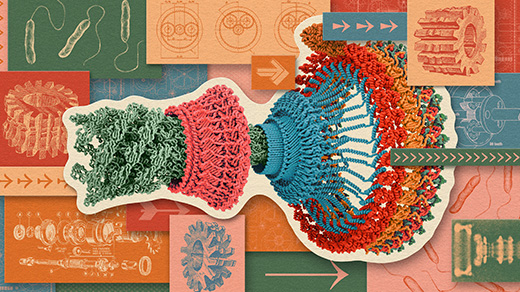
The solution was a feat of biological engineering: the rotary motor of the flagellum. By spinning a corkscrew-shaped tail, early life forms found a way to "drill" through the water, turning the medium’s very resistance into a source of propulsion. It is a reminder that the history of biology is, at its core, a history of physics—a long-arc struggle to negotiate with the fundamental laws of the universe.
With reporting from Quanta Magazine.
Source · Quanta Magazine