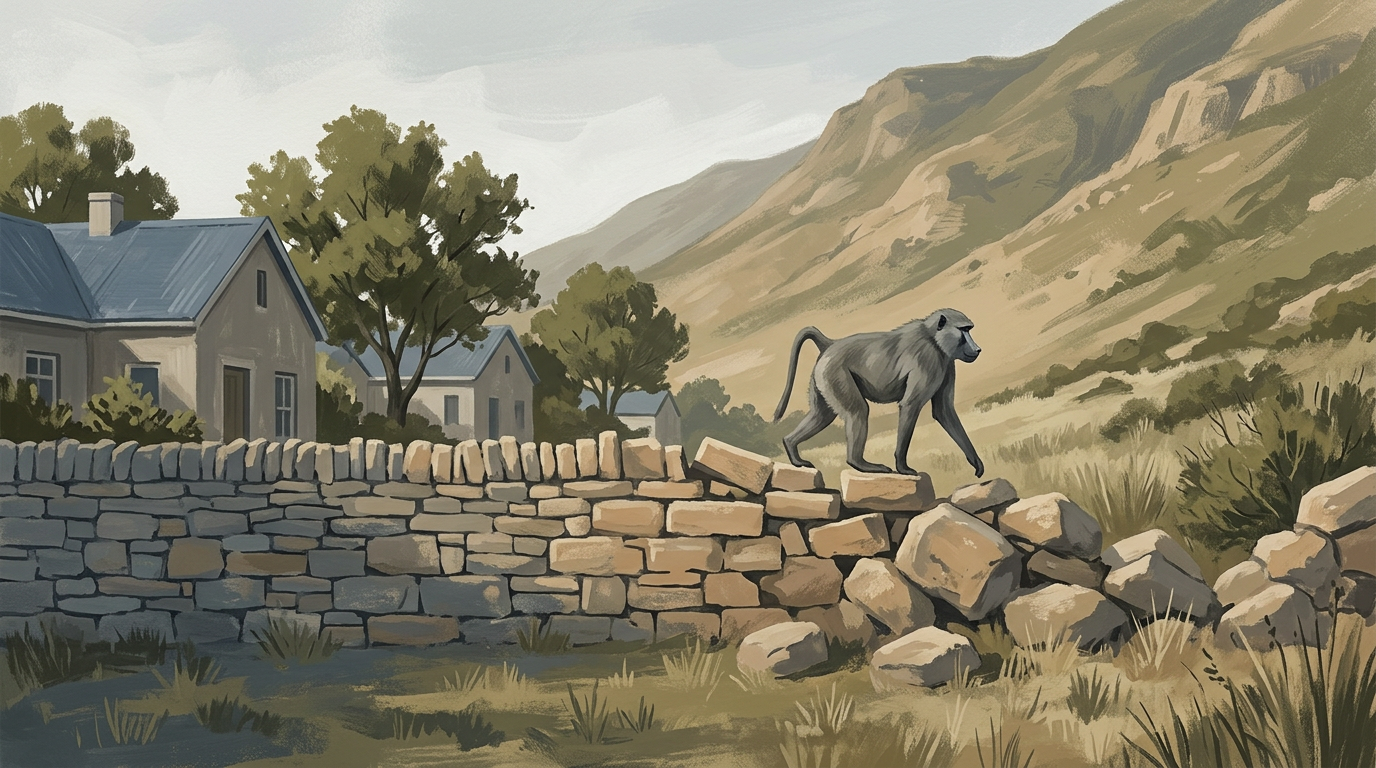
The modern city is often conceived as a fortress of human design — a controlled environment where nature is relegated to the periphery or contained within manicured parks. In Cape Town, that conception has been under sustained pressure for years. The city sits at the intersection of one of the world's most biodiverse regions and a rapidly expanding metropolitan footprint, a combination that makes clean boundaries between "urban" and "wild" difficult to maintain. Researcher Di Caelers has explored this tension through a specific lens: the chacma baboons that move freely between the Cape Peninsula's mountain slopes and the suburbs built into them.
The baboons are not newcomers. Chacma baboons (Papio ursinus) have inhabited the Cape Peninsula far longer than any human settlement. What has changed is the density and reach of the built environment around them. As Cape Town's residential areas have expanded toward the mountainous terrain that constitutes the baboons' historical range, encounters between the two species have become routine — and routinely contentious. The animals enter homes, raid bins, and navigate suburban streets with a spatial intelligence that unsettles the assumption of human dominion over built space.
When Infrastructure Meets Ecology
Caelers' investigation reportedly took shape against the backdrop of the 2018 "Day Zero" water crisis, when Cape Town came close to shutting off municipal water supply entirely. That episode laid bare a broader truth: the city's infrastructure depends on ecological systems that do not respect administrative boundaries. Reservoirs, watersheds, and aquifers operate on geological and climatic logic, not municipal planning. The baboons, in a sense, embody the same principle at a different scale. They treat the city as continuous habitat, not as a separate domain.
This is not unique to Cape Town. Cities worldwide contend with urban wildlife — leopards in Mumbai, wild boar in Rome, coyotes in Los Angeles. But the Cape Town case carries a particular philosophical weight because baboons are primates. Their behavioral repertoire includes tool use, social learning, and problem-solving capacities that make their incursions into human spaces feel less like intrusion and more like adaptation. When a baboon opens a locked window or learns to avoid a specific deterrent, it is demonstrating cognitive flexibility that mirrors, however distantly, the same adaptive intelligence that built the suburb it is raiding.
The city has tried various management strategies over the years, from dedicated baboon monitors — human rangers assigned to keep troops away from residential areas — to GPS tracking and aversive conditioning. These measures have met with mixed results, in part because the baboons learn and adjust. Management programs face the additional complication of public opinion, which ranges from residents who view the animals as dangerous pests to conservation advocates who argue the baboons have prior claim to the landscape.
Porosity as a Condition, Not a Problem
Caelers' work, as described, pushes beyond the management question toward a more fundamental reframing. If the city is not a sealed system but a porous one — permeable to weather, water scarcity, wildfire, and other species — then urban planning built on the assumption of separation is working from a flawed premise. The baboons do not represent a failure of boundary enforcement; they reveal that the boundary was always partly fictional.
This line of thinking connects to a broader current in urban ecology and environmental philosophy. The notion of "novel ecosystems" — environments shaped by human activity but not fully controlled by it — has gained traction in academic discourse over the past two decades. Cities, under this framework, are not the opposite of nature but a particular expression of it, one in which multiple species negotiate shared resources under conditions of rapid change.
The tension in Cape Town remains unresolved, and perhaps that is the point. The baboons are not going to withdraw to the mountains, and the suburbs are not going to retreat from the slopes. What sits between those two facts is a question that extends well beyond South Africa: whether urban societies can develop frameworks for coexistence that acknowledge ecological entanglement rather than treating it as an anomaly to be managed away. The answer likely depends less on better fences than on whether the underlying philosophy of the city can accommodate inhabitants it was never designed to include.
With reporting from 3 Quarks Daily.
Source · 3 Quarks Daily