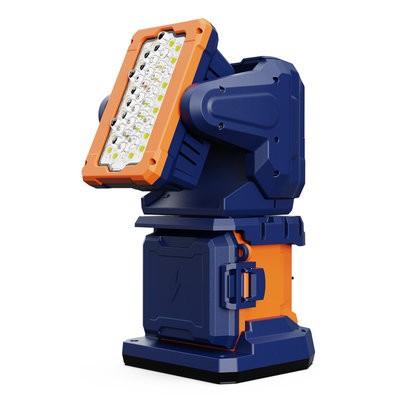
The industrial lighting landscape is often defined by its rigidity—heavy fixtures tethered to grids, requiring significant infrastructure to adjust or redirect. The PT-200, a remote-controlled LED system, proposes a more fluid alternative. By combining a 360-degree pan-and-tilt mechanism with a magnetic base, the device allows for precise illumination that can be deployed and redirected without the friction of traditional mounting hardware.
The PT-200's primary innovation lies in its modularity. Because the units are battery-powered and wire-free, they can be affixed to any ferromagnetic surface—from structural beams to vehicle exteriors—in seconds. This capability transforms the light from a static utility into a dynamic tool for environments that require rapid reconfiguration, such as emergency response sites or mobile workshops.
Perhaps most significant is the system’s capacity for synchronization. Multiple units can be daisy-chained to a single controller, allowing an operator to choreograph the movement of an entire array of lights simultaneously. This shift toward networked, remote-controlled hardware reflects a broader trend in industrial design: the move away from isolated tools toward integrated systems that prioritize ease of deployment and granular control.
With reporting from Core77.
Source · Core77