The initial promise of generative AI was largely conversational — a machine that could mirror human speech with uncanny precision. But the industry's center of gravity is shifting from dialogue to execution. To fulfill the grander economic predictions attached to the AI era, from streamlined drug discovery to automated engineering workflows, large language models must evolve into "agents": software entities capable of navigating interfaces, making decisions, and executing multi-step tasks with minimal human oversight.
This transition found its first messy prototype in OpenClaw, an open-source personal assistant that captured the industry's imagination despite significant security vulnerabilities. While OpenClaw functioned primarily as a proof of concept, it sparked a race among incumbents like Nvidia and Tencent to build more robust, enterprise-grade versions. The ambition is no longer a digital companion that can book a dinner reservation. It is a system that can transcend the "lone-wolf" limitations of current single-agent bots — and that requires a fundamentally different architecture.
From solo performers to orchestrated ensembles
The concept of software agents is not new. In computer science, the term has described autonomous programs since at least the 1990s, when researchers at MIT and Carnegie Mellon explored multi-agent systems for distributed problem-solving. What has changed is the substrate: large language models give agents a general-purpose reasoning layer that earlier rule-based systems lacked. An LLM-based agent can interpret ambiguous instructions, adapt to unfamiliar interfaces, and recover from errors in ways that prior generations of automation could not.
Yet a single agent, however capable, hits a ceiling quickly. Complex tasks — refactoring a large codebase, coordinating a supply-chain response, running a multi-stage scientific analysis — involve heterogeneous subtasks that benefit from specialization. A model optimized for code generation may be poorly suited to documentation or security review. The bottleneck is not intelligence in the abstract but the coordination of distinct competencies toward a shared objective.
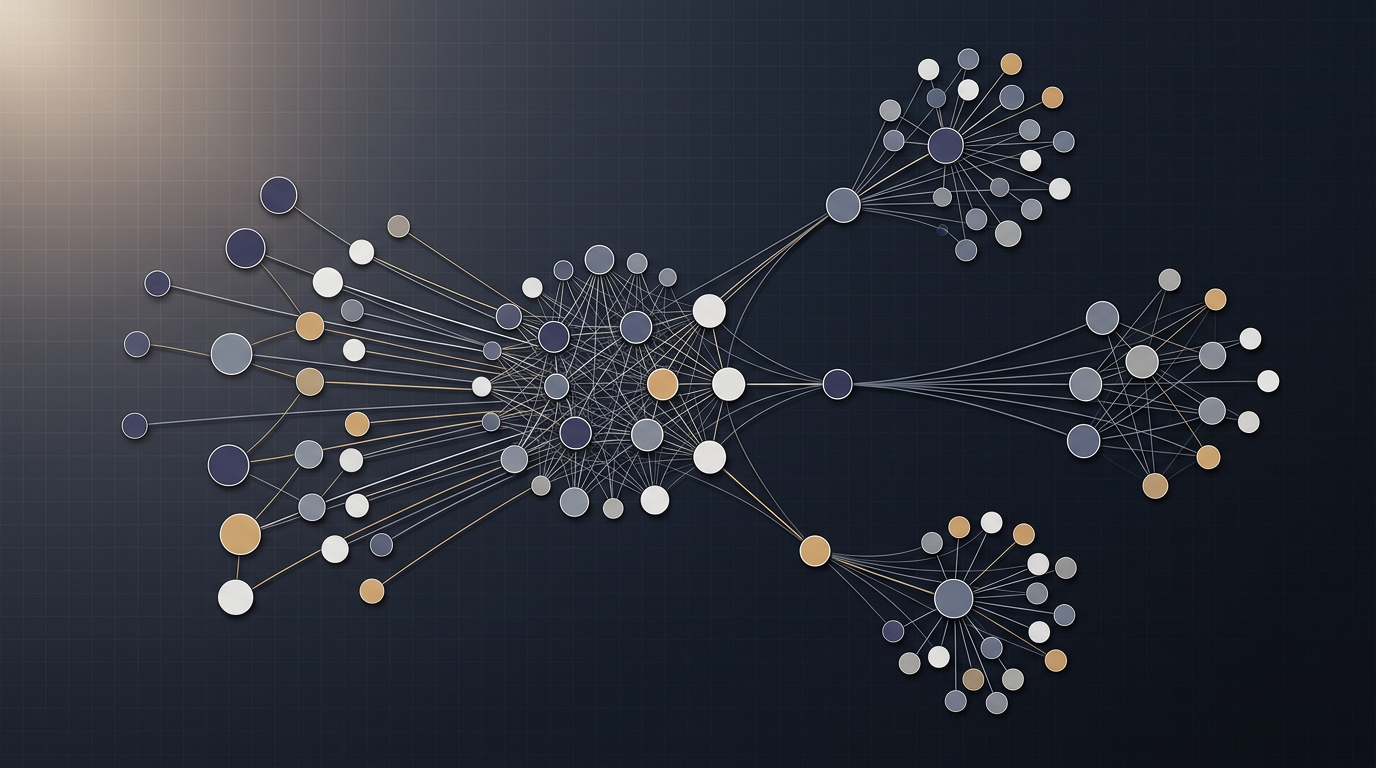
This is where orchestration enters the picture. Rather than relying on a single generalist model, orchestration frameworks allow users to deploy multiple specialized agents simultaneously, each assigned a discrete role. Tools like Anthropic's Claude Code illustrate the pattern: one sub-agent writes code, another debugs, a third documents, and a supervisory layer manages dependencies and resolves conflicts between them. The result is less a singular voice and more a coordinated digital workforce — what might be called a machine ensemble.
The hard problems ahead
Orchestration introduces capabilities that monolithic models cannot easily replicate, but it also surfaces a new class of engineering challenges. Coordination overhead is one: as the number of agents grows, so does the complexity of managing their interactions, handling contradictory outputs, and maintaining a coherent shared state. The parallel with distributed computing is instructive. Decades of work on distributed systems have shown that coordination costs can erode — and sometimes negate — the gains from parallelism if not carefully managed.
Security is another open question. OpenClaw's vulnerabilities hinted at the risks inherent in giving autonomous software broad access to systems and data. Multiply that surface area across dozens of concurrently operating agents, each with its own permissions and context window, and the attack vectors expand considerably. Enterprise adoption will likely hinge on whether orchestration platforms can offer auditability and access controls rigorous enough to satisfy compliance requirements in regulated industries.
There is also the question of accountability. When a single chatbot produces a flawed answer, responsibility is relatively easy to trace. When an ensemble of agents collaborates on a decision — each contributing partial reasoning, none holding the full picture — determining where an error originated becomes materially harder. This is not merely a technical problem; it carries implications for liability frameworks that regulators have barely begun to sketch.
The trajectory from conversational AI to agentic orchestration represents a genuine architectural shift, not simply an incremental feature upgrade. Whether the machine ensemble becomes the dominant paradigm depends on how effectively the industry resolves the tension between the productivity gains of specialization and the governance costs of coordination. The analogy to human organizations is hard to avoid: teams outperform individuals on complex work, but only when management structures, communication protocols, and accountability lines are sound. Whether the same principles translate cleanly to networks of AI agents — or whether entirely new frameworks are required — remains the central question the field has yet to answer.
With reporting from MIT Technology Review.
Source · MIT Technology Review