The portable Bluetooth speaker has undergone a quiet but consequential transformation over the past decade. What began as a fragile accessory — prone to failure at the first sign of rain, limited in battery life, and modest in sound quality — has evolved into a ruggedized, networked node of personal audio. The current generation of devices reflects a convergence of industrial design, environmental resilience, and wireless protocol innovation that is reshaping consumer expectations across every price tier.
The shift is visible in the specifications that now serve as table stakes. IP67 ratings — meaning full protection against dust ingress and the ability to withstand immersion in water up to one meter for thirty minutes — have migrated from premium product lines to mid-range and even budget offerings. Battery lives stretching to twenty hours or more, once a differentiator, are increasingly standard. Some models are designed to float, a feature that signals just how far the use case has drifted from the living room bookshelf toward the river, the construction site, and the trail.
From Pairing to Broadcasting
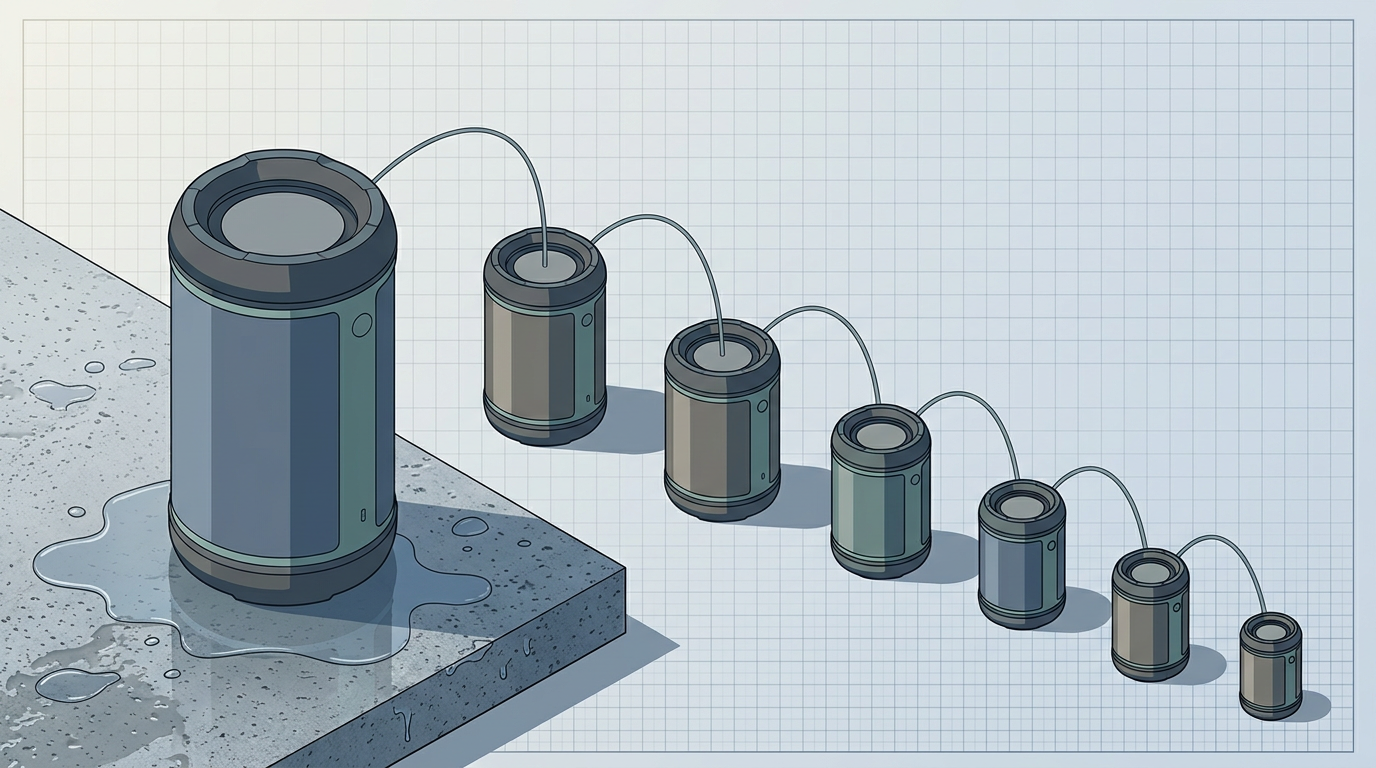
Perhaps more structurally significant than any improvement in durability is the emergence of Auracast, a broadcast audio capability built on the Bluetooth LE Audio standard. Traditional Bluetooth audio operates on a point-to-point model: one source device pairs with one speaker, or in some cases a small stereo pair. Auracast breaks that constraint. It allows a single audio source to broadcast to an unlimited number of compatible receivers simultaneously, without the need for individual pairing.
The inclusion of Auracast in widely available consumer models such as the JBL Go 4 marks an inflection point. The technology moves portable audio from a personal utility toward something closer to ad-hoc infrastructure — a distributed soundscape that can be assembled and dissolved on demand. The implications extend beyond casual listening. Venues, public spaces, and event organizers gain a lightweight mechanism for multi-zone audio without dedicated hardware. For consumers, it means the speaker ceases to function as a standalone object and begins to behave as a node in a flexible mesh.
This architectural shift echoes patterns seen in other consumer technology categories. Wi-Fi mesh networks replaced single-router setups; smart lighting moved from individual bulbs to coordinated scenes. In each case, the unit of value migrated from the individual device to the network it participates in. Portable audio appears to be following the same trajectory.
Durability as Default, Not Feature
The ruggedization trend also carries implications for product lifecycle and market structure. When durability becomes the baseline rather than a premium attribute, the competitive axis shifts. Brands like Anker's Soundcore line have demonstrated that robust environmental protection can be delivered at accessible price points, compressing the gap between entry-level and flagship categories. The result is a flattening of the value hierarchy: consumers no longer need to pay a significant premium for a speaker that survives outdoor conditions.
This dynamic puts pressure on established audio brands to differentiate on dimensions beyond hardware resilience — sound tuning, ecosystem integration, software features, and design language become the remaining vectors of competition. It also raises questions about replacement cycles. A speaker that is genuinely dustproof, waterproof, and built to endure physical impact is a speaker that lasts. Whether that longevity translates into slower unit sales or deeper brand loyalty remains an open question for manufacturers.
The broader pattern is one of ambient permanence. As portable speakers become more resilient and more networked, they drift from the category of consumer electronics — objects purchased, used, and eventually discarded — toward something more akin to durable infrastructure. They attach to backpacks, live in garages, survive seasons. The boundary between indoor high-fidelity and outdoor utility, once a clear dividing line in product catalogs, continues to dissolve.
What remains to be seen is whether the audio industry treats this convergence as a ceiling or a foundation. The hardware has reached a point of remarkable competence at nearly every price tier. The networking protocols are maturing. The question now is less about what these devices can withstand and more about what new behaviors and use cases they enable once durability and connectivity are simply assumed.
With reporting from Olhar Digital.
Source · Olhar Digital