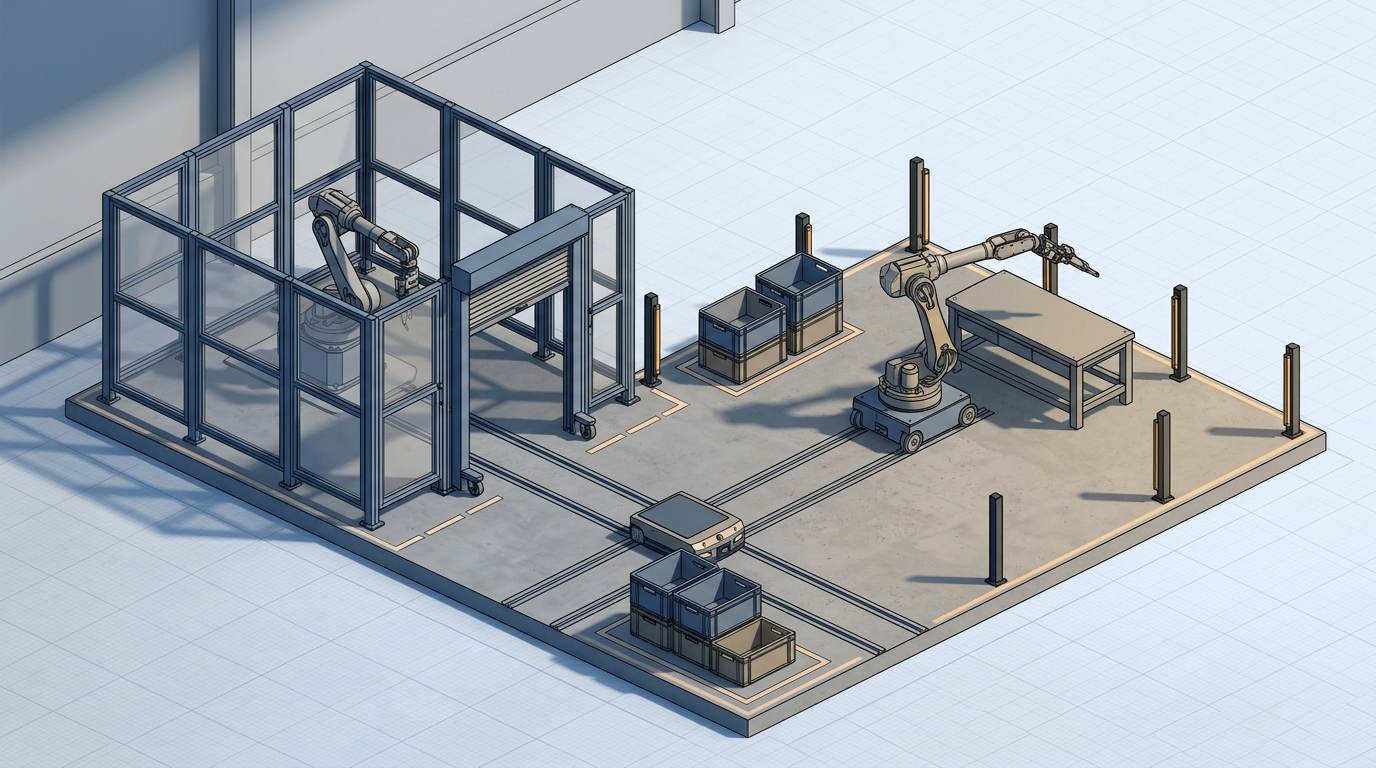
The landscape of robotics is undergoing a fundamental shift, moving away from the rigid, deterministic programming that has defined industrial automation for decades. According to reporting from t3n, the evolution of robotic systems—ranging from household appliances to sophisticated industrial platforms—is increasingly driven by machine learning and adaptive architectures rather than hard-coded logic. This transition signifies a movement toward systems that can interpret, navigate, and respond to their environments in real time without requiring explicit instructions for every potential contingency.
This departure from traditional programming is not merely an incremental improvement; it represents a structural change in how machines are deployed across both manufacturing and consumer sectors. As robots gain the ability to "understand" their surroundings through sensory data and neural networks, the barriers to entry for complex automation are lowering. This analytical perspective explores the shift from task-specific automation to generalized embodied intelligence, examining the implications for industrial efficiency, safety, and the future of human-machine interaction in complex, unstructured environments.
The Evolution of Robotic Control Architectures
For nearly half a century, the field of robotics was dominated by deterministic control systems. These machines operated within highly constrained environments, executing repetitive tasks defined by precise coordinates and logical loops. Whether in automotive assembly lines or early vacuum cleaners, the robot's "intelligence" was limited to the code injected by human engineers. If a variable deviated from the expected parameters, the system would typically fail or trigger a safety stop. This rigidity necessitated the creation of "caged" work environments where human workers were strictly separated from automated machinery to prevent accidents.
However, the integration of advanced sensors and neural processing has enabled a transition toward embodied intelligence. Modern robotic systems are increasingly leveraging deep learning models to process unstructured data, allowing them to perform tasks that were previously impossible for fixed-logic machines. By moving away from explicit programming, these systems can now adapt to variations in object placement, lighting conditions, and even the presence of dynamic human obstacles. This capacity for autonomous adaptation is the cornerstone of the next generation of robotics, where the machine is no longer just an executor, but an interpreter of its physical workspace.
This paradigm shift is supported by the convergence of high-performance computing at the edge and robust simulation environments. Before deploying these learning-based systems in the physical world, developers now utilize digital twins and synthetic data to train robots in virtual spaces. This drastically reduces the time required for trial-and-error learning, allowing robots to enter the workforce with a foundational understanding of their environment. The structural shift from "coding" a robot to "training" one marks a significant departure in the engineering lifecycle, prioritizing data quality and model architecture over traditional syntax-based development.
Mechanisms of Autonomous Learning and Adaptation
At the heart of this transition are several key technical mechanisms that facilitate autonomous behavior. Unlike traditional systems that rely on a linear decision tree, contemporary robots utilize probabilistic models to assess their environment. When a robot encounters an object, it does not look for a hard-coded identification tag; instead, it uses visual-spatial reasoning to classify the object based on learned features. This allows for a degree of operational flexibility that was previously unattainable, enabling robots to handle diverse items or navigate unpredictable floor plans.
Reinforcement learning plays a critical role in this mechanism. In this context, the robot is rewarded for successful task completion, allowing it to fine-tune its movements and decision-making processes over time. This iterative process mimics biological learning, where the machine refines its strategy based on cumulative experience rather than a static set of rules. This is particularly relevant for mobile robots and collaborative cobots, which must constantly recalibrate their position and force application to ensure both efficiency and safety in dynamic settings.
Furthermore, the move toward foundation models in robotics—similar to the large language models that have revolutionized text processing—is beginning to standardize how machines understand physical space. By training on massive datasets of physical interactions, these models provide a shared "world model" that can be fine-tuned for specific applications. This reduces the need for bespoke programming for every new task, as the robot inherits a generalized understanding of physics, object manipulation, and spatial navigation. The synergy between these models and real-time sensor fusion creates a feedback loop that continuously enhances the robot’s performance without human intervention.
Implications for Industrial and Regulatory Stakeholders
For industrial stakeholders, this shift introduces both significant opportunities and complex challenges. On the efficiency front, the ability to deploy robots into unstructured environments without expensive retooling is a game-changer for small-to-medium enterprises that were previously priced out of automation. However, this flexibility also complicates safety compliance. Regulators, accustomed to certifying machines that operate in predictable, static ways, are now tasked with evaluating the safety of systems that evolve through learning. The unpredictability inherent in autonomous systems requires a shift from static safety standards to dynamic, risk-based assessment frameworks.
Competitors in the robotics space are also pivoting their business models. The value proposition is shifting from the hardware itself to the software stack and the quality of the training data. As the hardware becomes increasingly commoditized, the competitive moat is being built around the proprietary models and the efficiency of the training pipelines. Consumers, meanwhile, are seeing the benefits in smarter, more capable household devices that can handle complex chores. Yet, this raises ongoing questions about data privacy and the security of connected devices that are constantly mapping and learning from their surroundings.
The Outlook for Embodied AI
Despite the advancements in learning-based robotics, significant uncertainties remain. One of the primary bottlenecks is the "sim-to-real" gap, where behaviors learned in a simulated environment do not perfectly translate to the physical world. While synthetic data has improved, the nuances of real-world physics—such as friction, material degradation, and lighting interference—remain difficult to model perfectly. The industry is still searching for a universal standard that can guarantee consistent performance across diverse environments.
Furthermore, the long-term reliability of these systems is a subject of ongoing scrutiny. As robots become more autonomous, the potential for "model drift"—where the system’s behavior changes over time due to new data inputs—poses a risk to operational stability. Ensuring that these machines remain within their operational boundaries while continuing to learn and adapt will require new forms of monitoring and governance. As the field matures, the tension between maximizing autonomy and maintaining deterministic control will likely define the next decade of robotic development.
As the integration of embodied intelligence continues to reshape the industrial landscape, the question of how to balance innovation with safety remains the industry's most pressing challenge. Whether these systems will eventually achieve true generalized autonomy or remain confined to specialized, high-performance domains is a question that will be answered as developers refine the intersection of neural architectures and physical reality.
With reporting from t3n
Source · t3n


