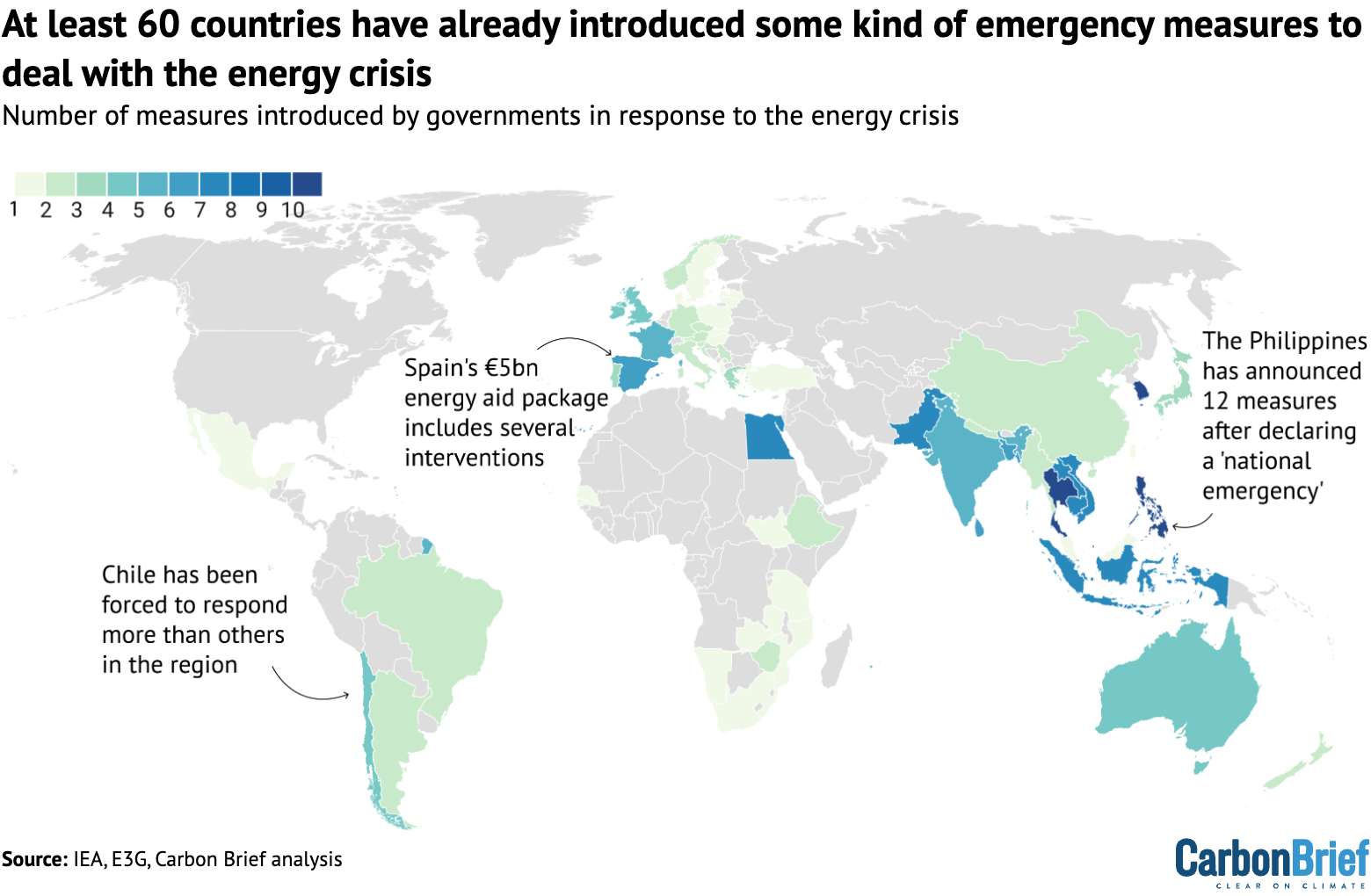
The blockade of the Strait of Hormuz, a narrow waterway through which roughly twenty percent of the world's petroleum and liquefied natural gas flows, has long been regarded as the single most disruptive scenario for global energy markets. One month into the conflict between Iran and a coalition led by the United States and Israel, that scenario materialized. As vital infrastructure was targeted and the strait closed to commercial traffic, the resulting price shocks forced a frantic, multi-front policy response from nearly sixty nations, according to a new analysis by Carbon Brief drawing on tracking data from the International Energy Agency. In total, those countries implemented close to two hundred emergency measures — a patchwork of fiscal relief, demand suppression, and supply-side improvisation that reveals both the resilience and the fragility of the global energy order.
Fiscal relief and forced austerity
The most immediate and widespread response was the blunt instrument of fiscal intervention. At least thirty nations, ranging from wealthy Norway to developing Zambia, slashed fuel taxes or introduced consumer subsidies to cushion the impact of soaring costs at the pump. The pattern echoes the policy playbook deployed during earlier energy shocks — the 1973 Arab oil embargo, the supply disruptions following Iraq's invasion of Kuwait in 1990, and the price volatility that accompanied Russia's invasion of Ukraine in 2022. In each case, governments reached first for the tools that offered the fastest political relief, even when those tools carried significant fiscal costs. Tax cuts on fuel reduce state revenue at precisely the moment budgets are under strain, and they blunt the price signal that might otherwise accelerate demand reduction.
In Asia, where reliance on Middle Eastern crude and LNG imports is particularly acute, the response moved beyond fiscal cushioning into outright demand suppression. Countries across the region implemented driving bans, fuel rationing, and school closures to curb consumption. The Strait of Hormuz has always represented a singular chokepoint for Asian energy security: Japan, South Korea, India, and China all depend on tanker traffic through the strait for a substantial share of their hydrocarbon imports. The forced retreat from normalcy — shuttered schools, restricted mobility — underscores the degree to which modern infrastructure in import-dependent economies remains vulnerable to disruption at a single geographic bottleneck. It also raises uncomfortable questions about the adequacy of strategic petroleum reserves, which were designed for short-duration supply interruptions rather than sustained blockades.
The energy transition under pressure
Perhaps the most consequential dimension of the crisis lies in its divergent effects on the global energy transition. The disruption has created two competing impulses. On one side, some nations have seized the moment to accelerate permitting and construction of renewable energy projects, framing energy independence through wind, solar, and battery storage as a matter of national security rather than climate ambition alone. The logic is straightforward: domestically generated electricity from renewables carries no geopolitical supply risk.
On the other side, the immediate imperative of keeping the lights on has forced a tactical retreat toward carbon-intensive reliability. Japan, Italy, and South Korea have increased coal-fired generation to bridge the supply gap left by missing LNG cargoes. This is not unprecedented — Germany made a similar pivot in 2022 when Russian pipeline gas was curtailed — but it illustrates a recurring tension. Decarbonization timelines assume a degree of geopolitical stability that the past decade has repeatedly failed to deliver. Each crisis that forces a temporary return to coal or oil erodes both emissions budgets and political momentum for long-term transition commitments.
As a temporary ceasefire takes hold, the global energy map remains fundamentally altered. Strategic reserves have been drawn down. Fiscal buffers have been spent. And the political coalitions that sustain climate policy have been tested by the raw arithmetic of energy security. The question now is whether the shock of Hormuz strengthens the case for accelerated diversification away from fossil fuels — as the 1973 embargo eventually did for energy efficiency standards — or whether it entrenches the argument that hydrocarbon baseload capacity remains indispensable for national resilience. Both readings find support in the data. The tension between them is unlikely to resolve quickly, and the policy choices made in the coming months will shape the trajectory of energy systems for years beyond the conflict itself.
With reporting from Carbon Brief.
Source · Carbon Brief