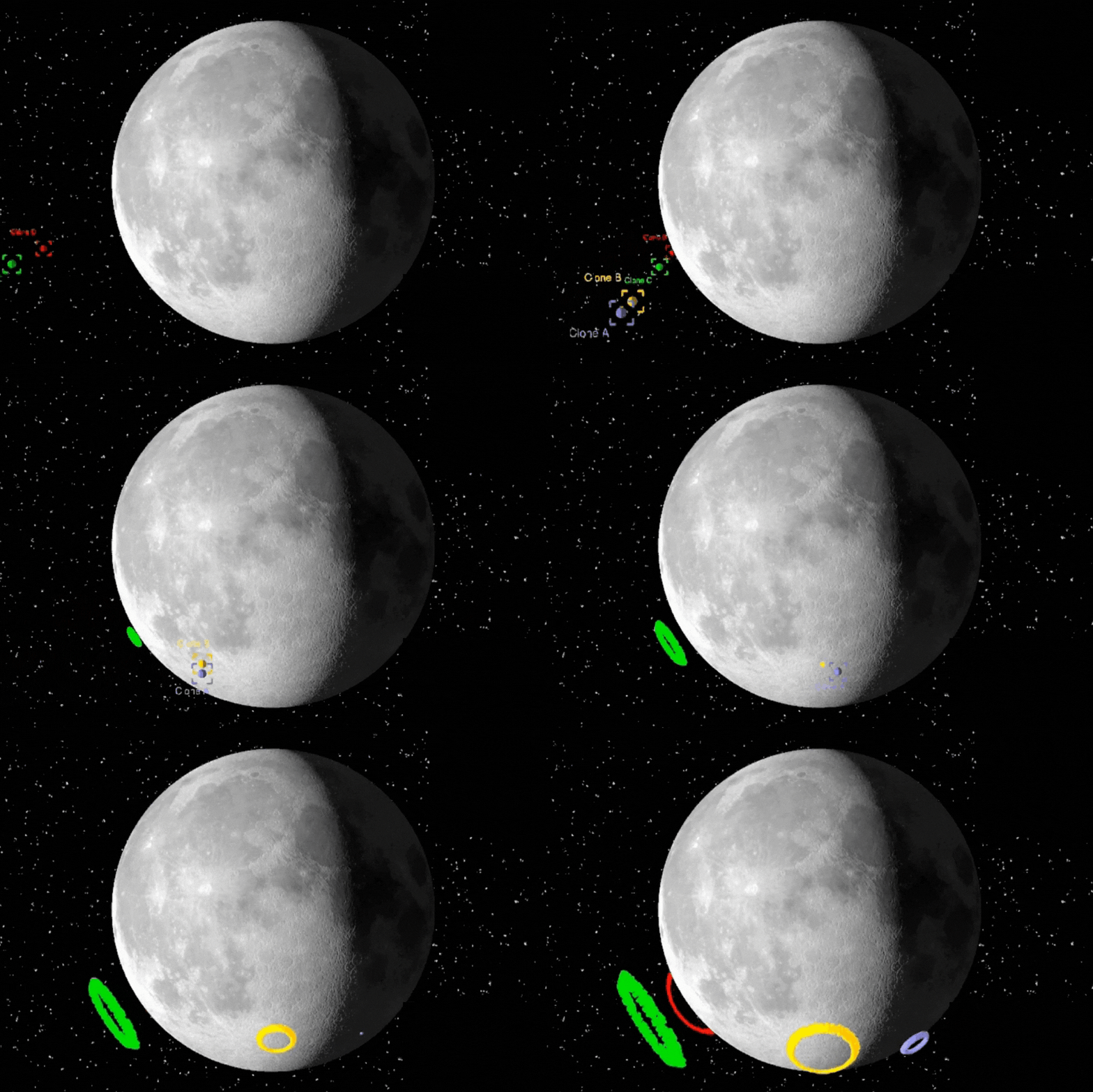
The Moon’s "far side" has long occupied a space in the collective imagination as a realm of mystery, though its existence is a matter of simple celestial mechanics. Due to a phenomenon known as tidal locking, the Moon rotates on its axis at the same rate it orbits Earth. This gravitational synchronization ensures that one hemisphere remains permanently averted from our view, a geographical constant that has shaped lunar observation for millennia.
As NASA prepares the Artemis II mission, this hidden territory transitions from an astronomical curiosity to a logistical hurdle. When the Orion capsule swings behind the lunar disc, the astronauts aboard will experience a profound disconnect. For approximately 40 minutes, the mass of the Moon will act as a physical barrier to radio waves, severing all communication with ground control on Earth.
This period of silence is more than a technical gap; it is a return to a specific kind of isolation last felt during the Apollo era. Without a relay infrastructure in place, the crew must rely entirely on their onboard systems and each other until the spacecraft emerges from the lunar shadow. It is a stark reminder that, despite our advances in connectivity, the geometry of the solar system still dictates the limits of our reach.
With reporting from Exame Inovação.
Source · Exame Inovação