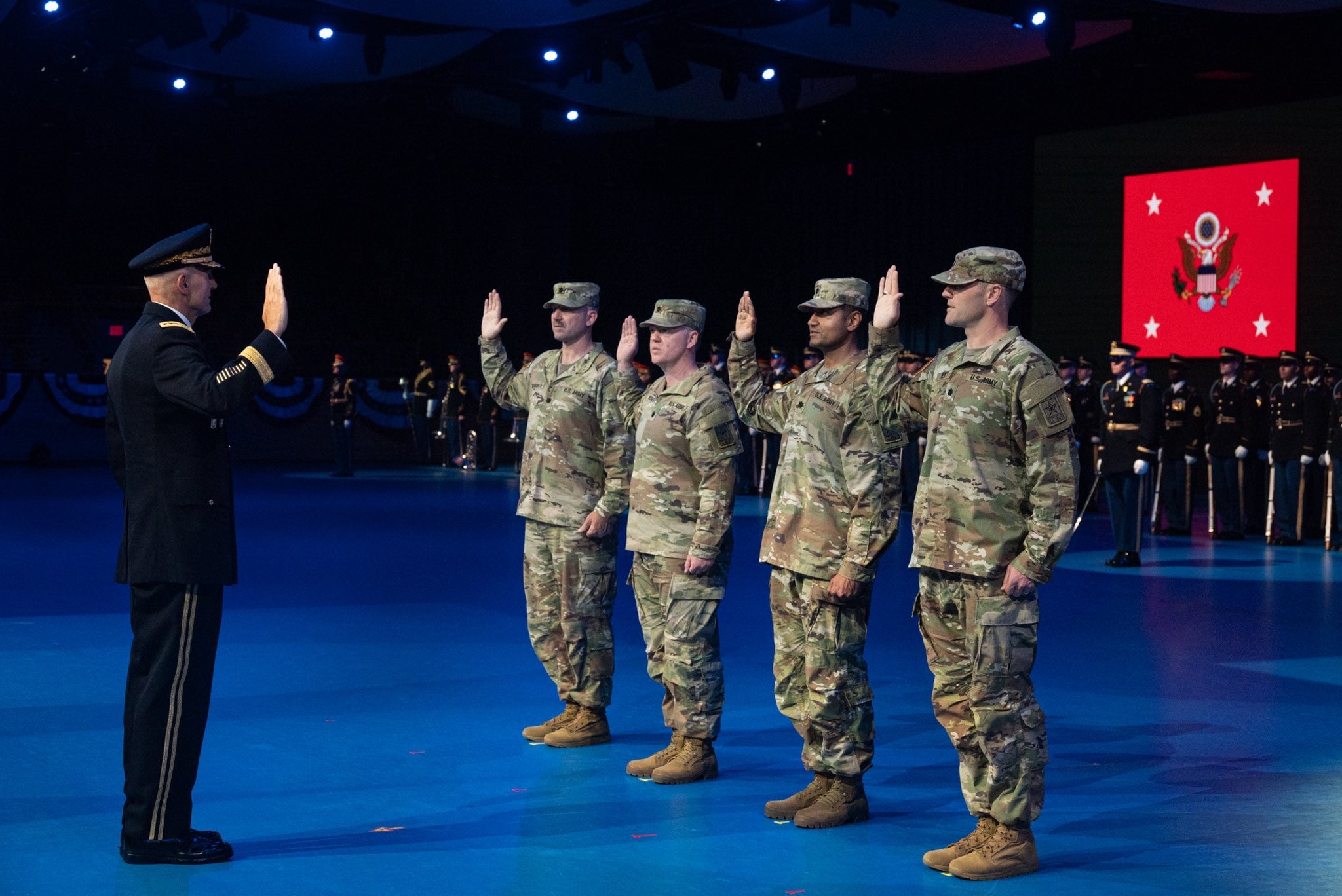
In a photograph from last June, Andrew Bosworth, the chief technology officer at Meta and a longtime confidant of Mark Zuckerberg, stands at attention at Myer-Henderson Hall. He is not in his typical Silicon Valley attire; instead, he wears a U.S. Army uniform, his hand raised in a solemn oath. Beside him are three other titans of the tech industry: Kevin Weil, OpenAI's head of product; Shyam Sankar, the CTO of Palantir; and Bob McGrew, a veteran of both Palantir and OpenAI. All four now carry the rank of lieutenant colonel.
This group forms the core of Detachment 201, officially known as the Executive Innovation Corps. Stationed just minutes from the Pentagon, the unit represents a formal bridge between the rapid-fire development cycles of the Bay Area and the bureaucratic, high-stakes requirements of national defense. The initiative is designed to fuse advanced technological knowledge with military innovation, acknowledging that the future of conflict will be determined as much by algorithms and data architecture as by traditional hardware.
From arm's length to officer's rank
The appointment of these executives marks a quiet but structurally significant shift in the relationship between Big Tech and the U.S. military. For much of the past decade, that relationship was defined by friction. In 2018, Google withdrew from Project Maven — a Pentagon initiative that used machine learning to analyze drone surveillance footage — after thousands of employees signed an internal petition opposing the work. The episode became a reference point for an industry that styled itself as idealistic and civilian-minded, wary of entanglement with defense institutions.
The landscape has since changed. Palantir, which built its reputation on government and intelligence contracts, has grown into one of the most valuable defense technology firms in the United States. OpenAI, originally founded as a nonprofit research lab, has expanded into enterprise and government applications of large language models. Meta, for its part, has invested heavily in mixed-reality hardware with obvious dual-use potential. The workforce politics that once constrained defense partnerships have softened, partly because of layoffs that reshaped internal power dynamics across the industry, and partly because geopolitical tensions — from the war in Ukraine to competition with China in semiconductor supply chains and AI capability — have made the case for collaboration harder to dismiss.
Detachment 201 formalizes what had been happening informally for years: senior technologists advising military leadership on procurement, architecture, and strategy. The difference is that these executives now hold commissions. They are not consultants on retainer. They are officers, subject to the Uniform Code of Military Justice, embedded in a chain of command. That distinction matters. It implies accountability, security clearance obligations, and a degree of institutional loyalty that advisory roles do not require.
Software as a core component of command
The broader signal is doctrinal. By granting lieutenant colonel ranks to leaders from generative AI and data analytics, the Army is acknowledging that software capability is not a support function but a central element of modern warfighting. This aligns with a pattern visible across Western militaries: the recognition that autonomous systems, real-time data fusion, and AI-assisted decision-making are reshaping operational tempo in ways that legacy procurement cycles cannot match.
The model also raises questions that remain unresolved. Dual loyalty is the most obvious: these officers retain their corporate roles. Bosworth is still Meta's CTO; Weil still leads product at OpenAI. How conflicts of interest will be managed — particularly when their companies bid for defense contracts or when classified knowledge intersects with commercial roadmaps — is not yet clear from public reporting. Historical precedents exist in the reserve officer system, where business leaders have long served in part-time military capacities, but rarely at this level of corporate prominence or in sectors so directly relevant to defense procurement.
There is also the question of institutional culture. The military values hierarchy, process, and risk mitigation. Silicon Valley prizes speed, iteration, and tolerance for failure. Whether Detachment 201 becomes a genuine mechanism for doctrinal modernization or a symbolic gesture dressed in fatigues will depend on how deeply these officers are integrated into decision-making — and how willing the Pentagon's permanent bureaucracy is to let them reshape it.
The unit sits at the intersection of several forces pulling in different directions: the accelerating militarization of AI research, the tech industry's post-idealist pragmatism, and the U.S. defense establishment's urgent need to modernize faster than its procurement apparatus was designed to allow. Which of those forces ultimately defines Detachment 201's legacy is a question that its four lieutenant colonels may not be the ones to answer.
With reporting from El País Tecnología.
Source · El País Tecnología