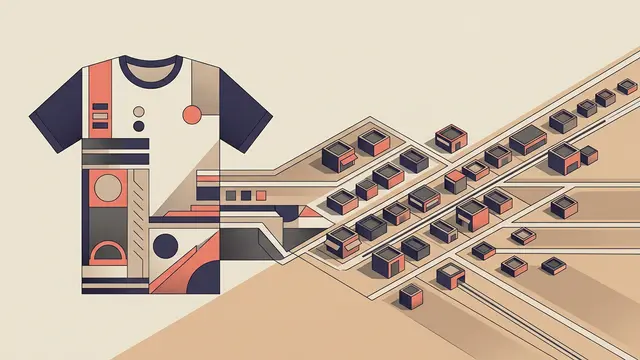
The global adoption of oversized clothing is frequently misattributed to a simple revival of 1990s hip-hop and Western skate culture. The reality of Japanese volume is far more architectural. In Tokyo, the draped silhouette is not an accident of sizing up, but a deliberate application of Ma—the traditional Japanese concept of negative space. Rather than letting fabric hang passively off the body, designers engineer garments to sculpt the void between cloth and skin. This spatial philosophy separates Western bagginess, which historically communicated rebellion or utility, from Japanese oversize, which operates as a study in meticulous proportion. It is a structural science that has quietly dictated the trajectory of global menswear over the last four decades.
The Evolution of Volume
The Japanese manipulation of scale occurred in three distinct waves, beginning with the 1980s DC (Designer/Character) boom. During this era, avant-garde pioneers like Yohji Yamamoto and Rei Kawakubo of Comme des Garçons weaponized oversized silhouettes to challenge Western tailoring conventions. They stripped away the rigid shoulder pads and darted waists of European luxury, replacing them with dark, billowing forms that obscured the physical form. This was less about comfort and more about subversion, treating the body as a secondary armature for textile experiments. It was a radical departure from the body-conscious silhouettes dominating Western fashion at the time.
By the 2010s, this avant-garde impulse was domesticated into the "City Boy" aesthetic—a term heavily popularized by the Japanese magazine Popeye under the editorial direction of Takahiro Kinoshita. The City Boy look synthesized the oversized tailoring of the 1980s with American trad and 1990s skate wear, creating a hybrid silhouette that felt both relaxed and obsessively curated. As documented in W. David Marx’s cultural history Ametora, Japan has a long history of importing American style codes and refining them into entirely new vernaculars. The baggy chino or the oversized oxford shirt was no longer a sloppy afterthought; it was recalibrated down to the millimeter to ensure a precise, intentional drape.
Editing the Silhouette
Today, the focus has shifted from avant-garde subversion to obsessive material engineering. Contemporary Japanese labels like Yoke and Graphpaper represent a new paradigm where "spec" outranks spectacle. These brands approach garment making through the lens of Henshu, or the art of editing. They take the foundational garments of the twentieth century—the trench coat, the fatigue pant, the loopwheeled sweatshirt—and edit their proportions to create an engineered drape. A Graphpaper chef pant, for instance, utilizes an intricate velcro waist system to maintain an exaggerated, balloon-like volume without collapsing around the ankles.
This meticulous approach to construction reflects a broader shift in the Japanese apparel market. In an era marked by economic stagnation and the hyper-saturation of fast fashion, independent labels cannot compete on price or rapid trend cycles. Instead, they compete on permanence and structural integrity. By prioritizing the invisible details—custom-milled textiles, specialized tension in the stitching, and the precise calculation of Ma—these designers justify premium price points. The oversized garment becomes an investment piece, engineered to hold its shape across years of wear rather than degrading after a single season.
The endurance of Japanese oversize proves that silhouette is not merely a trend, but a structural discipline. By treating the space between the body and the garment as a tangible material, Japanese designers have permanently altered how the world understands fit. The unresolved question is whether this architectural approach can survive the accelerating pace of global trend cycles, or if the meticulous editing of labels like Yoke will eventually be flattened by fast-fashion imitations that copy the scale but ignore the science.
Source · The Frontier | Fashion