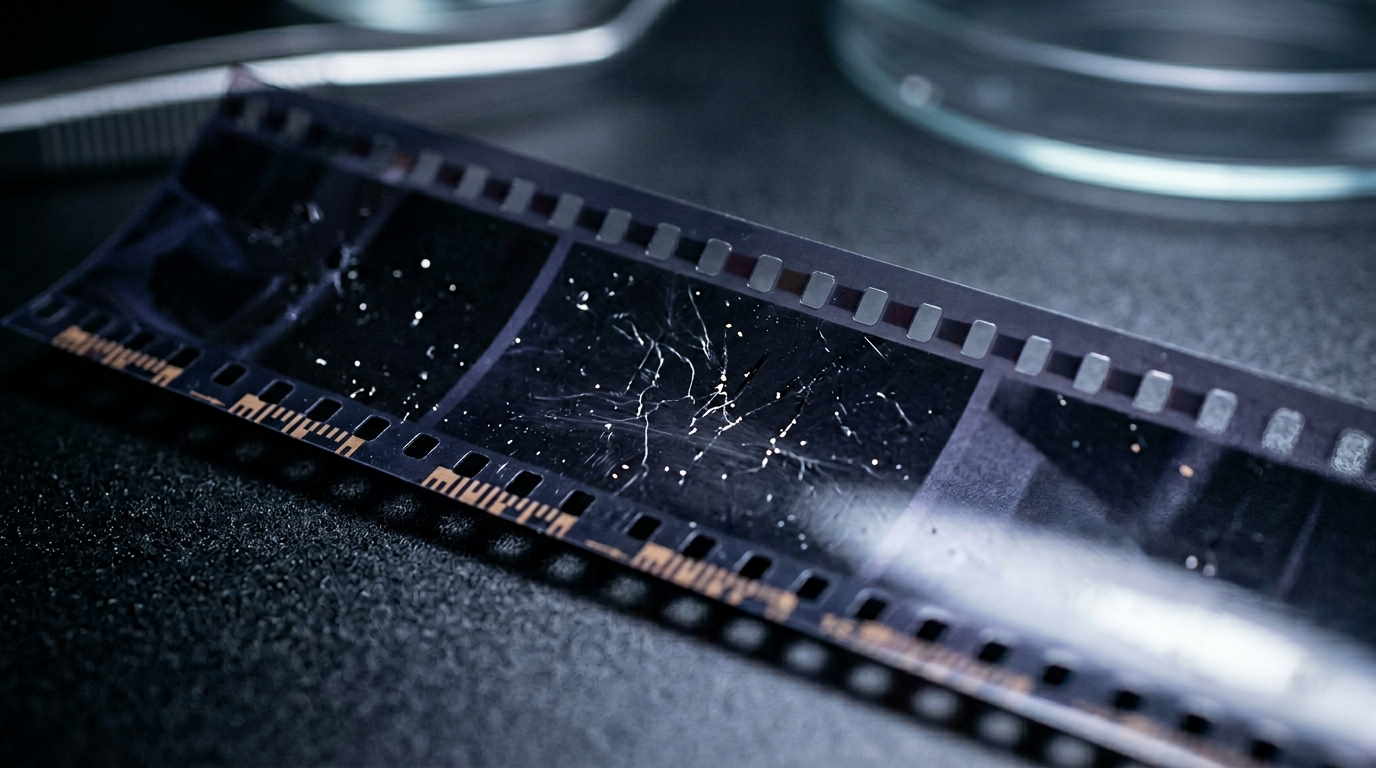
A recent experiment involving the deployment of photographic film to the edge of space has provided a striking illustration of the intersection between high-energy physics and creative expression. By sealing unexposed photographic negatives in specialized containers and launching them via helium balloons into the stratosphere, researchers have successfully captured the tracks of ionizing radiation. According to BBC Science reporting, these cosmic rays, which originate from deep space and interact with the Earth's atmosphere, leave distinct marks on the film, effectively turning the medium into a passive particle detector that records the invisible environment of the upper atmosphere.
This project highlights a growing trend in interdisciplinary inquiry, where technical scientific processes are repurposed to explore visual and conceptual boundaries. While the capture of cosmic rays is a well-established practice in particle physics—historically achieved through cloud chambers or complex scintillation detectors—the use of analog photographic film introduces a unique aesthetic dimension. By treating the film as a canvas for high-energy particles, the experiment bridges the gap between empirical data collection and artistic interpretation, demonstrating that the tools of the laboratory can serve as instruments for visual narrative.
The Physics of the Stratospheric Exposure
The fundamental mechanism behind this project relies on the interaction between high-energy particles and the silver halide crystals embedded in photographic film. As cosmic rays—primarily protons and atomic nuclei traveling at near-light speeds—penetrate the atmosphere, they collide with air molecules, producing a cascade of secondary particles. When these particles strike the film, they deposit energy that triggers a chemical change in the emulsion, mimicking the effect of light exposure. This is not a conventional photograph in the sense of a captured scene, but rather a direct physical record of a subatomic event.
Historically, the study of cosmic rays has been central to our understanding of the universe. In the early 20th century, researchers like Victor Hess used balloon-borne instruments to discover that radiation levels increased with altitude, proving the extraterrestrial origin of these particles. The current project follows in this tradition of high-altitude exploration, yet it shifts the focus from purely quantitative measurement to qualitative representation. By exposing film to the raw, unfiltered environment of the stratosphere, the experiment provides a tangible connection to phenomena that are otherwise imperceptible to the human eye.
This process underscores the inherent sensitivity of analog materials to environmental variables. Unlike digital sensors, which are often shielded to prevent noise and corruption, photographic film acts as an integrated recorder of its surroundings. The resulting images are characterized by intricate patterns, streaks, and clusters that reflect the stochastic nature of particle interactions. This provides a unique perspective on the invisible, high-energy landscape that perpetually surrounds the planet, transforming abstract physical constants into concrete, observable forms.
Mechanisms of Artistic and Scientific Synthesis
When evaluating the intersection of particle physics and art, one must consider the incentives that drive such experimentation. For students and researchers alike, the appeal lies in the ability to visualize the invisible. The technical challenge of designing a payload capable of surviving the harsh conditions of the stratosphere—including extreme temperature fluctuations and low pressure—adds a layer of rigor to the artistic endeavor. The success of the project demonstrates that scientific curiosity, when paired with creative intent, can yield outputs that defy traditional categorization.
Furthermore, the use of analog film serves as a poignant reminder of the physical nature of data. In an era dominated by digital capture and algorithmic processing, the reliance on chemical reactions to record subatomic particles offers a form of 'truth' that is inherently linked to physical interaction. Each mark on the negative is a direct result of a collision, a physical trace of an event that occurred thousands of miles above the surface. This creates an authentic link between the observer and the cosmos, emphasizing that scientific data is not merely a collection of numbers, but a reflection of a dynamic and reactive reality.
Implications for Stakeholders and Future Inquiry
This project carries implications that extend beyond the immediate results of the photographic experiment. For educators, it serves as a compelling case study in how complex scientific concepts can be made accessible through multidisciplinary projects. By grounding abstract physics in a visual medium, the experiment encourages a more holistic understanding of the scientific process. For the broader scientific community, it reinforces the value of low-cost, high-altitude research platforms, which continue to provide opportunities for innovation that are often inaccessible through traditional, high-budget institutional channels.
However, the tension between amateur experimentation and professional research remains a critical point of discussion. As access to space-based platforms becomes easier, regulators and safety agencies must balance the freedom of scientific exploration with the necessity of maintaining order in the airspace. The success of such projects also raises questions about the reproducibility of results in non-controlled environments. While the aesthetic outcome is the primary focus here, the data generated by such exposures could theoretically contribute to our understanding of radiation patterns in the upper atmosphere if subjected to rigorous analysis and peer review.
Outlook and Open Questions
The long-term impact of this project remains to be seen, particularly as it relates to the evolution of interdisciplinary art-science collaborations. One must ask whether the visual patterns captured on film can provide new insights into the behavior of cosmic rays or if they remain primarily an artistic endeavor. As technology continues to lower the barrier to entry for stratospheric research, we are likely to see an increase in similar experiments, potentially creating a new category of 'cosmic art' that serves both scientific and cultural purposes.
Looking forward, the question of how to interpret these results in a scientific context remains open. Will these images lead to new methods of particle detection, or will they remain a curiosity at the periphery of serious research? The answers will likely depend on the willingness of the academic community to embrace unconventional methods and the ability of future researchers to bridge the gap between aesthetic output and quantitative analysis. As the field of stratospheric exploration continues to evolve, the integration of diverse methodologies will be essential to uncovering the full potential of these high-altitude environments.
As the boundaries between scientific inquiry and creative practice continue to blur, the project serves as a reminder that the most profound insights often emerge at the intersection of disparate disciplines. Whether these images are viewed as raw data or as artistic interpretations of the cosmos, they challenge us to reconsider the ways in which we observe and document the invisible world. The ongoing dialogue between physics and art suggests that our understanding of the universe is not limited to what we can measure, but also to what we can visualize and imagine.
With reporting from BBC Science
Source · BBC Science


