When Land Rover reintroduced the Defender to the United States after a roughly twenty-year absence, the reception split along predictable lines. Loyalists welcomed the return of a nameplate that had become synonymous with expedition-grade capability. Skeptics questioned whether a vehicle now built on a modern monocoque platform — rather than the body-on-frame architecture of its predecessor — could credibly carry the Defender name. The initial lineup, anchored by turbocharged four- and six-cylinder engines, did little to settle the debate. It was not until Land Rover grafted a 5.0-liter supercharged V8 onto the Defender 110 that the vehicle acquired the kind of mechanical personality its heritage seemed to demand.
The Defender 110 V8 occupies an unusual position in the current market. It pairs a powertrain rooted in a previous generation of engineering — Jaguar Land Rover's long-serving supercharged V8, a unit that has seen duty across Range Rovers, F-Types, and various special editions — with a body and chassis designed squarely for the 2020s. The result is a vehicle that feels like two philosophies occupying the same sheet metal.
A powertrain out of time
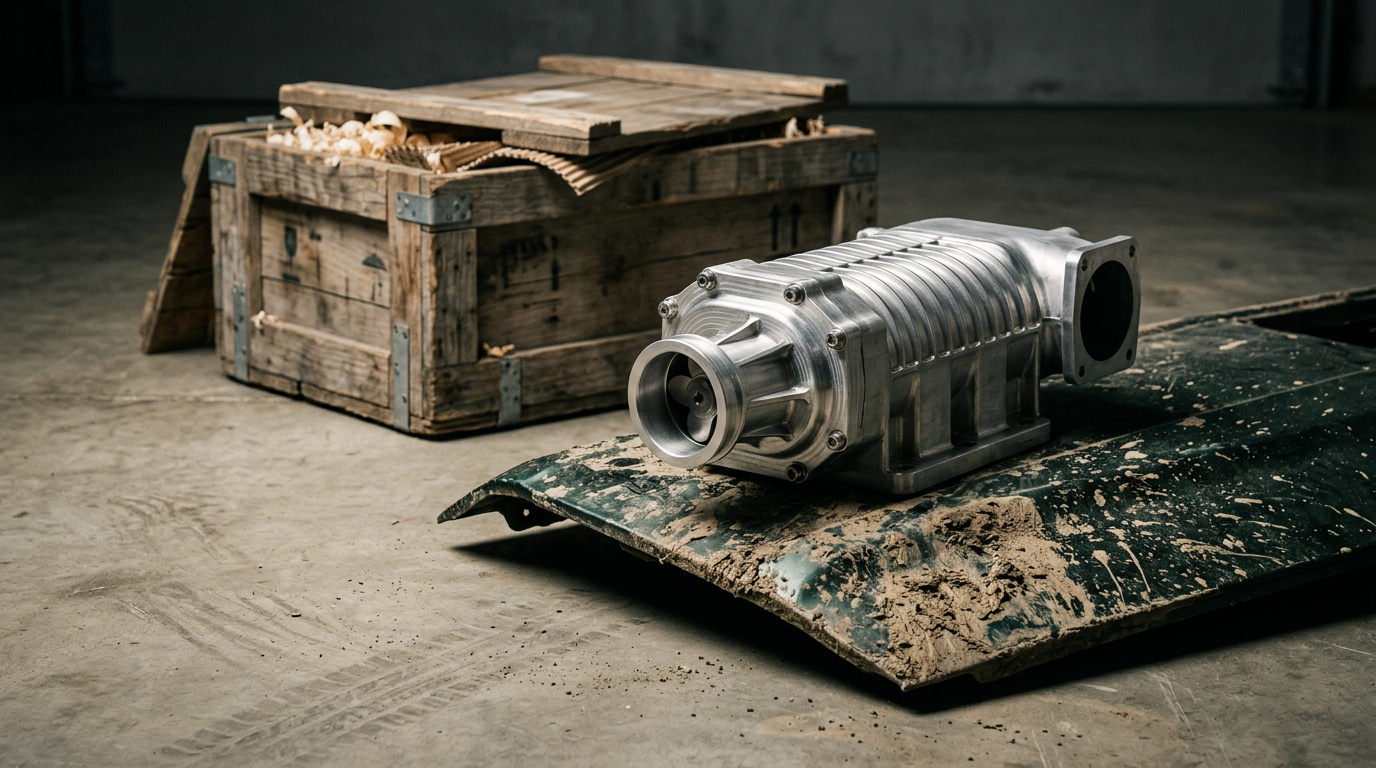
The supercharged 5.0-liter V8 is, by contemporary standards, an anachronism. In an era where most premium automakers have migrated toward smaller-displacement turbocharged units or electrified powertrains, a naturally aspirated-displacement engine with a Roots-type supercharger bolted on top belongs to a rapidly closing chapter of automotive engineering. It is loud at full throttle, conspicuously thirsty, and delivers its power with a linearity that modern turbo setups rarely replicate. For a segment of buyers, these are not drawbacks but features — the mechanical texture that turbocharged and electrified alternatives tend to smooth away.
The broader context matters here. Jaguar Land Rover has signaled its commitment to electrification across both brands. The Jaguar marque is undergoing a full reinvention as an electric-only proposition, and Land Rover's own roadmap includes battery-electric variants of its core models. Against that backdrop, the supercharged V8 Defender reads less as a permanent fixture and more as a limited-window offering — a powertrain whose continued availability depends on emissions regulations, corporate strategy, and the economics of maintaining a legacy engine line alongside new electric architectures.
The addition of the 4.4-liter twin-turbocharged V8 in the Defender Octa, sourced from BMW, further underscores the transitional nature of the moment. Land Rover now offers two distinct V8 options in the same vehicle family, each representing a different industrial relationship and a different engineering philosophy. The supercharged unit is an in-house holdover; the twin-turbo is a partnership product pointing toward the kind of powertrain-sharing arrangements that define modern automotive manufacturing.
Supply chains and the limits of iteration
Beyond the engine bay, the Defender 110 V8 reflects a broader reality facing the automotive industry: the degree to which external forces now shape product cadence. Land Rover's recent model years have been defined less by engineering breakthroughs than by the logistical constraints imposed first by semiconductor shortages, then by shifting trade policies and tariff regimes. The transition from the 2025 to the 2026 model year, marked primarily by adjustments to package availability and exterior color options rather than substantive mechanical changes, is characteristic of an industry where supply chain management has become as consequential as product development.
This is not unique to Land Rover. Across the premium SUV segment, manufacturers have found themselves managing allocation and trim-level availability as carefully as they once managed engineering timelines. The result is a market where the distinction between model years can feel cosmetic — a reality that complicates the traditional review cycle but accurately reflects how vehicles reach consumers in the current environment.
The Defender 110 V8, then, sits at the intersection of several tensions that define the automotive industry in the mid-2020s: legacy powertrains against electrified futures, heritage branding against luxury repositioning, engineering ambition against supply chain pragmatism. Whether the supercharged V8 Defender will be remembered as the last great expression of the nameplate's combustion-era identity or as a curious footnote in a longer electrification story depends on forces well beyond the vehicle itself — on regulatory trajectories, on consumer appetite for large-displacement engines at premium prices, and on how quickly Land Rover's own electric alternatives arrive and perform. The machine exists in a window that is open now but narrowing visibly.
With reporting from The Drive.
Source · The Drive