The heat radiating from a smartphone during a high-resolution game or a long GPS-guided drive is a visceral reminder of the laws of thermodynamics. While consumers often treat these devices as seamless portals to the digital world, they are, at their core, dense assemblies of hardware struggling with the physical cost of computation. Every operation performed by the processor requires energy, and in any electrical system, a portion of that energy is inevitably lost as heat. The phenomenon is not a defect. It is physics.
The Architecture of Constraint
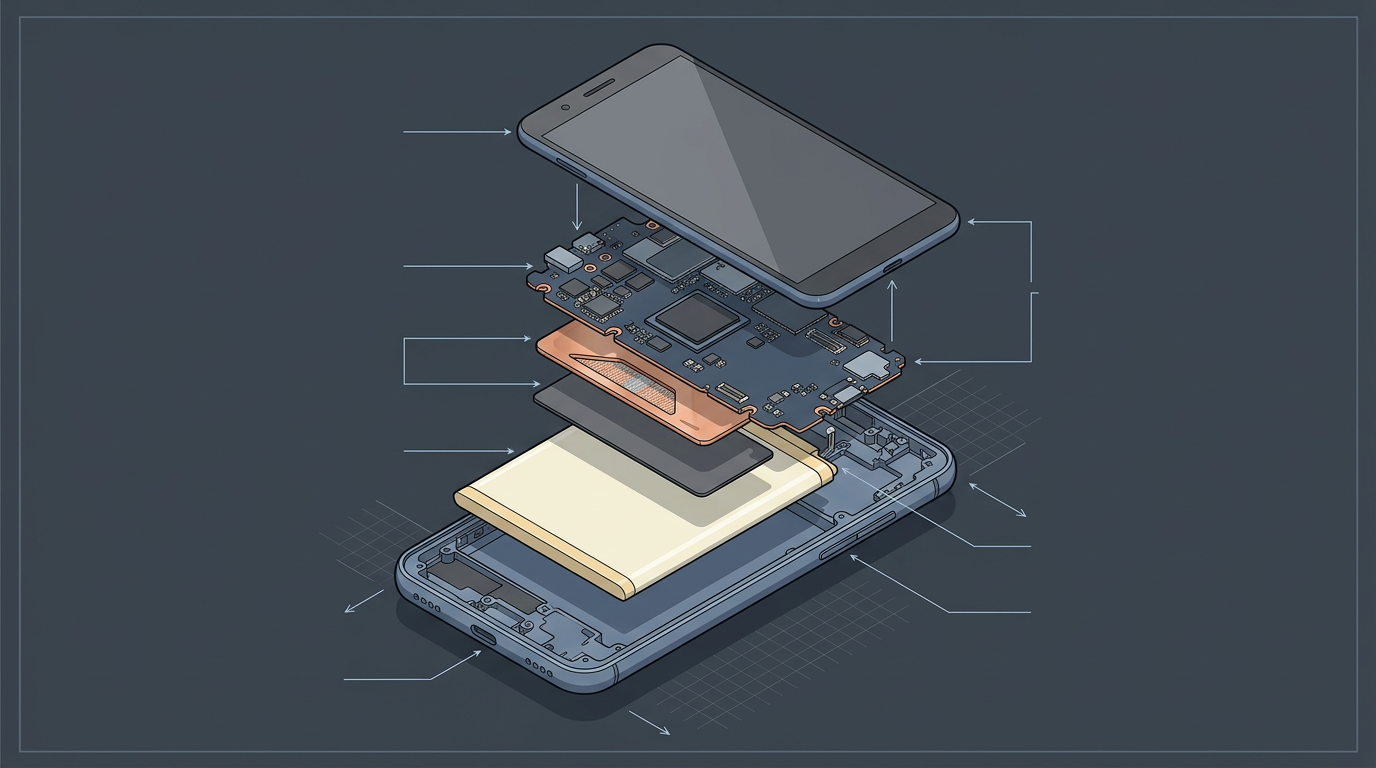
Unlike a laptop or a desktop, a smartphone operates under severe spatial constraints that preclude the use of active cooling. There are no fans to exhaust hot air, no copper heat pipes snaking through roomy chassis. Instead, manufacturers rely on passive dissipation — using internal heat spreaders, thin graphite sheets, and sometimes vapor chambers to pull thermal energy away from sensitive components and toward the device's outer shell. When a phone feels uncomfortably warm to the touch, it is often a sign that the thermal management system is working as intended, using the chassis itself as a radiator to prevent internal damage.
This design logic has remained broadly unchanged for over a decade, even as the silicon inside has transformed. Modern mobile system-on-chips pack CPU cores, GPU clusters, neural processing units, and modem radios onto a single die measured in square millimeters. Each generation promises higher transistor counts and faster clock speeds, but the thermal envelope — the total amount of heat a device can safely dissipate — has not expanded at the same rate. The result is a recurring engineering negotiation: chip designers push performance upward, and thermal engineers fight to keep temperatures within safe operating margins.
The most significant contributor to this thermal load, beyond the processor itself, is the lithium-ion battery. The movement of lithium ions between electrodes during discharge is a chemical process that generates its own heat. When demanding applications — such as 4K video recording, augmented reality overlays, or heavy multitasking — draw high currents, this electrochemical reaction intensifies. Charging compounds the problem further, particularly with fast-charging protocols that push higher wattages into the cell in shorter windows. Heat accelerates degradation of lithium-ion chemistry, which means that the very feature consumers value — rapid recharging — quietly shortens the battery's useful life.
Performance, Throttling, and the User Experience Trade-Off
Smartphone makers have developed a standard countermeasure for thermal spikes: throttling. When internal sensors detect temperatures approaching critical thresholds, the operating system reduces clock speeds, dims the display, or limits background processes. The device sacrifices performance to protect itself. For the user, the experience manifests as stuttering frame rates, slower app launches, or a camera that temporarily refuses to record. It is a deliberate compromise, though rarely a transparent one — few devices explain to the user why performance has suddenly degraded.
The tension between raw capability and thermal reality shapes product strategy across the industry. Chip manufacturers have pursued smaller fabrication nodes — moving from seven-nanometer to five-nanometer and beyond — partly because smaller transistors switch with less energy and therefore produce less waste heat per operation. But gains from process shrinks are often reinvested into additional transistors and higher peak performance, a pattern sometimes compared to the Jevons paradox in energy economics: efficiency gains get consumed by rising demand.
Material science offers incremental relief. Vapor chambers, once reserved for gaming phones, have migrated into mainstream flagships. Some manufacturers have experimented with boron nitride thermal interface materials or graphene-based heat spreaders. Yet no passive solution has fundamentally altered the equation. The smartphone remains a sealed system with a narrow thermal budget, asked to do more each year.
As mobile processors grow powerful enough to run large language models on-device and render console-quality graphics, the gap between computational ambition and thermal capacity widens. The next generation of mobile hardware will not be defined solely by benchmark scores or camera megapixels. It will be defined, in part, by how elegantly it manages the heat those capabilities produce — and by whether consumers accept the trade-offs that physics demands.
With reporting from Canaltech.
Source · Canaltech