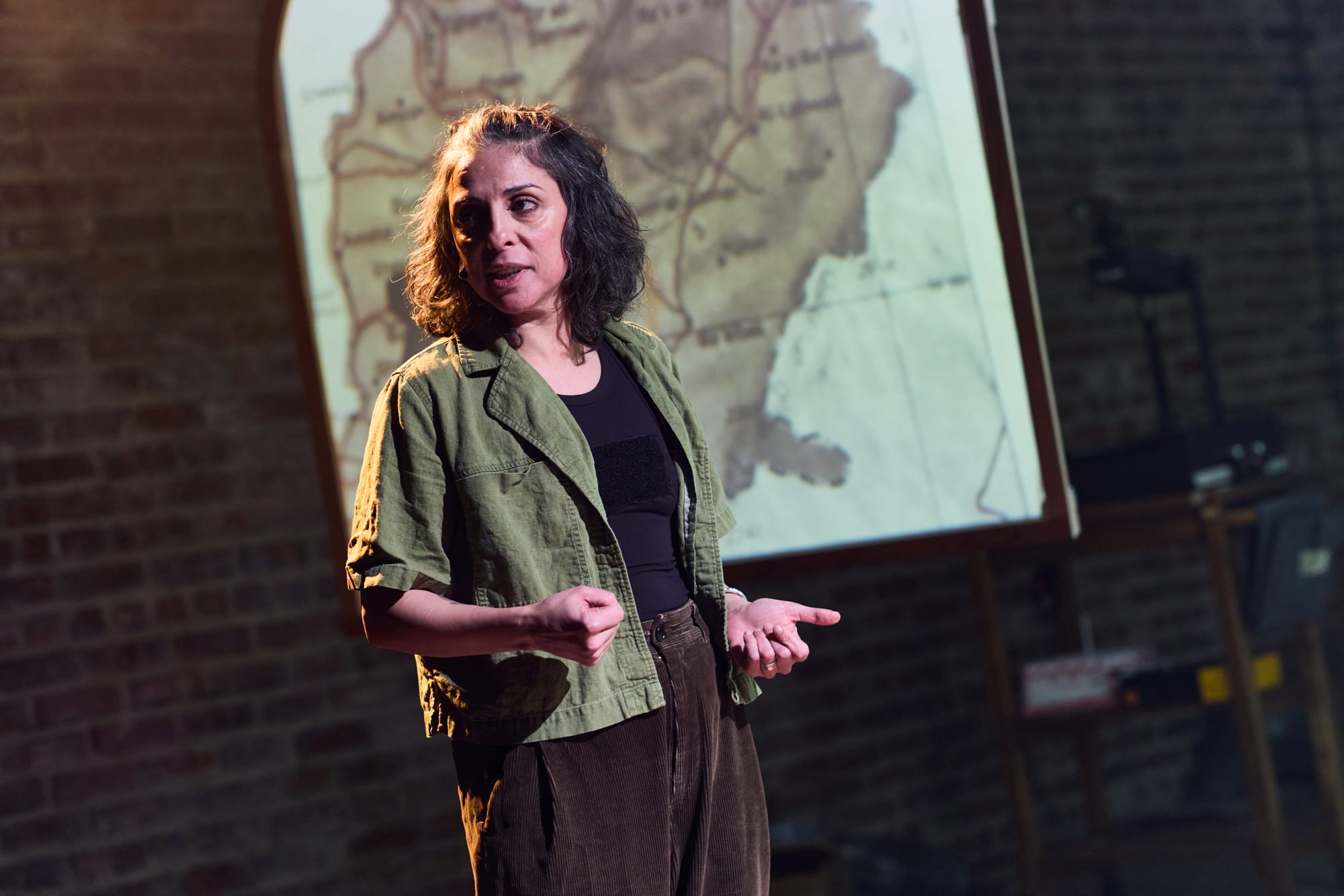
In a performance classroom in Sunset Park, Brooklyn, the silence of children has become a diagnostic tool. For Rawya El Chab, a 45-year-old Lebanese artist and educator, the recent reticence of her immigrant students — driven by fear of state intervention and the specter of immigration enforcement — carries a familiar resonance. It is an echo of her own youth in Beirut during the 1980s, a period defined by Syrian and Israeli occupations, where the weight of surveillance dictated the boundaries of public and private speech.
That biographical detail is not incidental to El Chab's art. It is the engine of it. Over more than two decades, her practice has moved through Palestinian refugee camps, nursing homes, and now the public schools of New York, always returning to the same question: how does the presence of state force reshape what people are willing to say, and what they learn to bury?
The architecture of silence
The Lebanese Civil War, which lasted from 1975 to 1990, produced not only physical destruction but a lasting culture of self-censorship. Under successive occupations, Lebanese citizens developed finely tuned instincts for what could be spoken aloud and what had to remain interior. The postwar period brought no formal truth and reconciliation process. The 1991 amnesty law effectively foreclosed public accountability for wartime atrocities, leaving the work of memory largely to artists, filmmakers, and writers rather than institutions.
El Chab's practice sits squarely in that tradition. Her work operates at the intersection of political theater and existential inquiry, using interactive forums and clowning techniques to open conversations that formal discourse has sealed shut. In Palestinian refugee camps, the subject is displacement and statelessness. In nursing homes, it is mortality. In Brooklyn classrooms, it is the fear that a parent may not come home. The settings differ; the underlying dynamic — authority suppressing voice — does not.
This approach places El Chab within a broader lineage of Lebanese and Arab performance artists who have used the body and live presence as counter-archives, creating ephemeral records of experience that official narratives refuse to hold. The form itself becomes political: performance leaves no permanent object that can be confiscated or censored, only the memory of witness.
Crossing waters, crossing eras
In her recent performance piece, Crossing the Water, El Chab takes on the mythological role of a guide across the River Styx. As a low rumble fills the theater, she offers a dark, stoic comfort to her audience: "Don't worry. It's not the first time I die." The line collapses temporal distance — between wartime Beirut and contemporary New York, between mythological underworld and the bureaucratic limbo of immigration status — into a single utterance.
The piece draws on a long theatrical tradition of using classical mythology to address present political conditions, a strategy that allows artists to speak about power without naming specific regimes. For audiences in New York's immigrant communities, the resonance requires no footnote. The river to be crossed is at once ancient and immediate.
What makes El Chab's work distinctive is not the political content alone but the insistence on intimacy as method. Her performances do not lecture; they create conditions under which silence can be recognized as a symptom. The classroom observation — that children have grown quieter — is not a metaphor. It is a clinical finding, arrived at through years of proximity to communities under pressure.
The parallel between 1980s Beirut and 2020s Brooklyn is not exact, and El Chab does not appear to claim equivalence. The mechanisms differ: military checkpoints are not immigration raids, and the Lebanese sectarian state is not the American federal apparatus. But the behavioral residue — the learned caution, the self-editing, the way fear restructures family conversation — follows recognizable patterns across contexts. Whether that pattern constitutes a universal grammar of state power or merely a surface resemblance is a question her work raises without resolving.
For communities navigating that tension in real time, the distinction may matter less than the recognition. The act of performance, in El Chab's framing, is not therapy and not protest. It is something closer to cartography: mapping the interior territory that authority claims but cannot fully occupy.
With reporting from Hyperallergic.
Source · Hyperallergic