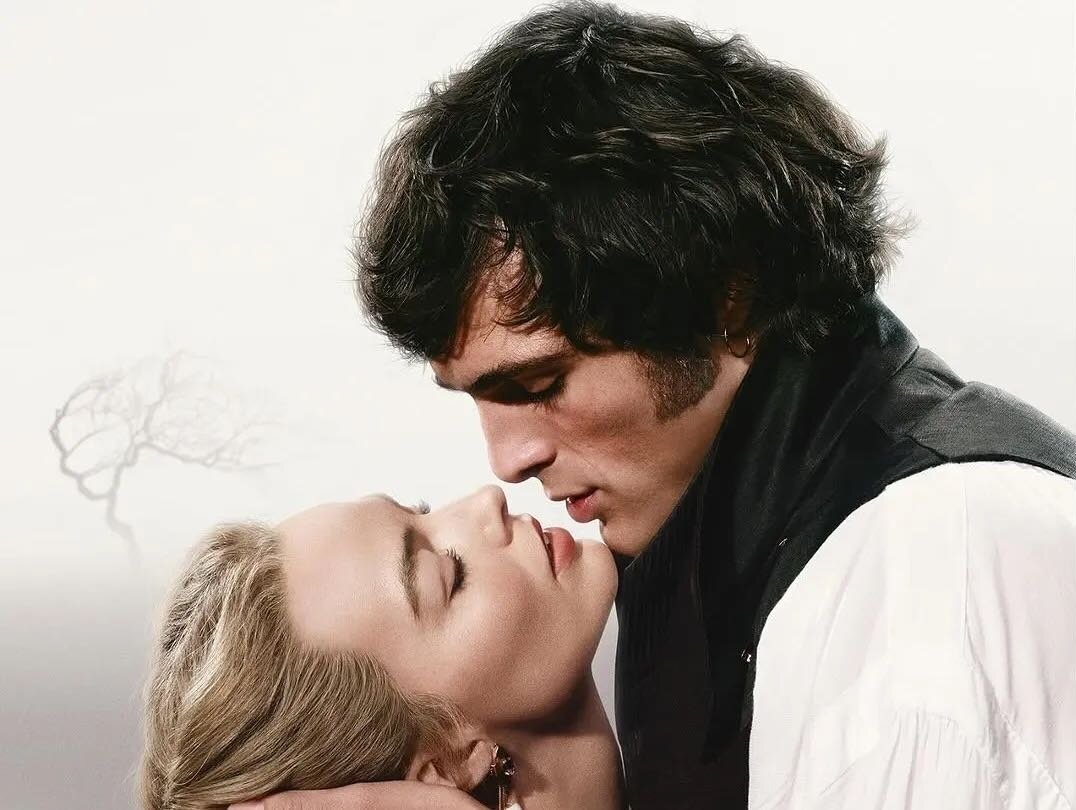
Emily Brontë's Wuthering Heights has always been an outlier — a work that resists the very categories it helped define. Since its 1847 publication under the pseudonym Ellis Bell, the novel has presented a structural and moral labyrinth that many critics, then and now, struggle to navigate. Unlike the era's more palatable Victorian narratives, Brontë's tale discarded traditional pillars like sacrifice and religious redemption in favor of a raw, almost nihilistic exploration of violence and obsessive yearning. Now, with Emerald Fennell's forthcoming film adaptation, the novel returns to the center of a familiar question: can cinema do justice to a book that actively resists domestication?
Early reception was famously fraught. As Lucasta Miller notes in The Brontë Myth, the contemporary consensus labeled the work "unforgivably coarse." It was a book that jittery Victorians found impossible to reconcile with the social mores of the time, though a few provocateurs, such as Algernon Charles Swinburne, championed its refusal to conform. The scandal only deepened when it was revealed that the "Bell brothers" were, in fact, the unmarried Brontë sisters, prompting Charlotte to issue a posthumous defense of Emily's "creative gift" — a force she described as something that masters the writer, rather than being mastered by them.
A novel that devours its adapters
The history of Wuthering Heights on screen is, in many respects, a history of strategic retreat. William Wyler's 1939 version, starring Laurence Olivier and Merle Oberon, remains the most commercially celebrated adaptation, yet it achieved its elegance by amputating roughly half the novel — the entire second-generation storyline — and recasting Heathcliff as a brooding romantic hero rather than the vengeful, self-annihilating figure Brontë wrote. Luis Buñuel's 1954 Mexican transposition, Abismos de pasión, leaned harder into the story's cruelty but still imposed a surrealist logic foreign to the original's bleak Yorkshire realism. Jacques Rivette reportedly considered and abandoned the project. Andrea Arnold's 2011 version came closest to the novel's feral texture, stripping away period-drama polish in favor of handheld naturalism and casting a Black actor, James Howson, as Heathcliff — a choice that foregrounded the character's status as a racial and social outsider in ways the text arguably invites but never resolves.
Each attempt reveals the same tension. The novel's nested narration — Lockwood recounting Nelly Dean recounting events she only partly witnessed — creates an unreliable architecture that cinema, a medium of visible surfaces, finds structurally difficult to replicate. Filmmakers tend to flatten the frame, choosing one emotional register where Brontë maintained several in deliberate, dissonant counterpoint.
Fennell and the question of abrasion
Fennell arrives at the material with a particular reputation. Her previous directorial work has demonstrated a willingness to inhabit morally uncomfortable territory and to let audiences sit with characters whose motivations resist easy sympathy. That sensibility, at least in principle, aligns with a novel whose two central figures — Heathcliff and Catherine Earnshaw — are neither heroes nor antiheroes in any modern screenwriting sense but something closer to elemental forces, destructive and self-destructive in equal measure.
The challenge, however, is not simply tonal. Brontë's prose operates through a kind of controlled grammatical violence — sentences that twist against themselves, dialogue that refuses to clarify motive. The novel's power is inseparable from its texture on the page. Translating that into visual storytelling without either softening the edges or tipping into melodrama is the problem every previous adaptation has, to varying degrees, failed to solve.
What makes the prospect worth watching is not any guarantee of success but the collision itself: a filmmaker drawn to provocation meeting a text that has outlasted every attempt to tame it. Wuthering Heights does not reward faithfulness or irreverence in predictable ways. It tends, instead, to expose the assumptions of whoever approaches it — about love, about narrative structure, about what audiences are willing to endure. Whether Fennell's version joins the long line of honorable compromises or finds a new way to let the novel's abrasion survive the screen remains the open question. The moors, as ever, are indifferent to the answer.
With reporting from MUBI Notebook.
Source · MUBI Notebook