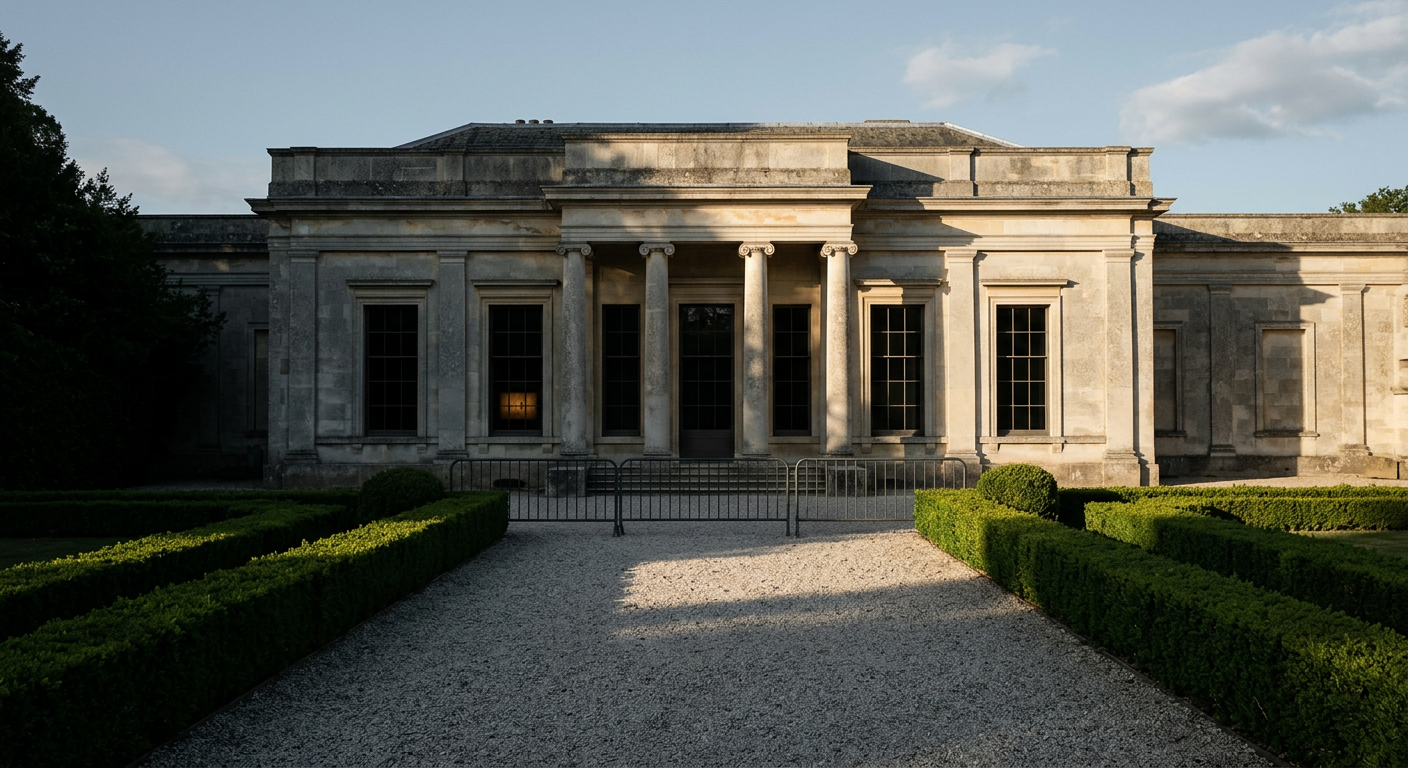
The 61st Venice Biennale has become a focal point for the tensions defining contemporary international relations, as the return of the Russian Pavilion triggers a complex exercise in administrative maneuvering. According to reports from Italian news outlets, including Open and La Repubblica, the pavilion will restrict physical access to a brief window during the vernissage dates of May 5–8. Following this period, the physical space will remain closed to the public, with the exhibition, titled The tree is rooted in the sky, presented only through multimedia documentation displayed on screens at the building’s windows. This operational pivot follows intense public criticism and scrutiny from European Union officials regarding the potential breach of financial and diplomatic sanctions.
This arrangement highlights the precarious position of legacy cultural institutions attempting to balance their mandate for international inclusivity against the mandates of national and supranational policy. While the Biennale Foundation maintains that its actions remain in "strict compliance with applicable national and international laws," the decision to limit public access suggests a recognition that traditional cultural presence is no longer tenable for the Russian Federation under current geopolitical conditions. The move serves as a stark illustration of how cultural diplomacy, once a soft-power tool for states, is increasingly being forced into a narrow, performative corner by the weight of global sanctions.
The Erosion of Cultural Neutrality
The Venice Biennale has historically operated under the assumption that the Giardini and the Arsenale function as neutral ground—a space where national pavilions exist as sovereign enclaves for artistic expression, independent of the volatile currents of state policy. However, the Russian Federation’s return to the event after two consecutive absences since the invasion of Ukraine fundamentally challenges this institutional framework. In 2022, the withdrawal of the Russian pavilion by its own artists and curator served as an act of internal dissent, signaling that the cultural sector was not immune to the moral imperatives triggered by state aggression. By 2024, the loan of the pavilion space to Bolivia provided a temporary, face-saving solution that allowed the Biennale to bypass direct confrontation with the issue of Russian state participation.
Today, the situation has evolved from spontaneous protest to structural constraint. The current controversy reveals that the Biennale is no longer merely a venue for art, but a site where the limits of international cooperation are tested. The involvement of the Italian Ministry of Culture, particularly the demands for transparency from Minister Alessandro Giuli, underscores that these decisions are no longer purely curatorial or administrative. They are political. The pressure placed on the Biennale Foundation to disclose communications with Russian authorities suggests that the "neutrality" of the art world is being actively reclaimed by national governments, which are increasingly unwilling to allow cultural platforms to serve as conduits for state-aligned representation without rigorous, state-sanctioned oversight.
The Mechanism of Managed Exclusion
The strategy of limiting physical access to the Russian Pavilion acts as a mechanism of "managed exclusion." By allowing the pavilion to open for a short, industry-facing window, the Biennale Foundation attempts to satisfy the technical requirements of participation while simultaneously acknowledging the toxicity of a full-scale presence. This approach functions as a compromise that satisfies neither the proponents of total exclusion nor the advocates of cultural continuity. For the Biennale, this is a risk-mitigation strategy designed to prevent the total rupture of the pavilion structure while avoiding the optics of a fully operational, state-sponsored exhibition.
This dynamic highlights a broader trend in global institutional management: the shift toward procedural compliance as a defense against moral and political criticism. By documenting the exhibition through screens at the windows, the organizers are creating a physical barrier that serves as a metaphor for the current state of Russia’s relationship with the West. The art remains visible, but the interaction is mediated, controlled, and fundamentally distant. This is not the open exchange of ideas that the Biennale was designed to foster, but rather a digital proxy for participation, reflecting a world where the physical movement of state-sanctioned cultural actors is increasingly restricted by the mechanisms of international law.
Implications for Global Cultural Institutions
The implications of this situation extend far beyond the Giardini. Other international cultural bodies, from film festivals to sporting organizations, are watching this precedent closely. The decision by the Biennale’s international awards jury to exclude countries whose leaders are charged with crimes against humanity by the International Criminal Court (ICC) marks a significant shift in how cultural prizes are administered. By formalizing this exclusion, the jury has moved from a position of passive observation to one of active moral arbitration. This sets a precedent that will likely be invoked in future conflicts, forcing institutions to define their own red lines in a landscape where geopolitical alignment and artistic merit are increasingly inseparable.
For stakeholders—ranging from the artists involved to the diplomatic missions managing these pavilions—the takeaway is clear: the era of the "apolitical" pavilion is effectively over. Regulators and cultural administrators are finding that they can no longer treat national pavilions as independent entities. Instead, they are being held accountable for the political implications of the states they host. This creates a difficult environment for artists who may wish to participate in international discourse but find themselves caught in the machinery of state policy and the administrative barriers of their host countries.
The Uncertainty of Cultural Diplomacy
What remains uncertain is the long-term viability of this model. Can an institution as large and complex as the Venice Biennale continue to operate under such high levels of political scrutiny, or will it eventually be forced to adopt a more rigid set of criteria for participation? The current situation is a fragile compromise that likely cannot be sustained indefinitely. If the political situation in Europe remains in a state of high-intensity conflict, the pressure on institutions to fully sever ties with state-sponsored entities will only increase, potentially leading to a fragmentation of the Biennale’s national pavilion structure.
Observers should watch for how other national pavilions respond to the precedent set by this year's constraints. If the Biennale succeeds in navigating this without a total breakdown of its diplomatic ties, it may provide a roadmap for other events facing similar pressures. However, if the controversy continues to escalate, it may signal the end of the traditional pavilion model, as institutions move toward more centralized, curator-led exhibitions that bypass the complications of direct state representation entirely. The tension between the desire for global cultural unity and the reality of state-level division remains the defining challenge of the contemporary art world.
As the Venice Biennale moves forward, the question of whether cultural institutions can maintain their independence from the geopolitical agendas of their participating nations remains open. The path taken by the Foundation in this instance highlights the difficulty of preserving a facade of normalcy in an era defined by profound global fractures. Whether this administrative approach will satisfy the demands of a changing political climate or simply delay a more definitive reckoning is a matter that will continue to unfold as the exhibition season progresses.
With reporting from Hyperallergic
Source · Hyperallergic