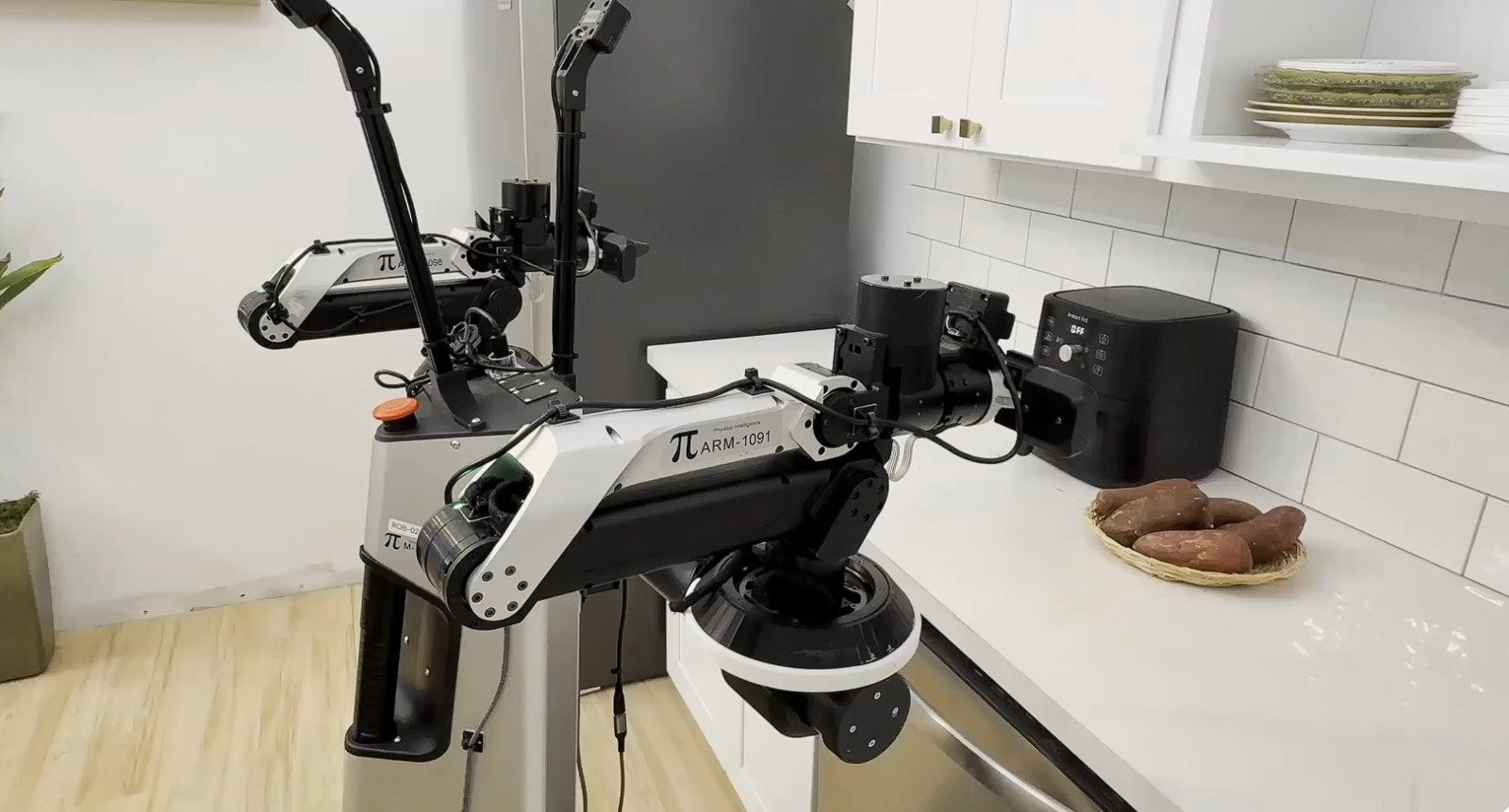
Robots have long been prisoners of specificity. A machine trained to weld car doors does precisely that — and nothing else. Introduce a slightly different door geometry, and the system falters. Physical Intelligence, a San Francisco-based startup building robotic foundation models, is challenging that constraint with the release of π0.7, a model designed to perform tasks it was never explicitly trained on by recombining skills acquired in other contexts.
The underlying mechanism is known as compositional generalization — the ability to take discrete learned competencies and assemble them into novel sequences of action. Rather than programming a robot for every conceivable scenario, π0.7 draws on a repertoire of previously mastered sub-skills and chains them together when confronted with an unfamiliar task. If the system has learned to grasp objects and has separately learned to navigate cluttered surfaces, it can, in principle, combine those abilities to clear a dinner table without ever having been trained on that specific chore.
From narrow skill to cognitive flexibility
The concept of compositional generalization is not new in artificial intelligence research. In natural language processing, large language models already demonstrate a version of it: they produce coherent sentences about topics absent from their training data by recombining syntactic and semantic patterns. Extending this principle to the physical world, however, introduces a layer of difficulty that language models never face. A robot must contend with gravity, friction, variable object geometries, and the unforgiving feedback loop of real-world physics. A misplaced grip does not merely produce a grammatical error — it drops a glass.
What makes Physical Intelligence's approach notable is the ambition to treat robotic control as a foundation-model problem, borrowing the scaling logic that transformed language AI. Instead of hand-engineering control policies for each task, the company trains a single large model across diverse manipulation scenarios, betting that sufficient breadth of training will yield emergent generalization. π0.7 represents an iteration on that thesis: a system whose value lies not in any single capability but in the combinatorial space of capabilities it can improvise.
The parallel to human cognition is instructive. When a person enters an unfamiliar kitchen, they do not consult a manual. They draw on a lifetime of spatial reasoning, object manipulation, and causal inference to open cabinets they have never seen and operate appliances they have never touched. The gap between that fluid human improvisation and current robotic performance remains vast, but compositional generalization is the architectural bet that the gap can be narrowed through scale and structure rather than exhaustive programming.
The road between demonstration and deployment
Early-stage demonstrations of generalized robotic behavior tend to generate enthusiasm that outpaces near-term commercial reality. The history of robotics is littered with impressive lab videos that did not survive contact with the chaos of warehouses, hospitals, or homes. Variability in lighting, object texture, human interference, and edge cases that no training distribution fully covers have historically humbled systems that looked capable in controlled settings.
Physical Intelligence operates in a competitive landscape that includes efforts from several well-funded labs pursuing similar foundation-model approaches to robotic manipulation. The strategic question is less whether compositional generalization works in principle — the cognitive science literature suggests it should — and more whether current model architectures and available training data are sufficient to make it reliable at the margins, where real deployment lives.
There is also a broader industrial dimension. If general-purpose robotic models mature, the economics of automation shift. Instead of purchasing a bespoke machine for each production step, a facility could deploy a smaller fleet of adaptable robots that learn new tasks through demonstration or brief fine-tuning. That prospect reshapes capital expenditure calculations and potentially lowers the barrier to automation for small and mid-sized manufacturers who cannot justify single-purpose robotic cells.
The tension, then, is between the elegance of the architectural idea and the stubbornness of physical reality. Compositional generalization offers a plausible path toward machines that improvise rather than merely execute. Whether π0.7 or its successors can do so reliably enough to leave the lab is the question the field now has to answer — not with papers, but with deployed hours and failure rates.
With reporting from Exame Inovação.
Source · Exame Inovação