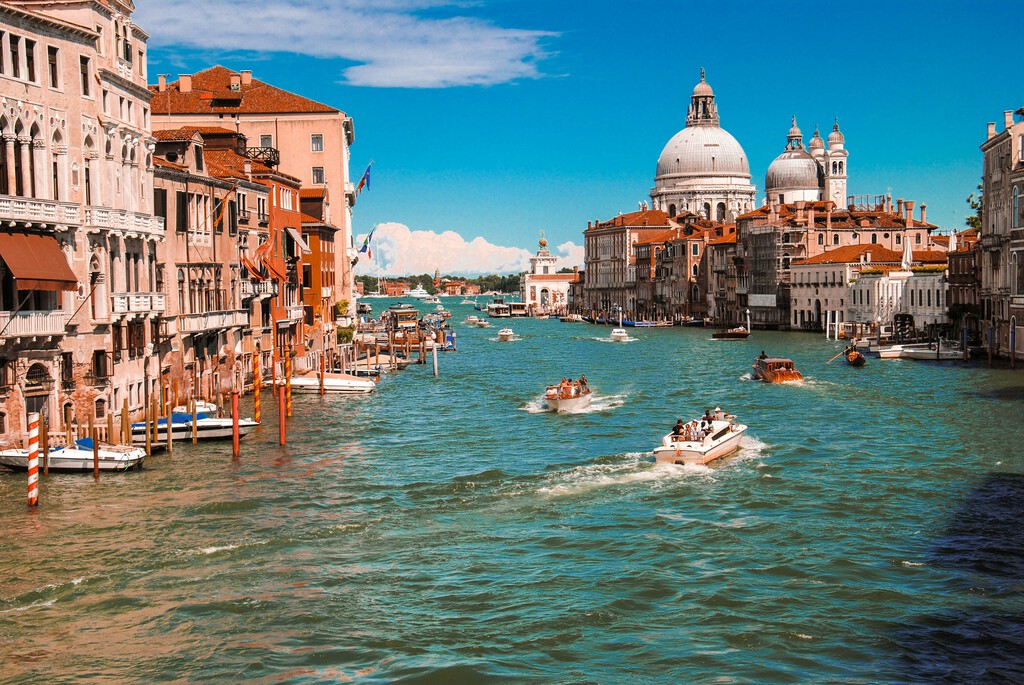
Venice, once a sovereign naval power that commanded the Mediterranean, now finds itself in a defensive crouch against the very waters that built it. The city's relationship with the Adriatic has shifted from one of strategic advantage to existential threat. In 2019, an acqua alta event submerged 80 percent of the city under 187 centimeters of water, a haunting echo of the record 194-centimeter flood of 1966. To combat this, Italy deployed MOSE — Modulo Sperimentale Elettromeccanico — a system of 78 mobile barriers installed across the three inlets connecting the Venetian lagoon to the open sea. The barriers, which lie flat on the seabed when inactive and rise by filling with compressed air when tides exceed a certain threshold, were designed to seal the lagoon during high water events.
While MOSE was heralded as a definitive solution, its long-term viability is increasingly in doubt. The engineering project, which cost upwards of five billion euros and took decades to complete — construction began in 2003, with full operation declared only in 2020 — was designed for a climate reality that is rapidly shifting. Recent data reveals a troubling acceleration in extreme weather: of the 28 "extreme" floods recorded over the last 150 years, defined as events covering 60 percent of the city's surface, a disproportionate number have occurred in the last few decades. The system's design parameters assumed a certain ceiling for sea level rise over its projected century-long lifespan. That ceiling now looks optimistic.
The paradox of permanent barriers in a living lagoon
The core tension facing Venice is not merely engineering but ecological. MOSE was conceived for occasional deployment — a handful of closures per year during the most severe tidal surges. But as baseline sea levels creep upward, the frequency of activation increases. Each closure seals the lagoon off from the Adriatic, interrupting the tidal exchange that flushes pollutants, replenishes oxygen, and sustains the delicate balance of marine life within the lagoon. A barrier system activated a few times a year is a flood defense. A barrier system activated dozens or hundreds of times a year becomes something closer to a permanent dam — with consequences the original design never intended to absorb.
This is a familiar pattern in large-scale climate adaptation infrastructure. The Thames Barrier in London, operational since 1982, has seen its closure frequency rise steadily over the decades. The Dutch Delta Works, perhaps the most celebrated flood defense system in history, have undergone continuous revision and expansion since their initial construction in the mid-twentieth century. The lesson from these precedents is consistent: static infrastructure built against a dynamic threat requires perpetual reinvestment and, eventually, fundamental rethinking. Venice's situation is arguably more acute because the lagoon is not just a body of water to be managed — it is the city's foundation, its transport network, and its ecological identity.
Searching for Plan B in an uncertain climate
The acknowledgment that MOSE may not suffice for the long term has prompted discussion of complementary strategies. Among the approaches that surface in such debates are raising the physical elevation of the city's most vulnerable areas, injecting water or other materials beneath the lagoon floor to lift the land, and rethinking urban planning to accommodate periodic flooding rather than resist it entirely. Each approach carries its own set of trade-offs — cost, feasibility, disruption to a city that is simultaneously a living community, a UNESCO World Heritage Site, and one of the most visited tourist destinations on earth.
The broader question Venice raises extends well beyond Italy. Coastal cities around the world face analogous dilemmas as sea levels rise and storm surges intensify. The instinct to build a single, monumental defense — a wall, a barrier, a levee — is powerful and politically legible. But the Venetian experience suggests that such projects, however technically sophisticated, operate within assumptions that the climate is steadily invalidating. The five billion euros spent on MOSE bought time. How much time, and what comes after, remains an open question — one that forces a reckoning with the gap between the pace of infrastructure and the pace of environmental change.
With reporting from Xataka.
Source · Xataka