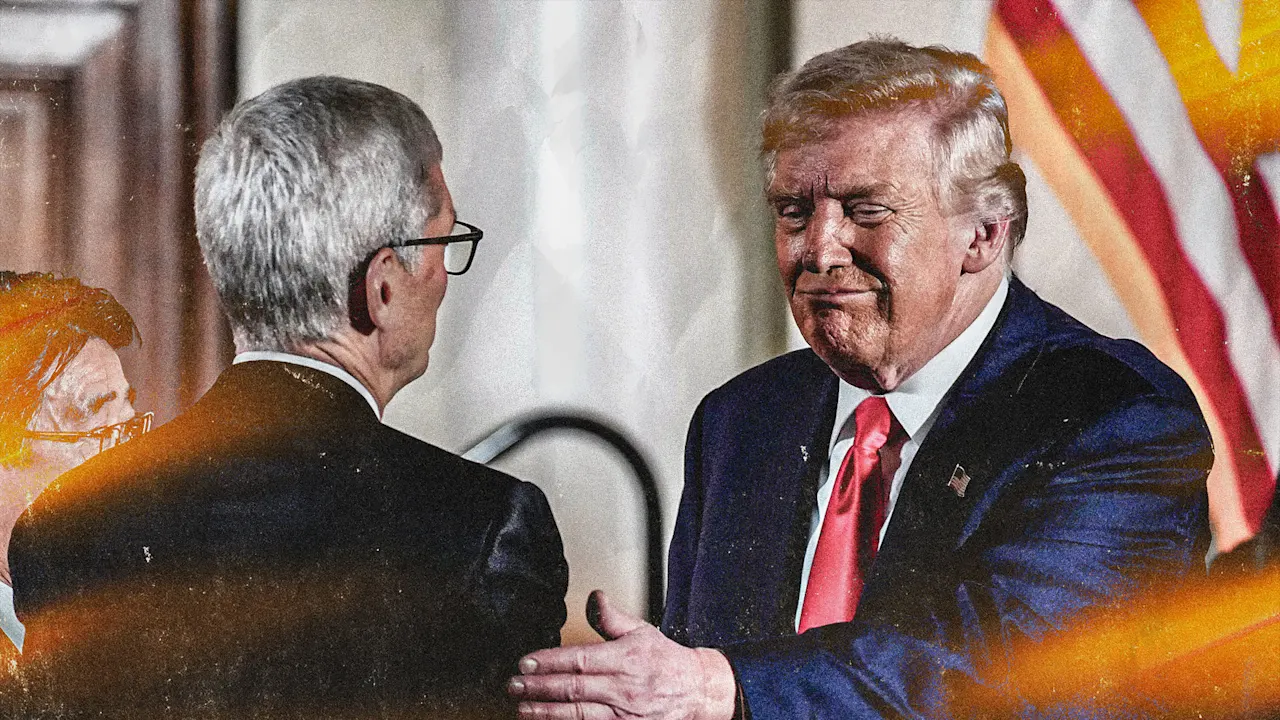
The announcement that Tim Cook will step down after 15 years as CEO of Apple marks the end of one of the most successful corporate stewardships in history. Cook, who will be succeeded by hardware engineering executive John Ternus, transformed Apple from a hit-driven hardware company into a diversified services giant and a $3 trillion juggernaut. While the transition has been met with predictable praise from Silicon Valley, it also elicited a characteristically idiosyncratic tribute from Donald Trump.
Writing on Truth Social, Trump praised Cook as an “incredible guy,” but went further by framing Cook’s success against the shadow of his predecessor. Trump suggested that Apple performed better under Cook’s operational discipline than it would have had Steve Jobs lived—a provocative claim that touches on the long-standing debate over the value of visionary leadership versus logistical mastery. Under Cook, Apple’s market capitalization grew by more than $2 trillion, a feat achieved largely through the relentless optimization of global supply chains.
The relationship between Trump and Cook was always one of the more pragmatic alliances in modern tech politics. During Trump’s presidency, Cook famously maintained a direct line to the White House, navigating trade wars and tariff threats with a level of diplomatic finesse that other tech leaders struggled to emulate. Trump’s latest comments reflect that history, acknowledging Cook’s role in steering the American corporate flagship through increasingly turbulent geopolitical waters.
As John Ternus prepares to take the helm, he inherits a company that is fundamentally different from the one Jobs left behind. If Jobs provided the spark of creation, Cook provided the engine of permanence. Trump’s assessment, however hyperbolic, underscores the reality that Cook’s legacy is defined not by invention, but by the sheer, overwhelming scale of Apple’s dominance in the modern economy.
With reporting from Fast Company.
Source · Fast Company