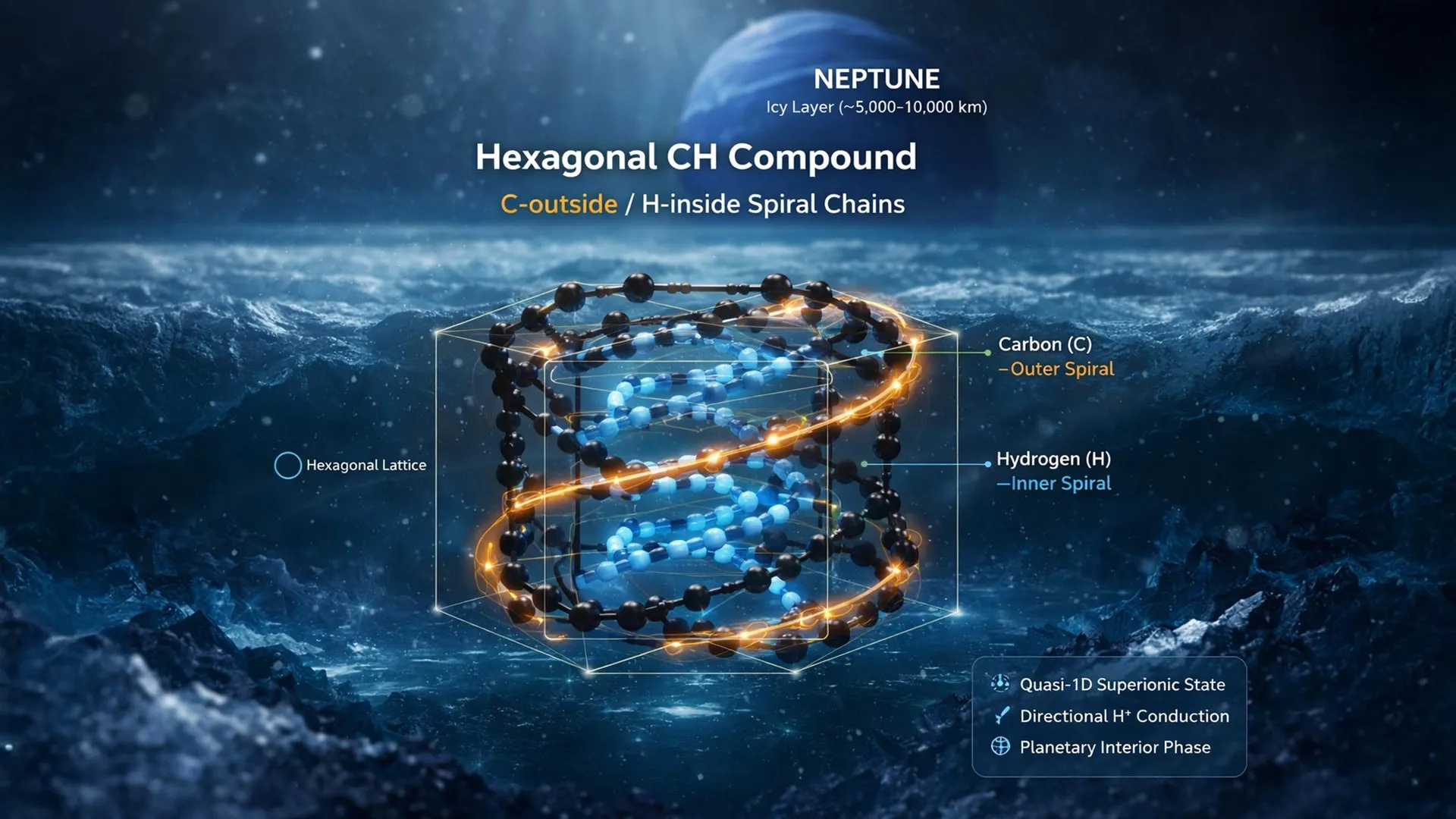
Deep within the pressurized interiors of Uranus and Neptune, the familiar boundaries between phases of matter appear to dissolve. According to new advanced simulations, the intense heat and crushing gravitational forces of these "ice giants" may forge a bizarre hybrid state of matter that is neither entirely solid nor purely liquid.
In this "superionic" phase, carbon and hydrogen behave with a strange, coordinated autonomy. While carbon atoms lock into a rigid, crystalline framework, hydrogen atoms remain mobile, spiraling through the solid lattice like a fluid. This structural duality creates a material that possesses the structural integrity of a solid but the transport properties of a liquid, a phenomenon that challenges conventional planetary models.
The discovery offers a potential solution to one of the more enduring mysteries of the outer solar system: the erratic and asymmetrical magnetic fields of Uranus and Neptune. If this superionic matter exists at scale, its unique ability to conduct electricity and heat would fundamentally alter how energy moves through a planet’s core. Understanding these internal dynamics is a prerequisite for mapping the evolution of our solar system—and for identifying the compositions of similar worlds orbiting distant stars.
With reporting from Science Daily.
Source · Science Daily