Fully rapid reusability is not an incremental improvement over existing rocket technology — it is a categorical break from every operational launch system in history. SpaceX's Starship program, now entering what the company frames as a third-generation configuration, is the only active effort to make a vehicle the size of a Saturn V fly, land, and fly again on a turnaround measured in hours rather than months. Whether that is achievable at scale remains genuinely open.
What "New" Actually Means in Rocketry
The language of "new ship, new booster, new engines, new pad" is easy to dismiss as marketing cadence. In rocketry, it carries weight. Each Starship iteration since the first integrated flight attempt in April 2023 has incorporated substantive hardware changes — the Raptor 3 engine, for instance, represents a significant reduction in part count and external plumbing compared to Raptor 2, which itself was a departure from the original Raptor flown on early Starbase prototypes. Engine simplification is not cosmetic; it directly determines how quickly a vehicle can be inspected, serviced, and returned to the pad.
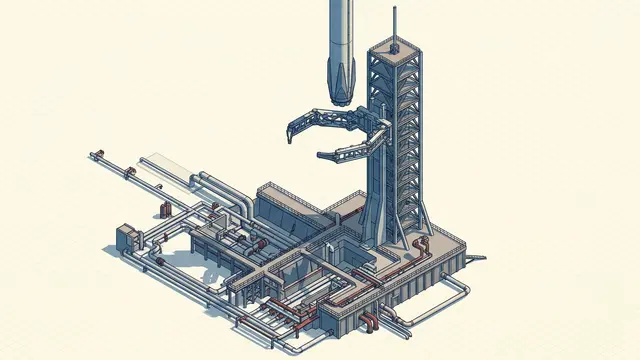
The new launch infrastructure at Starbase in Boca Chica, Texas, is equally consequential. The mechazilla catch system — which debuted operationally in October 2024 when the Super Heavy booster was caught mid-air by the launch tower arms — eliminates the need for booster landing legs and the ground infrastructure to support them. That is a mass and complexity reduction that compounds across every flight. Compare this to the Space Shuttle, where each orbiter required roughly 40,000 person-hours of refurbishment between flights, a burden that made "reusability" largely theoretical as a cost-reduction strategy.
The new test site framing suggests SpaceX is also expanding its flight test cadence beyond what a single pad at Boca Chica could support — a necessary condition if the program is to move from demonstration to operational tempo.
The Engineering Problem That Doesn't Have a Precedent
Rapid reusability at Starship's scale — a two-stage vehicle standing roughly 123 meters tall and producing over 16 million pounds of thrust at liftoff — has no historical analogue to draw confidence from. The closest comparison is Falcon 9, where SpaceX achieved booster reuse with turnarounds as short as 21 days and, in some cases, reflew the same booster over 20 times. But Falcon 9's first stage is a fraction of Super Heavy's complexity, and the upper stage is expendable. Starship requires both stages to be recovered and rapidly reflown.
The thermal protection system on the Ship remains one of the least-resolved subsystems. Reentry heating at orbital velocities is orders of magnitude more severe than what Falcon 9 boosters experience during their subsonic return burns. The hexagonal heat shield tiles — ceramic, individually bonded — have shown vulnerability to loss during reentry in earlier flights. Each lost tile is a potential failure cascade. SpaceX's iterative approach, flying vehicles that are not yet fully mature and learning from destruction, is philosophically sound but operationally expensive.
The "Test Like You Fly" framing signals something important about methodology: SpaceX explicitly rejects the traditional aerospace model of exhaustive ground testing before flight. The vehicle is the test article. This compresses development timelines but transfers risk to the flight environment, where failures are visible and consequential.
What remains unresolved is the gap between demonstration and doctrine. SpaceX can show that Starship flies and lands. It has not yet shown that it can do so on a schedule that makes the economics of Mars colonization or point-to-point Earth transport coherent. That proof will not come from a single flight series — it will come from the maintenance logs.
Source · The Frontier | Space