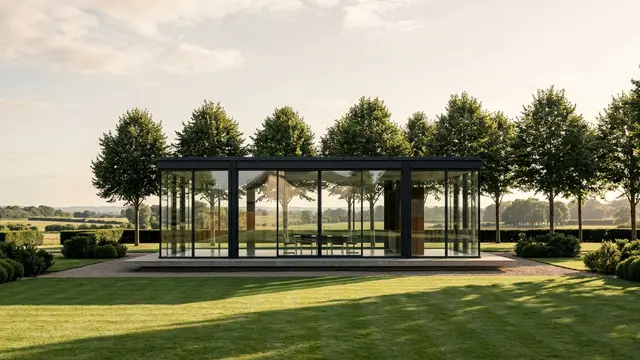
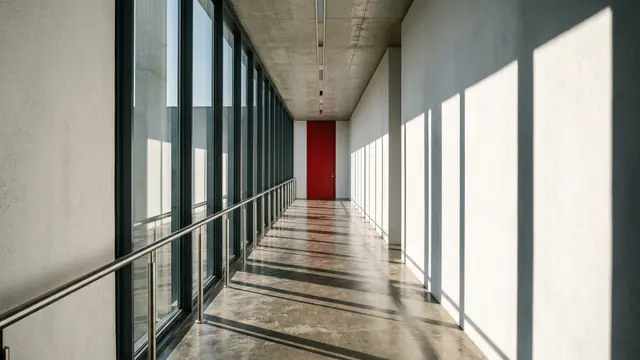
The ultimate test of architectural ego is the demand for total invisibility. When David Chipperfield Architects took on the refurbishment of Berlin’s Neue Nationalgalerie, the mandate was not to create, but to resurrect. Completed in 1968, the steel-and-glass temple was Ludwig Mies van der Rohe’s final masterwork and his sole European building after emigrating to the United States. Half a century of intense use and exposure left the monumental structure severely compromised, suffering from structural fatigue, failing glass, and outdated climate control. The intervention required a surgical dismantling of the building's fabric—a process of extreme preservation where success is measured by the absolute absence of the architect's hand. It is a profound inversion of contemporary architectural practice: an exercise in radical deference to a twentieth-century icon.
The Paradox of Modernizing Modernism
Preserving a modernist structure presents a unique philosophical trap. Unlike nineteenth-century masonry, which ages gracefully into a state of romantic ruin, the mid-century aesthetic relies on an illusion of absolute precision and weightlessness. When the Neue Nationalgalerie opened in the Kulturforum, its vast, unsupported roof and transparent perimeter redefined the spatial possibilities of the museum. Yet, the very technologies that enabled this transparency were fundamentally flawed. The original massive glass panes acted as thermal bridges, causing condensation to pool on the floor during Berlin’s harsh winters, while the building's environmental systems were entirely inadequate for contemporary museum standards.
Addressing these deficits without destroying the building’s soul required an almost forensic methodology. Chipperfield’s team dismantled over 35,000 original components—from the granite paving stones to the intricate steel grilles and the expansive lighting fixtures. Each piece was carefully cataloged, painstakingly restored off-site, and eventually returned to its exact original position within the structural grid.
This approach stands in stark contrast to Chipperfield’s celebrated restoration of Berlin’s Neues Museum, where the scars of World War II were left visible as a historical record. At the Neue Nationalgalerie, history demanded the exact opposite: the total erasure of time to reinstate Mies’s original, uncompromising vision of universal space.
Invisible Interventions and Institutional Memory
The most contentious aspect of the refurbishment centered on the building's defining feature: its glass envelope. The original glazing, a triumph of 1960s manufacturing, could not meet modern thermal or security requirements. Replacing it involved sourcing new glass capable of matching Mies’s original specifications without introducing new, disruptive mullions. The new glass maintains the visual permeability that connects the museum’s interior to the surrounding urban fabric, preserving the crucial dialogue between the art and the city.
This obsessive attention to material fidelity extends to the museum's lower level, which houses the permanent collection of twentieth-century art. Here, the spatial logic is denser, a strict grid of concrete and wood that contrasts with the airy pavilion above. The restoration of the original modular partitions and the careful replication of the original carpet and wood veneers re-establish the precise phenomenological experience of 1968. It is a rejection of the contemporary impulse to update exhibition spaces for the digital age.
Chipperfield’s methodology here redefines the parameters of architectural stewardship. The project operates as a live critique of the starchitect era, proving that the highest form of architectural intelligence is sometimes the refusal to leave a signature. "As much Mies as possible," became the guiding mantra, a self-effacing philosophy that prioritizes institutional memory over individual expression.
The reopening of the Neue Nationalgalerie is more than the salvage of a decaying monument; it is a masterclass in architectural restraint. By subordinating their own design vocabulary to that of Mies van der Rohe, Chipperfield Architects have secured the future of a modernist masterpiece without compromising its historical integrity. It proves that the preservation of twentieth-century architecture requires not just technical innovation, but a profound psychological discipline. The building survives not as a relic of 1968, but as a fully functioning machine for art, completely indistinguishable from its own legend.
Source · The Frontier | Art