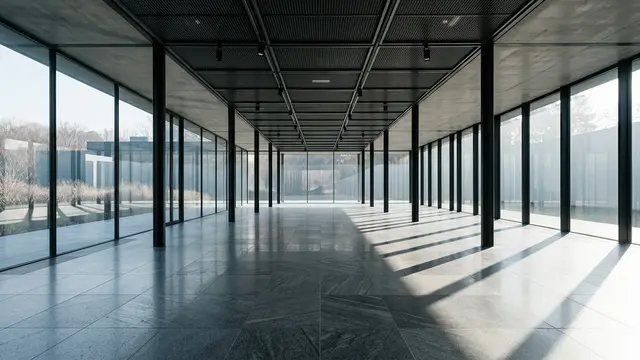
Philip Johnson’s Glass House did not merely introduce modernism to the American landscape; it weaponized transparency. Completed in 1949, the structure stripped away the foundational promise of domestic architecture—privacy—in favor of absolute exposure. By eliminating interior walls and relying entirely on glass panels framed by steel, Johnson forced the occupant into a continuous, inescapable dialogue with the surrounding environment.
The Illusion of Boundlessness
The genius of the Glass House lies in its deception. While the structure appears weightless and entirely open, it is a highly controlled viewing mechanism. The 50-acre property in New Canaan, Connecticut, serves as a curated diorama rather than untamed wilderness. The architecture dictates how nature is consumed, turning the landscape into a static mural viewed from a glass pavilion. This dynamic is sharply counterbalanced by the adjacent Brick House, a solid, enclosed structure that provides the psychological retreat the glass pavilion explicitly denies.
A Monument to Curated Living
Beyond its residential function, the estate operates as a sprawling gallery of spatial experiments. The inclusion of a dedicated Painting Gallery, housing works by Frank Stella and Andy Warhol, underscores the property’s true purpose: it is less a home than an exhibition space for Johnson’s aesthetic ideology. The architecture demands a performative existence from its inhabitants, where every object and movement is placed on display.
The Glass House endures not because it is a practical model for living, but because it remains a radical statement of intent. It challenges the assumption that a home must be a sanctuary from the outside world. As modern architecture continues to grapple with the tension between integration and isolation, Johnson’s transparent box remains a definitive, unresolved provocation.
Source · The Frontier | Architecture