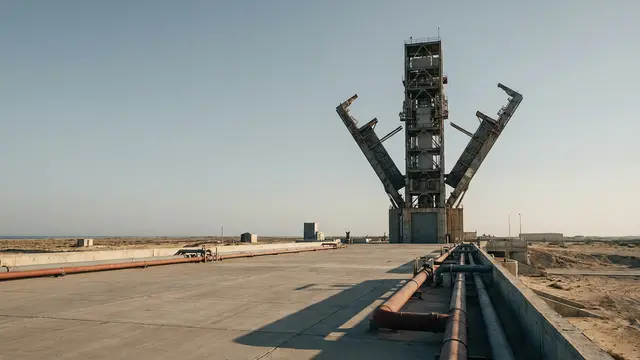
The recovery of a super-heavy class booster using mechanical infrastructure on the launch pad represents a structural shift in aerospace economics. Historically, rockets were expendable munitions; even the Space Shuttle required months of refurbishment. By shifting the complexity of recovery from the vehicle to the ground infrastructure—specifically the launch tower's mechanical arms—SpaceX has effectively stripped mass from the rocket to increase payload capacity. This is not merely a technical milestone. It is the commoditization of orbital access, turning a bespoke manufacturing process into a logistical operation akin to commercial aviation turnaround.
Shifting Complexity to the Ground
The Apollo era's Saturn V relied on brute force and disposability, discarding millions of dollars of hardware into the ocean with every launch. The Space Shuttle attempted reusability but failed economically due to the immense complexity housed within the orbiter itself. Every thermal tile and hydraulic system required microscopic inspection. SpaceX’s Falcon 9 introduced propulsive landing, but it still required landing legs—dead weight that serves no purpose during ascent. The recent Starship architecture removes this penalty entirely, fundamentally altering the mass fraction equation.
By utilizing the 469-foot "Mechazilla" launch tower at Starbase in Boca Chica, Texas, engineers relocated the recovery hardware from the vehicle to the launch pad. The Super Heavy booster, standing 232 feet tall, hovers and is caught by mechanical "chopsticks." This architectural decision saves tons of mass. In orbital mechanics, every kilogram shed from the vehicle translates directly to payload capacity, creating a compounding economic advantage that legacy systems cannot match.
The economic leverage here is profound. Ground infrastructure, unlike flight hardware, is not subject to the extreme acoustic and thermal environments of ascent. It can be built heavier, more robustly, and maintained without the stringent aerospace tolerances required for flight, dramatically lowering the cost of operations.
The End of Bespoke Aerospace
The broader industry remains anchored to a different paradigm. NASA’s Space Launch System (SLS), which powers the Artemis program, operates on a traditional expendable model. At an estimated cost of over $2 billion per launch, the SLS treats each mission as a unique, handcrafted event. In contrast, the Starship program treats the rocket as a high-volume manufacturing output, heavily informed by automotive supply chains and iterative testing.
This shift mirrors the transition from mainframe computing to cloud architecture. Just as data centers centralized computing power to make individual terminals lighter and cheaper, SpaceX is centralizing recovery infrastructure to make the rockets themselves simpler and more rapidly deployable. The launch tower becomes the data center; the rocket, a mere packet of data moving to orbit.
The implications extend beyond launch costs. If turnaround times can be reduced from months to days, or even hours, the bottleneck of space exploration ceases to be the availability of vehicles. Instead, the constraint shifts to payload generation—whether the global market can produce satellites, habitats, and scientific instruments fast enough to fill the available cargo volume.
Ultimately, the spectacle of a rocket hovering into a mechanical embrace obscures the real achievement: the standardization of orbital logistics. The aerospace industry must now contend with an environment where launch capacity outstrips demand. The unresolved question is no longer whether rapid reusability is physically possible, but how global supply chains will adapt to an era where Earth orbit is as accessible as a commercial shipping lane.
Source · The Frontier | Space