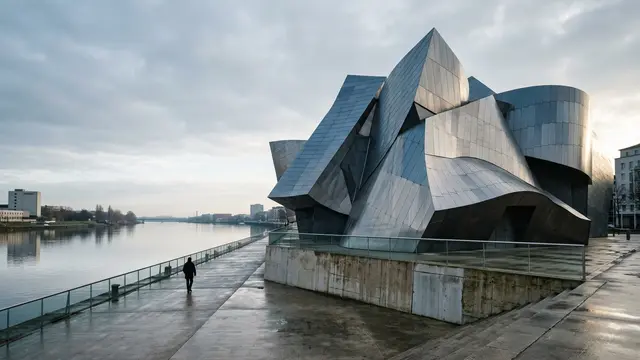
Zaha Hadid did not simply design buildings; she dismantled the Cartesian grid that had governed architecture since the Renaissance. Before her structures materialized in concrete and steel, they existed as explosive, fragmented paintings. Influenced heavily by Kazimir Malevich and the Russian Suprematists of the early 20th century, Hadid used abstract art not as mere representation, but as a generative tool to fracture space. Her early career was defined by these theoretical canvases—most notably the proposal for The Peak in Hong Kong (1983)—which many dismissed as unbuildable. Yet, this visual logic laid the groundwork for a radical shift in architectural production, proving that gravity-defying, non-linear forms could transition from the canvas to the physical metropolis. She forced the built environment to catch up to her imagination.
The Suprematist Foundation
To understand Hadid’s spatial vocabulary, one must look backward to the 1910s, when Malevich declared the supremacy of pure feeling in creative art. Hadid adopted this Suprematist rejection of conventional perspective. While her contemporaries in the 1980s were mired in the historical pastiche of Postmodernism—gluing classical columns onto corporate facades—Hadid was painting shattered isometric projections. Her graduation project at the Architectural Association in London (1977), titled Malevich's Tektonik, proposed a hotel on the Hungerford Bridge that looked like a Suprematist composition colliding with the Thames.
This reliance on painting was a calculated mechanism to bypass the limitations of standard architectural drafting. Traditional plans and sections force the designer into orthogonal thinking, locking buildings into rigid, box-like geometries. By contrast, Hadid’s paintings introduced multiple, simultaneous vantage points, warping topographies and suspending mass in a state of apparent weightlessness. When she won the competition for the Vitra Fire Station in Weil am Rhein (completed in 1993), it was a direct translation of this painted kinetic energy into sharp, intersecting planes of raw concrete. The building did not sit on the landscape; it seemed to slice through it, proving that her abstract geometric collisions were structurally viable.
From Canvas to Computation
The transition from angular, aggressive planes to the fluid, sweeping curves of her later career was driven by the advent of parametric modeling. If abstract painting liberated Hadid from the right angle, computational design allowed her to execute complex topologies at an unprecedented scale. Projects like the Heydar Aliyev Center in Baku (2012) abandoned the sharp shards of the Vitra Fire Station for a continuous, folding skin that blurs the distinction between roof, wall, and floor. This evolution mirrors a broader industrial shift: the software initially developed for aerospace engineering became the very medium through which modern architecture is now realized.
Yet, unlike the generation of digital architects who followed her, Hadid’s computational forms were always anchored in her original artistic logic. The software did not generate the aesthetic; it merely provided the mathematical scaffolding to construct it. Compare her work to the rigid functionalism of the International Style—where form strictly followed function, as seen in Mies van der Rohe’s Seagram Building (1958). Hadid inverted this paradigm. She demanded that engineering bend to the will of dynamic form. Her legacy is not just a catalog of iconic structures, but a fundamental rewriting of the sequence in which architecture is conceived, visualizing the impossible before figuring out how to build it.
The architectural discipline is still processing the full implications of Hadid’s methodology. Her trajectory from theoretical painter to the architect of monumental civic structures demonstrates that radical formal experimentation is not antithetical to built reality. However, the reliance on highly complex, bespoke engineering raises ongoing questions about the ecological and economic costs of such singular visions. Hadid proved that architecture could break free from the grid; the challenge for the next generation is determining how to apply that freedom within the increasingly strict constraints of a warming, resource-scarce world.
Source · The Frontier | Architecture