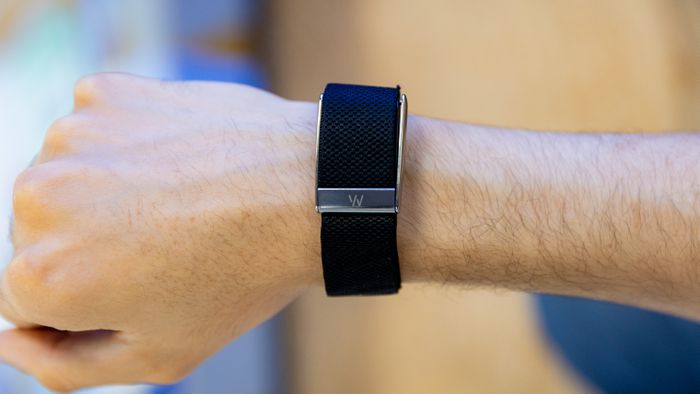
In a market saturated with luminous screens and incessant wrist notifications, the Whoop MG emerges as a radical counterpoint. The device foregoes any visual interface to concentrate exclusively on the collection and interpretation of biometric data. Its proposition is not to offer a smartwatch, but rather a silent personal laboratory that continuously monitors the body — demanding a paradigm shift from the user: from the immediacy of notifications to the profundity of analysis.
The latest entry in Whoop's product line, the MG sits at the intersection of two trends reshaping consumer health technology. The first is the maturation of biometric sensors small enough to be worn continuously without discomfort. The second is a growing skepticism, among serious athletes and health-conscious consumers alike, toward the attention economy that most wearables have imported wholesale from the smartphone.
Functional minimalism as a design thesis
The wearable's distinction lies not in its hardware sophistication, but in the intelligence of its ecosystem. By eliminating distractions, the Whoop MG focuses on what it terms "intelligence about one's own body." The accompanying application processes variables related to exertion, sleep, and recovery to provide diagnoses concerning an individual's physiological readiness. This approach replaces step counting with metrics of strain and fatigue, enabling users to decide, based on empirical data, whether to intensify their training or prioritize rest.
The design philosophy has precedent. Since Whoop first appeared as a strap marketed to elite athletes, the company has consistently refused to add a screen — a decision that looked eccentric when Apple, Garmin, and Samsung were competing on display brightness and widget density. Over successive product generations, that refusal hardened into a brand identity: the absence of a screen is not a limitation to be apologized for but a thesis about what a health device should do. The MG represents the most refined articulation of that thesis to date.
Stripping away the screen also strips away a category of engagement that most tech companies treat as sacred: glanceable interaction. Where a conventional smartwatch invites dozens of micro-check-ins per day — time, steps, heart rate, message previews — the Whoop MG routes all insight through a dedicated mobile application. The tradeoff is deliberate. Users lose the convenience of a quick wrist glance but gain, at least in theory, a deeper relationship with their data, one mediated by charts and longitudinal trends rather than momentary numbers.
The quiet wearable in a noisy category
This "silent" relationship with technology alters daily perception. Without the need for constant hardware interaction, users observe the effects of their habits more passively and, paradoxically, more consciously. The Whoop MG does not seek to compete for user attention; instead, it aims to be an invisible layer of data that informs long-term health and performance decisions.
The broader wearable industry is watching this space with interest. As health-tracking devices move from novelty gadgets toward something closer to medical-adjacent tools, the question of interface design becomes more consequential. A screenless device that prioritizes recovery analytics over notification delivery occupies a fundamentally different product category than a smartwatch — even if both sit on the same wrist. The distinction matters for how consumers interpret the data they receive and, ultimately, for whether that data changes behavior.
There is a tension worth noting. Whoop's model has historically relied on subscription revenue tied to its software platform, making the app experience not merely complementary but essential to the product's value proposition. A screenless wearable without a compelling software layer is just a bracelet. The MG's success, then, depends less on the elegance of its hardware minimalism and more on whether its analytical engine can deliver insights that justify sustained engagement — and sustained payment.
The wearable market continues to bifurcate. On one side, devices that aspire to replace the smartphone for ever more tasks. On the other, devices that aspire to disappear entirely, surfacing only when their data demands attention. The Whoop MG sits firmly in the second camp. Whether that camp grows large enough to reshape industry assumptions or remains a niche for the performance-obsessed is a question the next product cycle will begin to answer.
With reporting from Canaltech.
Source · Canaltech