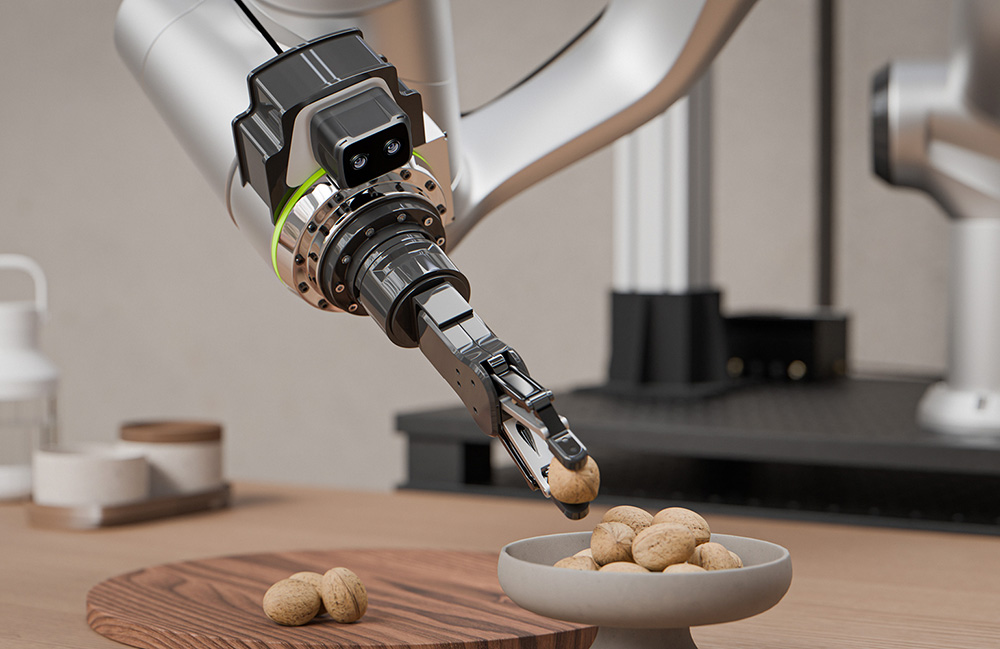
The development of "Physical AI" — the ability of machines to interact with the physical world with human-like nuance — has long been constrained by a sensory lag. For a robotic arm to perform delicate manipulation or learn through imitation, it requires vision that is not only high-resolution but also immediate. Ouster's new Stereolabs ZED X Nano, a compact wrist-mounted stereo camera, is designed specifically to bridge this gap between perception and action.
Traditional vision systems in robotics often rely on legacy USB connections and CPU-mediated pipelines, which introduce latency and limit resolution to 720p. These technical hurdles create a bottleneck for imitation learning and reinforcement learning alike, where every millisecond of delay complicates the machine's ability to map visual input to motor output. By shrinking the camera's height by 40 percent compared to previous industrial solutions, Ouster has enabled the ZED X Nano to sit directly on the robotic wrist or end-of-arm tooling without compromising the machine's range of motion.
Why Wrist-Mounted Vision Matters
The placement of cameras in robotic systems is not a trivial design choice. For decades, industrial robots relied on fixed overhead or peripheral cameras to guide manipulation tasks. That architecture works well enough for repetitive pick-and-place operations in structured environments, where the geometry of the workspace is known in advance. But it falters when tasks demand dexterity — when a robot must handle objects of varying shape, adjust grip force in real time, or learn new behaviors from human demonstration.
Wrist-mounted or eye-in-hand cameras address this by giving the robot a first-person perspective that tracks the end effector's relationship to the target object. The approach reduces occlusion, simplifies coordinate transformations, and — critically — shortens the feedback loop between what the robot sees and what it does. The challenge has always been hardware: cameras mounted at the wrist must be small enough not to interfere with the robot's kinematics, yet capable enough to deliver the frame rates and resolution that modern learning algorithms demand.
The ZED X Nano's 1920×1200 global shutter sensor represents a direct response to that tension. Global shutters capture the entire frame simultaneously rather than scanning line by line, which eliminates the motion artifacts that rolling shutters produce during fast arm movements. For data collection pipelines feeding imitation learning models — where a human operator demonstrates a task and the robot attempts to replicate the motion — clean, undistorted frames are not a luxury but a prerequisite.
The Broader Race for Robotic Perception at the Edge
Ouster's move sits within a wider industry shift. As robotic learning methods mature, the quality of training data has become as important as the architecture of the models themselves. The principle is straightforward: a learning algorithm is only as good as the sensory stream it trains on. Latent delays, low resolution, and compression artifacts all degrade the signal that maps human demonstration to robot policy. Hardware that minimizes these distortions at the point of capture — at the "edge," in Ouster CEO Angus Pacala's framing — reduces the need for costly post-processing and improves the fidelity of learned behaviors.
This logic mirrors developments across adjacent domains. In autonomous vehicles, the migration from centralized sensor fusion to distributed, high-bandwidth perception nodes has been underway for years. In warehouse robotics, companies have invested heavily in onboard compute and low-latency vision to enable robots to handle the unpredictable geometries of e-commerce fulfillment. The ZED X Nano applies the same principle to the manipulator arm: push perception closer to the task, reduce the pipeline between photon and decision, and let the learning algorithm work with richer data.
What remains to be seen is whether improved wrist-mounted hardware alone can unlock the dexterity gains that Physical AI proponents envision, or whether the binding constraint lies elsewhere — in sim-to-real transfer, in the scarcity of high-quality demonstration data, or in the fundamental difficulty of generalizing learned manipulation across novel objects and environments. The camera is one link in a long chain. Whether it proves to be the weakest link, or merely one of many that needed strengthening, will depend on what roboticists build on top of it.
With reporting from The Robot Report.
Source · The Robot Report