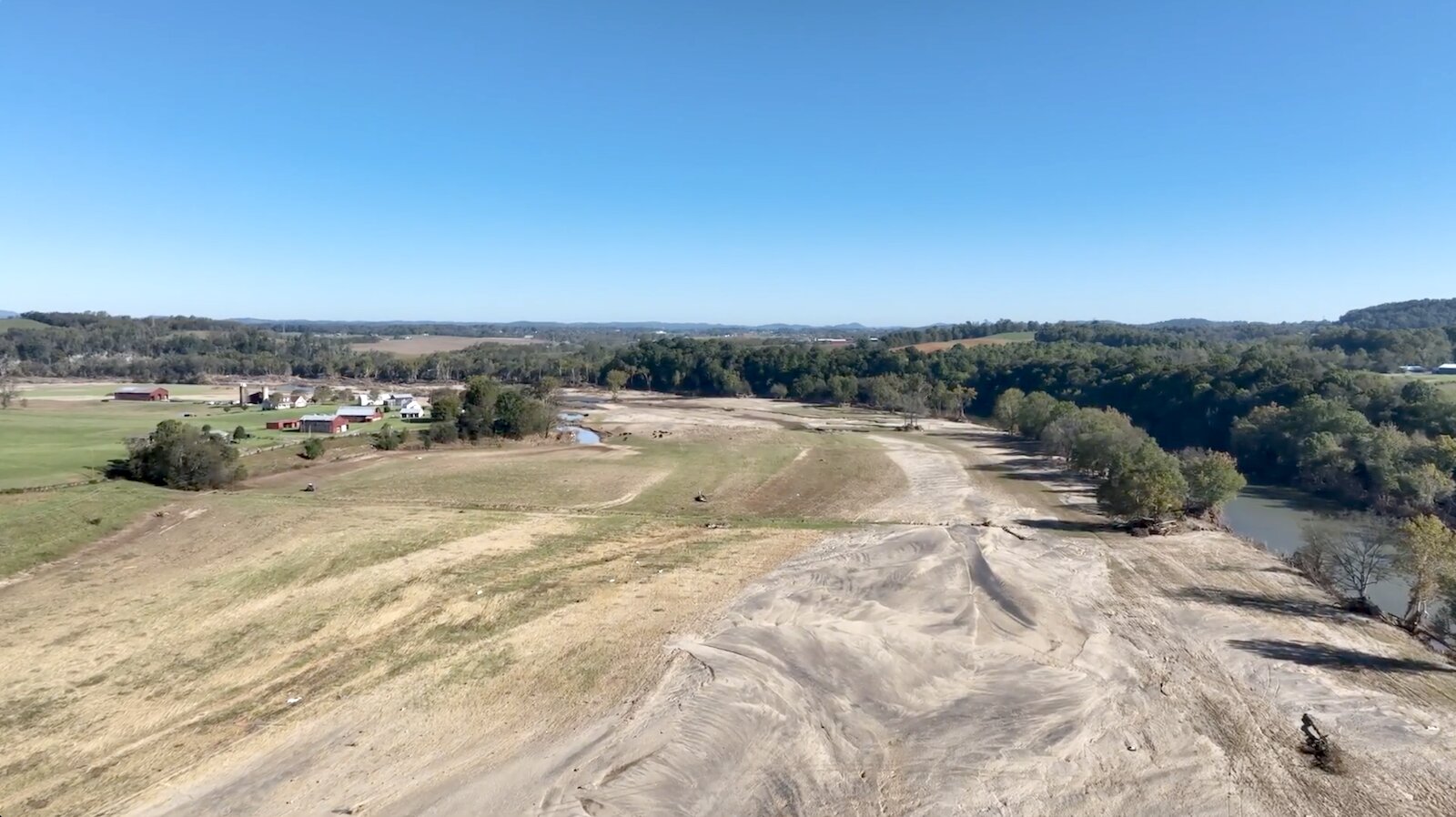
For Will Runion, the Nolichucky River was a predictable neighbor until the morning of September 27, 2024. Operating a 736-acre cattle and hay farm in northeast Tennessee, Runion was balancing the final hay cut of the season with plans for a new riverfront campground. But as Hurricane Helene moved inland, the river ignored its historical boundaries, swelling from its usual 120-foot width to a 1,200-foot expanse of brown water that consumed the landscape.
The transformation was both rapid and total. Within hours, farm equipment and a small white house intended for the campground office were swept away. The river became a conveyor belt for the debris of the Appalachian highlands: snapped trees, neighbors' barns, and household remnants swirled through what had been productive hay fields. When the water finally receded, it left behind a graveyard of dead fish and upstream produce, coating a third of Runion's land in a thick layer of sediment and waste.
The Geology of Loss
The immediate destruction of machinery and structures is quantifiable and, in principle, insurable. The deeper threat to the farm's viability lies underground. Topsoil — the uppermost layer of earth, typically six to twelve inches deep, where organic matter, microbial life, and nutrients concentrate — is the foundation of productive agriculture. It forms at geological pace: under favorable conditions, a single inch may take several hundred years to develop through the slow interplay of decomposing plant matter, weathering rock, and biological activity.
Floods of the magnitude Helene produced do not merely deposit silt. They scour. Fast-moving water strips away the organic-rich upper layer and replaces it with coarse sediment carried from upstream — material that may be mineral-heavy but biologically inert. What remains after the water retreats is land that looks like farmland but behaves more like a construction site. Compaction from heavy sediment loads further degrades soil structure, reducing the porosity that allows roots to penetrate and water to drain.
Appalachian agriculture has always contended with thin, sloping soils prone to erosion. The region's farms tend to occupy narrow river valleys precisely because those bottomlands accumulated the richest deposits over millennia of gentle, seasonal flooding. A catastrophic flood inverts the equation: the same hydrological forces that built fertile bottomland can, in a single event, redistribute or destroy it. The distinction between a nourishing seasonal flood and a destructive one is largely a matter of velocity and volume — and Helene delivered both in excess.
A Recovery Measured in Seasons, Not Months
For farmers facing stripped or buried fields, the restoration process is neither quick nor straightforward. Rebuilding soil fertility typically involves repeated applications of organic amendments — compost, cover crops, manure — over multiple growing seasons. Cover crops such as clover or rye help reintroduce root networks that bind loose sediment and channel microbial life back into depleted ground. Each cycle adds a thin increment of organic matter, gradually coaxing the land back toward productivity.
The challenge is compounded by economics. Farmers who have lost equipment, structures, and an entire season's output face the cost of soil restoration without the revenue that functioning land would generate. Federal disaster assistance programs exist, but they are generally designed around crop loss and structural damage — categories that fit poorly with the slow, invisible degradation of soil health. A barn can be rebuilt in months; a living soil system cannot.
The Nolichucky Valley is not unique in facing this bind. Across the southeastern United States, intensifying hurricane seasons have pushed inland flooding into areas historically considered low-risk, exposing agricultural communities to damage patterns more commonly associated with coastal zones. The underlying tension is structural: climate-driven precipitation extremes are accelerating, while the soil systems that sustain rural economies operate on timescales that admit no acceleration.
Runion's farm sits at the intersection of those two timescales. The river has returned to its banks. The debris has been cleared, or is being cleared. But the land beneath is altered in ways that will shape the farm's output for years. Whether Appalachian farmers can secure the sustained support and technical resources needed to rebuild what was lost — or whether the economics of marginal agriculture simply close the door — remains an open question, and one that extends well beyond a single valley in northeast Tennessee.
With reporting from Grist.
Source · Grist