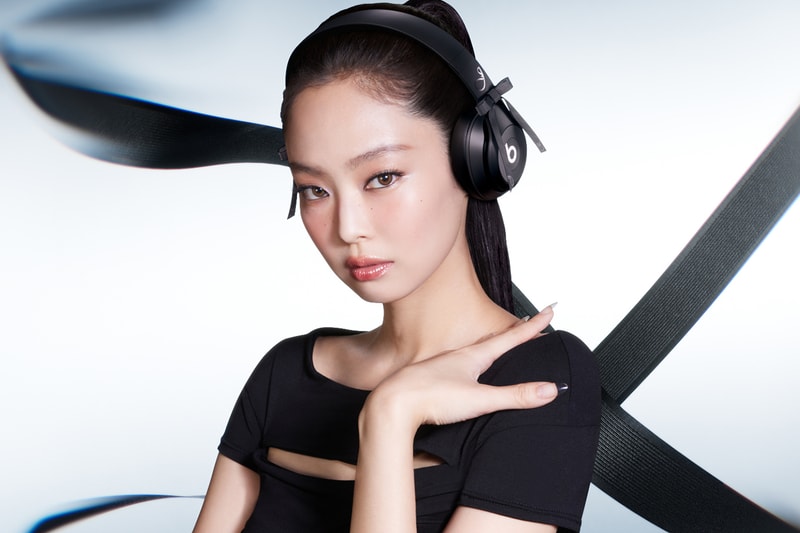
The partnership between Beats and JENNIE, the South Korean artist whose solo career has made her one of the most commercially potent figures in global pop, has produced its second collaborative product. The Beats Solo 4 "Onyx Black" Special Edition, priced at $199.99 and scheduled for global release on April 24, 2026, pairs monochromatic hardware with customizable design elements — attachable black bows and embossed symbols on the ear cushions — that position the headphones as much as a fashion object as an audio device. A campaign video accompanying the launch offers a first listen to unreleased music from the artist, folding product marketing into the cadence of a music rollout.
The previous Beats x JENNIE collaboration sold out in under 24 hours, a data point that frames the commercial logic of the sequel. The technical specifications of the Solo 4 remain unchanged from the standard model; the premium here is entirely aesthetic and cultural.
Hardware as Fashion Object
Beats has operated at the intersection of audio and personal style since its founding. The brand's original proposition — that headphones could be a visible marker of taste, not just a utility — predated the current wave of "wearable tech as fashion" by nearly a decade. Under Apple's ownership since 2014, that identity has been maintained even as the competitive landscape for wireless headphones has grown dense with technically superior alternatives. Beats has rarely competed on specification sheets alone. It competes on shelf presence, on cultural association, on the logic that what a product signals matters as much as what it delivers.
The "Onyx Black" edition extends that logic further than most Beats releases. The inclusion of attachable, swappable bows and custom-embossed cushions borrows from the language of fashion accessories — modularity, personalization, seasonal refreshment — rather than consumer electronics. It reflects a broader trend in which hardware companies have begun treating physical products the way fashion houses treat seasonal collections: the core silhouette stays fixed while surface treatments rotate to maintain novelty. Apple itself has practiced this with the Apple Watch, where band collaborations with Hermès and Nike serve a similar function of cultural segmentation within a standardized product line.
For JENNIE, the collaboration fits within a broader pattern of brand partnerships that position her not merely as an endorser but as a co-designer with creative input over materials and aesthetics. The framing of the product as reflecting her "personal evolution" is standard language in celebrity collaborations, but the specificity of the design choices — the monochromatic palette, the tactile customization — suggests a level of curation that goes beyond a name on a box.
The Drop as Cultural Event
Perhaps the more strategically notable element of the release is the decision to embed unreleased music within the product campaign. This collapses two distinct marketing cycles — a music rollout and a product launch — into a single event, creating a feedback loop in which fans engage with the hardware announcement to access the music and vice versa. The tactic is not entirely new; artists have bundled music with merchandise and brand partnerships for years. But the integration here is tighter, positioning the product video as a primary channel for new creative work rather than a secondary promotional vehicle.
For Apple, which acquired Beats in part to maintain a foothold in youth and culture-driven markets, limited-edition collaborations serve a function that extends beyond unit sales. They generate attention cycles in media ecosystems — streetwear blogs, K-pop fan communities, fashion aggregators — that Apple's own product marketing rarely penetrates directly. Each collaboration is, in effect, a cultural probe: a test of which audiences, aesthetics, and artists can extend the brand's relevance without diluting its core identity.
The tension worth watching is whether this model scales or whether it depends on scarcity to function. The previous sellout suggests demand outstripped supply, which is ideal for brand heat but less so for revenue. A broader production run risks diluting the exclusivity that makes these collaborations legible as fashion events in the first place. The question is not whether Beats can sell headphones with a celebrity's name attached — that much is established — but whether it can sustain a release cadence that keeps each drop feeling like an event rather than a routine.
With reporting from Hypebeast.
Source · Hypebeast