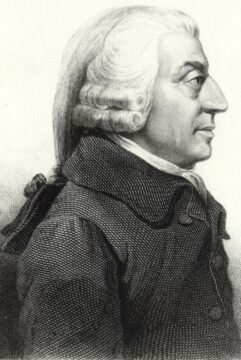
Adam Smith is frequently invoked as the architect of the modern free market, his legacy often reduced to the "invisible hand" and the cold calculations of self-interest. Yet Smith’s foundational economic theories were originally tethered to a deeply humanistic moral philosophy. Long before Milton Friedman wore neckties emblazoned with his image, Smith was preoccupied not with the "utility monster" of modern capitalism, but with the "moral sentiments" that allow individuals to coexist.
Drawing on the work of David Hume, Smith grappled with the "is-ought" problem—the logical chasm between descriptive facts and moral imperatives. Hume argued that one cannot derive a moral truth from a simple statement of fact; there is always a leap required to move from what *is* to what *ought* to be. For Smith, that bridge was built from sympathy, a natural, reflexive concern for the well-being of others that he believed was hardwired into the human experience.
This architecture of the mind suggests that responsibility is not merely a social contract or a survival strategy of the "selfish gene," but a product of our emotional capacity. While contemporary thought often looks toward virtue ethics—an Aristotelian revival focusing on the cultivation of character—Smith’s reliance on feeling as a moral anchor remains a provocative challenge. In an era increasingly defined by data and algorithmic efficiency, Smith reminds us that a sturdy moral system may require more than logic; it requires the messy, unquantifiable pull of human sympathy.
With reporting from 3 Quarks Daily.
Source · 3 Quarks Daily