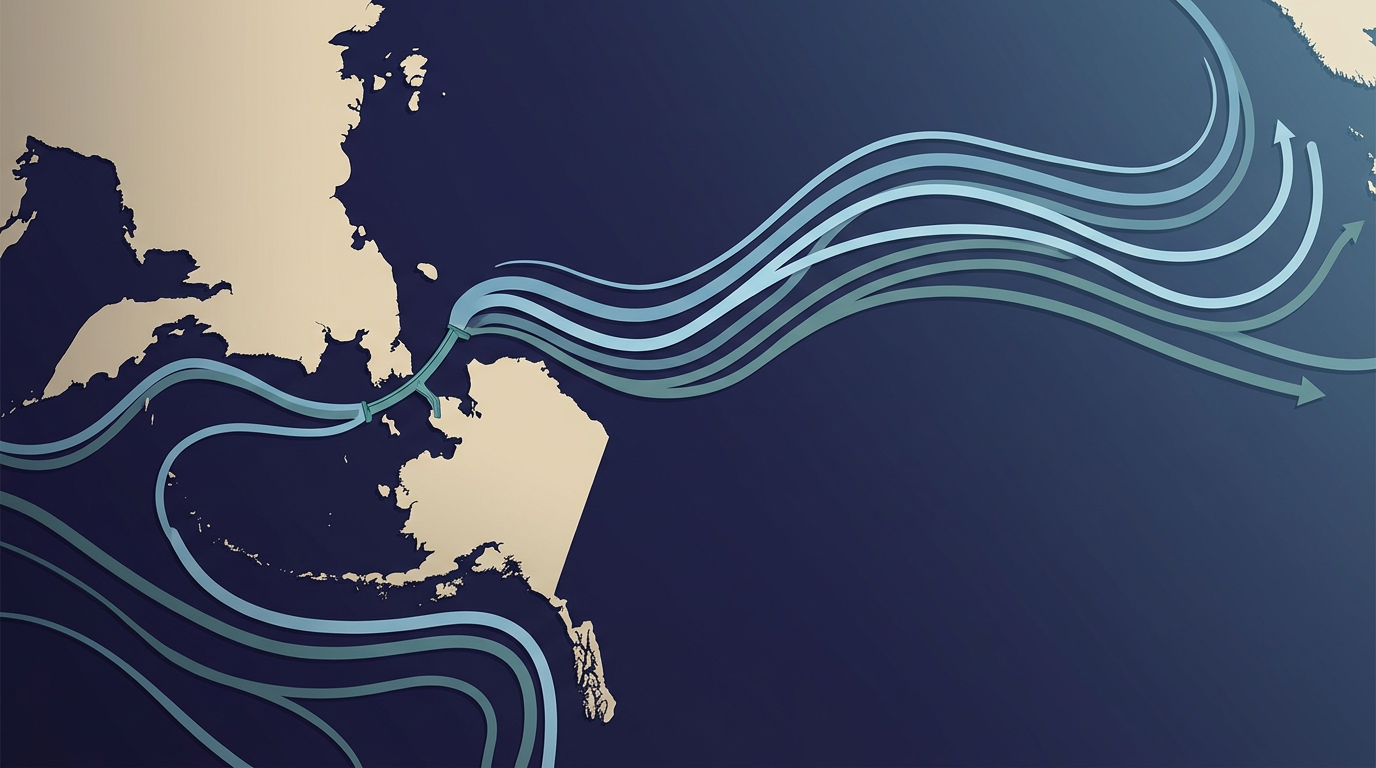
Scientists have put forward a striking proposal to address one of the most consequential risks of climate change: damming the Bering Strait, the narrow waterway separating Russia and Alaska, in order to stabilize the Atlantic Meridional Overturning Circulation, or AMOC. According to New York Times reporting, a new study found that blocking the strait could help shore up the vulnerable system of ocean currents that plays a critical role in regulating global climate.
The AMOC functions as a vast conveyor belt, carrying warm water northward through the Atlantic and returning cold, dense water southward at depth. Its potential weakening or collapse — a scenario that climate models have increasingly flagged as plausible under continued warming — could trigger dramatic shifts in weather patterns, sea levels, and ecosystems across the Northern Hemisphere and beyond. The Bering Strait proposal represents a new front in the growing debate over whether large-scale geoengineering interventions should be seriously considered as climate risks intensify.
Why the Bering Strait Matters for the AMOC
The connection between the Bering Strait and the AMOC may not be immediately intuitive. The strait, roughly 85 kilometers wide and only about 50 meters deep at its shallowest, allows relatively fresh Pacific water to flow into the Arctic Ocean. From there, this lower-salinity water can make its way into the North Atlantic, where it dilutes the dense, salty water whose sinking drives the AMOC's deep circulation. In essence, the Pacific inflow acts as a freshening agent — and freshwater is precisely what threatens to slow or shut down the overturning process as Arctic ice melts and precipitation patterns shift.
The study's logic is straightforward in principle: by damming the strait and cutting off this freshwater pathway, the salinity of the North Atlantic could be better preserved, helping maintain the density-driven sinking that keeps the AMOC running. The researchers found, through modeling, that such an intervention could meaningfully reduce the risk of AMOC weakening under various warming scenarios. Yet the gap between a modeled outcome and a feasible engineering project is vast — and the proposal immediately raises questions about ecological disruption, Arctic marine ecosystems, Indigenous communities on both sides of the strait, and the geopolitical reality of a structure that would require cooperation between the United States and Russia.
Geoengineering's Growing Shadow Over Climate Policy
The Bering Strait dam idea arrives at a moment when geoengineering proposals are moving from the margins of climate discourse toward its center. Solar radiation management, ocean iron fertilization, and marine cloud brightening have all attracted growing attention — and growing controversy — as the gap between emissions reduction pledges and actual decarbonization trajectories widens. What distinguishes the Bering Strait concept is its specificity: rather than attempting to modulate global temperatures or carbon concentrations, it targets a single, well-defined physical mechanism.
That specificity is both its appeal and its limitation. Even if the engineering were feasible, blocking a natural oceanic passage would carry cascading consequences for marine migration, nutrient flows, and Arctic water circulation that are difficult to model with precision. The strait is also a culturally and economically significant waterway for Indigenous peoples, including the Iñupiat and Yupik communities. And any serious discussion of construction would require navigating a geopolitical relationship between Washington and Moscow that has shown little capacity for large-scale cooperative ventures in recent years. The proposal, in other words, is less a blueprint than a provocation — a way of illustrating both the severity of the AMOC threat and the scale of intervention that might be required to address it.
As climate science continues to refine its understanding of AMOC vulnerability, proposals like the Bering Strait dam serve a dual function: they advance the technical conversation about what stabilization might require, while forcing a broader reckoning with the trade-offs inherent in planetary-scale intervention. Whether this particular idea gains traction or remains a thought experiment, the underlying tension it exposes — between the urgency of the risk and the complexity of the response — is unlikely to resolve anytime soon.
With reporting from The New York Times — Science
Source · The New York Times — Science