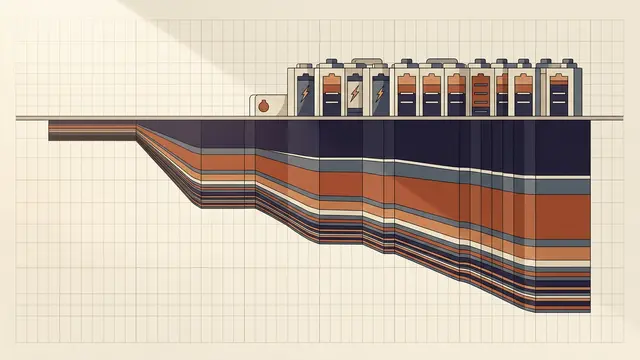
A study published in Nature Energy estimates that the cost of fusion power, even if the technology becomes viable, may decline far more slowly than solar panels, batteries, or wind turbines. According to MIT Technology Review reporting, the research places fusion's "experience rate" — the percentage by which costs fall each time installed capacity doubles — at between 2% and 8%, well below the 20% or more enjoyed by lithium-ion batteries and solar modules.
The finding lands at a moment when both public and private capital is flowing into fusion at scale. The United States allocated over $1 billion to fusion in the 2024 fiscal year, and private-sector funding totaled $2.2 billion between July 2024 and July 2025. The study's central implication is uncomfortable but important: the economic assumptions embedded in many modeling exercises — which often project experience rates of 8% to 20% — may be significantly too optimistic. If fusion's costs prove sticky, the technology's role in decarbonization portfolios could be far more limited than its advocates suggest.
The physics of cost curves
The researchers at ETH Zurich approached the problem by examining three characteristics that historically correlate with how quickly a technology gets cheaper: unit size, design complexity, and the degree of customization required for deployment. Fusion plants, like coal and fission facilities, generate electricity through heat, which tends to demand large physical footprints. They will likely require less customization than fission reactors — primarily because safety and regulatory frameworks should be simpler — but considerably more than modular technologies like solar panels.
Complexity, however, is where fusion stands apart. The study's lead author, Lingxi Tang, a PhD candidate at ETH Zurich, noted that experts surveyed for the research were nearly unanimous in rating fusion as extraordinarily complex, with some placing it beyond the scale provided. This trifecta — large unit size, high complexity, moderate customization — maps onto a sluggish cost trajectory. For comparison, nuclear fission's experience rate sits at roughly 2%, while onshore wind comes in at 12%. Fusion, the researchers conclude, will likely land somewhere between fission and wind — better than the worst-case precedent, but nowhere near the exponential cost drops that have made solar and batteries dominant forces in energy markets.
Investment logic under pressure
The study's implications extend well beyond engineering. If fusion's costs decline slowly, the sheer volume of deployment needed to bring prices down becomes daunting — and the timeline stretches accordingly. Electricity from fusion plants could remain expensive for decades after the first commercial reactors come online, a scenario that complicates the technology's value proposition against renewables and storage, which continue to get cheaper on well-established curves.
Tang's own conclusion is pointed: given the pace of decarbonization required, questions should be raised about whether current investment levels in fusion represent the best use of public money. That framing will be contested. Egemen Kolemen, a professor at the Princeton Plasma Physics Laboratory, cautioned against over-reliance on historical analogies, noting that analysts in 2000 widely predicted solar power would remain expensive — before China's manufacturing surge sent prices plummeting. The counterargument is that fusion has not yet produced a single commercial kilowatt-hour, making any cost projection inherently speculative. Regulations, geopolitics, and labor markets could all reshape the curve in ways no model can capture today. The study focused only on magnetic confinement and laser inertial confinement — the two approaches receiving the most funding — leaving open the possibility that alternative fusion architectures could follow different economic paths.
The tension at the heart of the fusion debate is not whether the physics can be made to work, but whether the economics will cooperate even if it does. Billions of dollars are being allocated on the assumption that fusion will eventually become competitive. If the experience rate turns out to be closer to 2% than to 20%, the gap between scientific achievement and commercial viability could persist for far longer than investors and policymakers currently anticipate. As deployment timelines and cost curves continue to be refined, the question of how much decarbonization capital should flow toward fusion — versus technologies already riding steep cost declines — remains genuinely open.
With reporting from MIT Technology Review
Source · MIT Technology Review