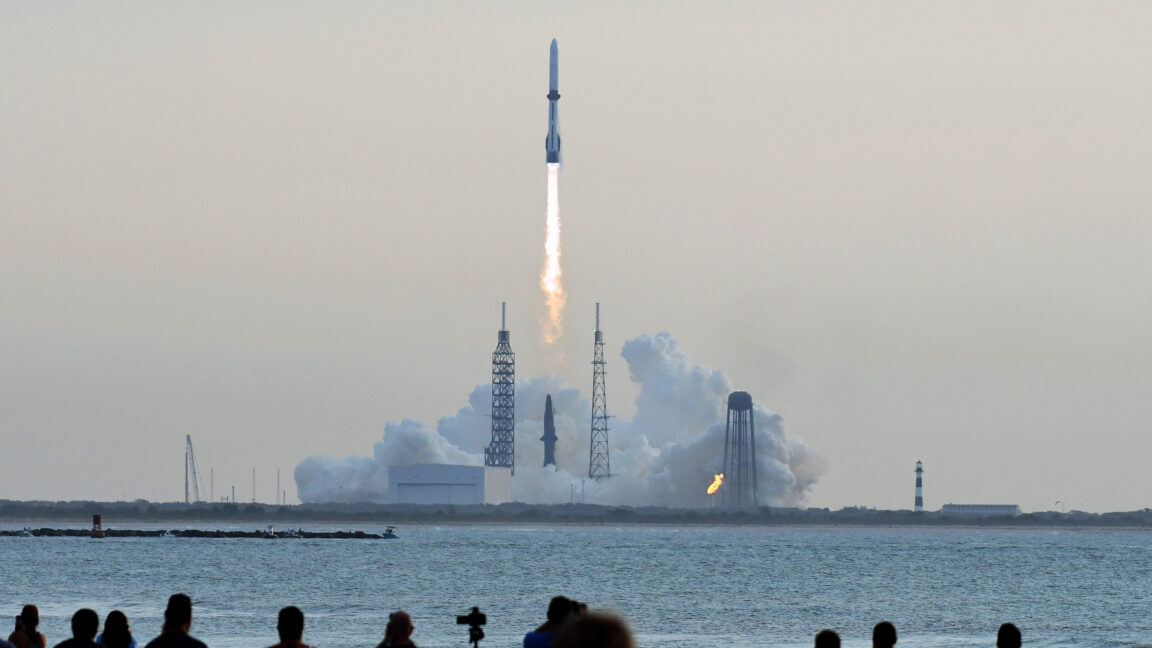
Sunday morning at Cape Canaveral marked a chapter simultaneously historic and frustrating for Blue Origin. The New Glenn, the 98-meter-tall launcher developed by Jeff Bezos's company, completed its third test flight, achieving for the first time the successful reuse of an orbital-class booster — a central pillar in the company's cost-reduction strategy. The milestone places Blue Origin alongside SpaceX as one of only two entities to have reflown an orbital-class first stage, a technical feat that took the broader launch industry decades to normalize.
Propelled by seven methane-fueled BE-4 engines, the booster performed its role with precision, separating from the rest of the vehicle approximately three minutes after launch and returning to a controlled landing. Yet the celebration was cut short. The upper stage, equipped with hydrogen-fueled BE-3U engines, failed to maintain the expected trajectory or stability, compromising the mission's outcome and preventing the payload from reaching its intended orbit.
A booster milestone shadowed by upper stage fragility
The significance of first-stage reuse for New Glenn is difficult to overstate. Reusability is the economic logic that underpins the entire heavy-lift launcher market as it has evolved over the past decade. SpaceX's Falcon 9 demonstrated that recovering and reflying boosters could dramatically lower per-launch costs, reshaping commercial and government procurement alike. Blue Origin's entry into that club — on only the rocket's third flight — suggests that the engineering fundamentals of New Glenn's first stage are sound.
But orbital launch vehicles are systems, not individual components. The upper stage is responsible for the most demanding phase of flight: circularizing the orbit, managing precise burns in vacuum, and delivering payloads to their target trajectories. An anomaly at that level negates whatever the booster achieves below it. The BE-3U engine, which burns liquid hydrogen and liquid oxygen, operates in a different thermal and mechanical regime from the methane-burning BE-4s on the first stage. Hydrogen stages are notoriously difficult to manage — the propellant's low density and cryogenic demands introduce complexity that methane architectures were partly designed to avoid. That Blue Origin chose hydrogen for the upper stage while using methane below reflects a set of engineering trade-offs that now faces renewed scrutiny.
The failure also raises questions about the maturation timeline for New Glenn as a whole. Three flights is a thin statistical base from which to draw reliability conclusions, and the upper stage has now underperformed on at least one of those attempts. For commercial satellite operators evaluating launch providers, the calculus involves not just price but demonstrated mission success rates — a metric where New Glenn still has ground to cover.
Artemis implications and the pressure of programmatic timelines
The stakes extend beyond the commercial market. New Glenn is a critical element in NASA's architecture for the Artemis lunar program, selected to carry components and logistics payloads that support crewed missions to the Moon. Programmatic timelines for Artemis are already under strain from multiple directions — delays in the Space Launch System, hardware readiness for the Human Landing System, and budget uncertainty on Capitol Hill. Adding a launch vehicle reliability question to that list compounds the challenge.
NASA's approach to Artemis has deliberately diversified its supplier base, partly to avoid single points of failure. But diversification only works if each provider can deliver on schedule and with confidence. An upper stage anomaly on a high-profile test flight does not disqualify New Glenn from future Artemis roles, though it does tighten the margin for error on subsequent missions. Blue Origin will need to demonstrate a clean upper stage performance before the program's confidence fully solidifies.
The broader pattern is familiar in aerospace: first-stage recovery tends to capture public attention, but upper stage reliability is what determines whether a rocket becomes operationally trusted. SpaceX encountered its own upper stage challenges in Falcon 9's early years before accumulating the flight heritage that made it the dominant Western launch provider. Blue Origin now faces a compressed version of that same learning curve, with contractual obligations and national exploration goals adding weight to each attempt.
What remains to be seen is whether the upper stage issue stems from a design limitation inherent to the BE-3U architecture or from a manufacturing or integration defect correctable between flights. The answer will shape not only New Glenn's commercial trajectory but also the timeline on which NASA can rely on it for missions where failure is not an administrative inconvenience but a programmatic setback.
With reporting from Ars Technica Space.
Source · Ars Technica Space