The Paradox of Artificial Gravity: Einstein's Physics Versus Space Engineering
The return of crewed missions beyond low Earth orbit has revived a problem that aerospace medicine has catalogued for decades but never resolved: the human body deteriorates in microgravity. Bone density declines, cardiovascular function weakens, and fluid redistribution inside the skull raises concerns about long-term neurological damage. For a transit to Mars lasting several months each way — plus surface time on a planet with roughly one-third of Earth's gravitational pull — the question of artificial gravity shifts from theoretical curiosity to operational prerequisite.
The physics, in principle, have been settled for more than a century. Albert Einstein's Equivalence Principle, a cornerstone of general relativity, establishes that the force felt inside an accelerating vehicle is indistinguishable from gravitational attraction. A spacecraft accelerating at 9.8 m/s² would reproduce the sensation of standing on Earth's surface. The elegance of this solution is matched only by the severity of the engineering constraints it imposes.
The fuel arithmetic that defeats constant acceleration
The core difficulty is propellant mass. Chemical rockets — the only human-rated propulsion systems with a flight heritage spanning decades — produce thrust by expelling reaction mass at high speed. To maintain continuous acceleration over an interplanetary trajectory, a vehicle would need to carry fuel quantities that dwarf the payload by orders of magnitude. The relationship is governed by the Tsiolkovsky rocket equation, which shows that the fuel requirement grows exponentially with the desired change in velocity. For a months-long burn at one g, the mass ratio becomes prohibitive under any chemical propulsion scheme currently in use.
Alternative propulsion concepts exist on paper and, in some cases, in early testing. Ion thrusters and Hall-effect engines achieve far higher exhaust velocities, meaning they extract more momentum per kilogram of propellant. Several robotic missions have employed these systems for deep-space maneuvers. Yet their thrust levels remain minuscule compared to what would be needed to accelerate a crewed habitat at anything close to Earth gravity. Nuclear thermal propulsion, which heats a propellant using a fission reactor, offers a middle path — higher thrust than electric engines, better efficiency than chemical rockets — but no crewed vehicle has ever flown with such a system, and the regulatory and safety hurdles are substantial.
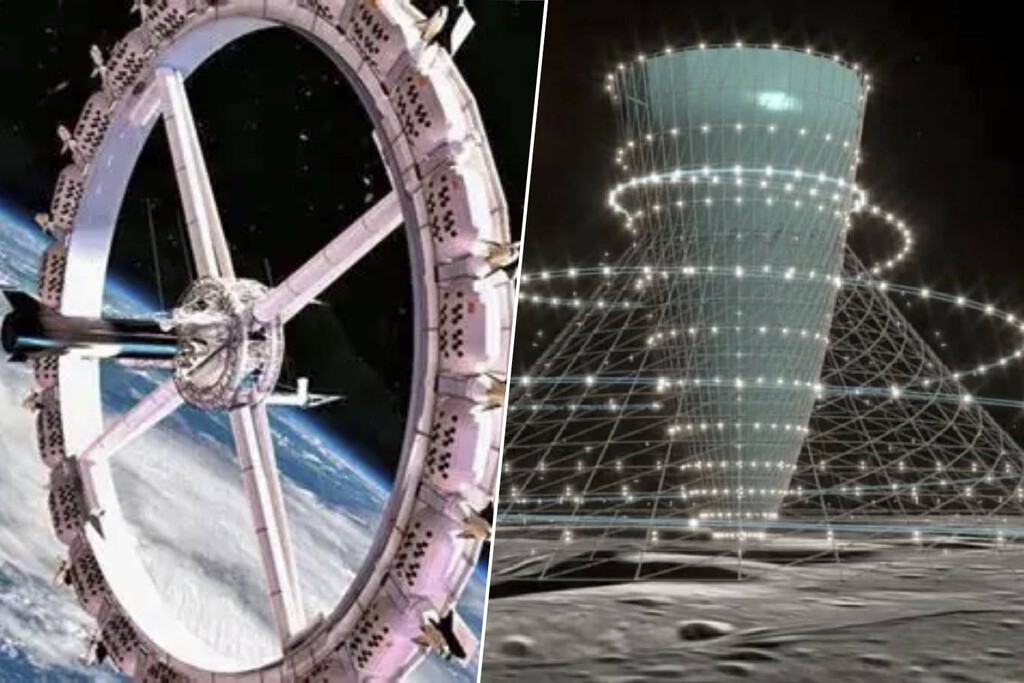
A different architectural approach sidesteps the fuel problem entirely: rotation. A spinning habitat generates centripetal acceleration along its interior walls, mimicking gravity without continuous propellant expenditure. The concept dates to early 20th-century spaceflight theory and has appeared in countless engineering studies since. The trade-offs, however, are nontrivial. To produce comfortable, Earth-like conditions without inducing motion sickness from Coriolis effects, the structure must rotate slowly, which in turn demands a large radius — on the order of tens or hundreds of meters. Building, launching, and assembling such a structure in orbit represents a materials and logistics challenge that no space agency has yet committed to at full scale.
Where physics waits for engineering to catch up
The situation illustrates a recurring pattern in spaceflight history: the governing science is well understood long before the enabling technology matures. Orbital mechanics were formalized centuries before rocketry could exploit them. Reentry heating was modeled analytically before ablative heat shields were manufactured. Artificial gravity sits at the same juncture — a solved equation awaiting a viable machine.
What makes the current moment distinct is the convergence of pressures. Biomedical data from the International Space Station continues to sharpen the picture of microgravity's toll on the human body, strengthening the case that some form of gravity substitution will be necessary for missions measured in years rather than months. At the same time, propulsion research is advancing along multiple fronts, from high-power solar electric systems to renewed interest in nuclear options. Neither track has yet produced a solution at the scale required.
The gap between Einstein's blueprint and a functioning artificial-gravity vehicle is not a gap in understanding. It is a gap in energy density, structural engineering, and institutional willingness to fund hardware that has no near-term commercial return. Whether that gap narrows through incremental propulsion gains, rotating habitat demonstrators, or some combination of both remains an open question — one whose answer will shape the timeline and feasibility of any sustained human presence beyond Earth.
With reporting from Xataka.
Source · Xataka