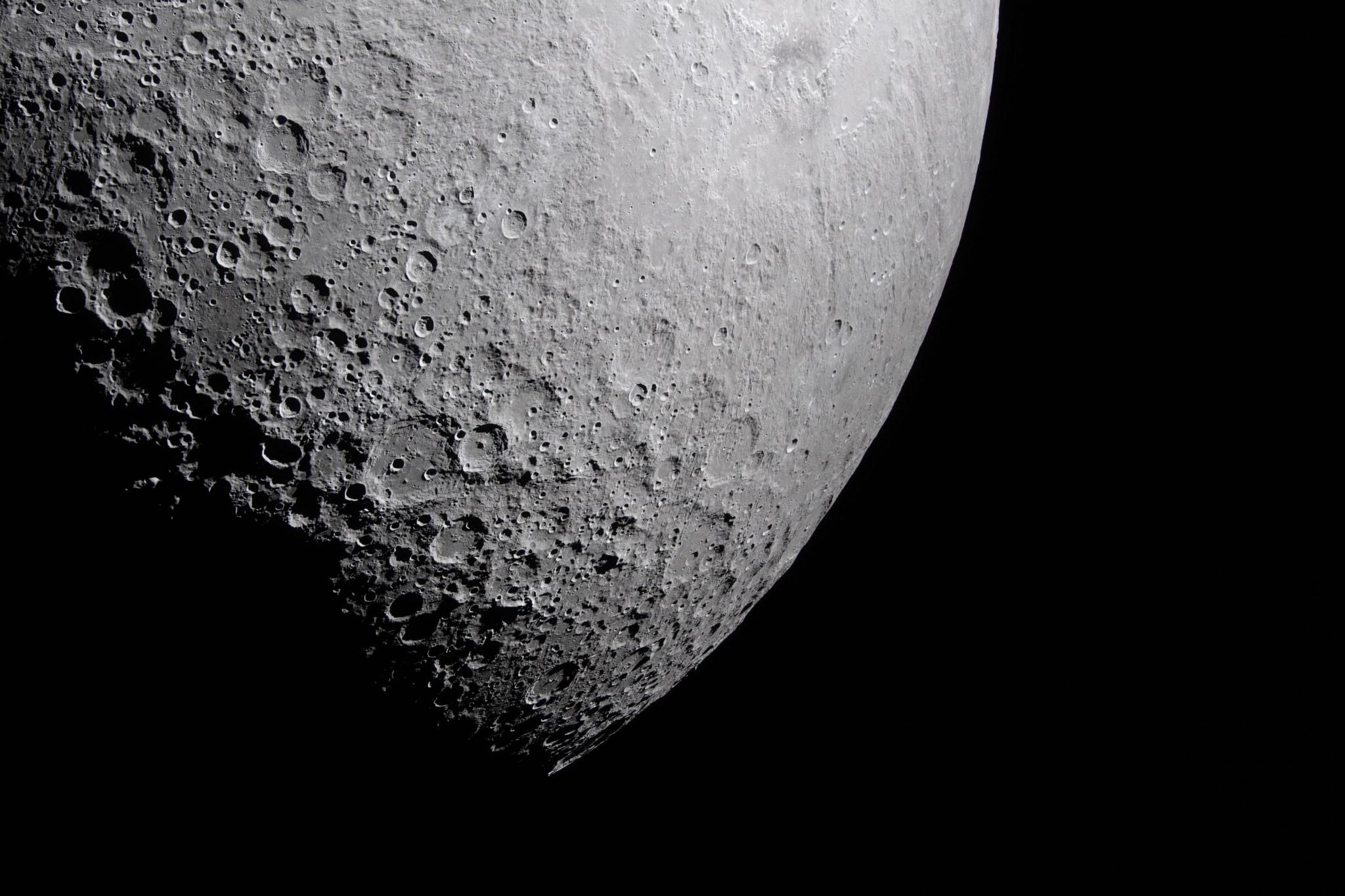
The Artemis II mission, NASA's first crewed voyage to lunar orbit in over half a century, has returned imagery that offers more than spectacle. A photograph captured on April 6, 2026, shows the lunar far side along the terminator — the shifting boundary between day and night on the Moon's surface. In this narrow band of transition, where sunlight arrives at extreme angles, the topography of a world without atmosphere or weather is rendered in sharp relief. The image centers on a portion of the Orientale Basin, a massive multi-ring impact structure located on the Moon's western limb, and it demonstrates why low-angle illumination remains one of the most powerful tools in planetary geology.
The Orientale Basin is among the youngest large impact basins on the Moon, and also one of the best preserved. Spanning roughly 930 kilometers across its outermost ring, it was formed by a collision billions of years ago — an event violent enough to send concentric shockwaves rippling through the lunar crust, creating a series of mountainous rings that radiate outward from the impact center. Because the basin sits at the far western edge of the Moon as seen from Earth, ground-based telescopes have only ever captured it at extreme foreshortening, making detailed study difficult. Orbital missions have gradually filled in the picture, but crewed observation from lunar orbit adds a dimension that robotic cameras alone do not replicate: the ability to select targets of opportunity in real time, adjusting framing and exposure as lighting conditions shift.
What Grazing Light Reveals
The technique at work in the Artemis II photograph is sometimes called grazing illumination. When sunlight strikes a surface at a steep angle — near the terminator — even modest variations in elevation cast long, exaggerated shadows. Features that appear flat and featureless under the overhead sun of lunar noon become legible: subtle ridges, shallow craters, ancient lava channels, and the faint outlines of buried ring structures all emerge. For planetary geologists, this effect transforms a photograph into a topographic dataset. Shadow length, combined with knowledge of the sun's angle, allows researchers to estimate the height and depth of surface features with considerable precision.
This is not a new principle. Apollo-era astronauts used terminator photography for similar purposes, and the Lunar Reconnaissance Orbiter has spent years systematically imaging the surface under varied lighting. What Artemis II adds is context and continuity: a crewed platform in a trajectory that sweeps past terrain rarely observed under optimal conditions. The far side of the Moon, permanently turned away from Earth, has always been harder to study in detail. Each pass along the terminator at a different orbital phase reveals structures from a slightly different angle, building a richer composite understanding of the surface.
The Orientale Basin as Geologic Archive
The Orientale Basin holds particular scientific interest because its relative youth and preservation make it a reference case for understanding impact mechanics across the solar system. Multi-ring basins exist on Mercury, Mars, and several of Jupiter's moons, but most are heavily degraded by subsequent impacts or geological activity. Orientale's rings remain distinct enough to test models of how impact energy propagates through planetary crusts — models that have implications for understanding everything from asteroid threat assessment to the early bombardment history that shaped the inner solar system.
The Artemis II imagery arrives at a moment when lunar science is experiencing a broader resurgence. Multiple national space agencies and private companies have lunar surface missions in various stages of development, and the data gathered from orbit helps prioritize where future landers and rovers might be directed. High-resolution terminator photography contributes to that effort by flagging geological features that merit closer investigation on the ground.
As Artemis II continues its trajectory, the interplay of light and shadow across the far side serves as a reminder of how much remains unresolved about the Moon's deep history. The basin's rings record an ancient catastrophe; the question is whether the current generation of missions can read that record with enough fidelity to settle longstanding debates about impact dynamics, crustal composition, and the Moon's thermal evolution — or whether it will take boots on the surface to do so.
With reporting from NASA Breaking News.
Source · NASA Breaking News