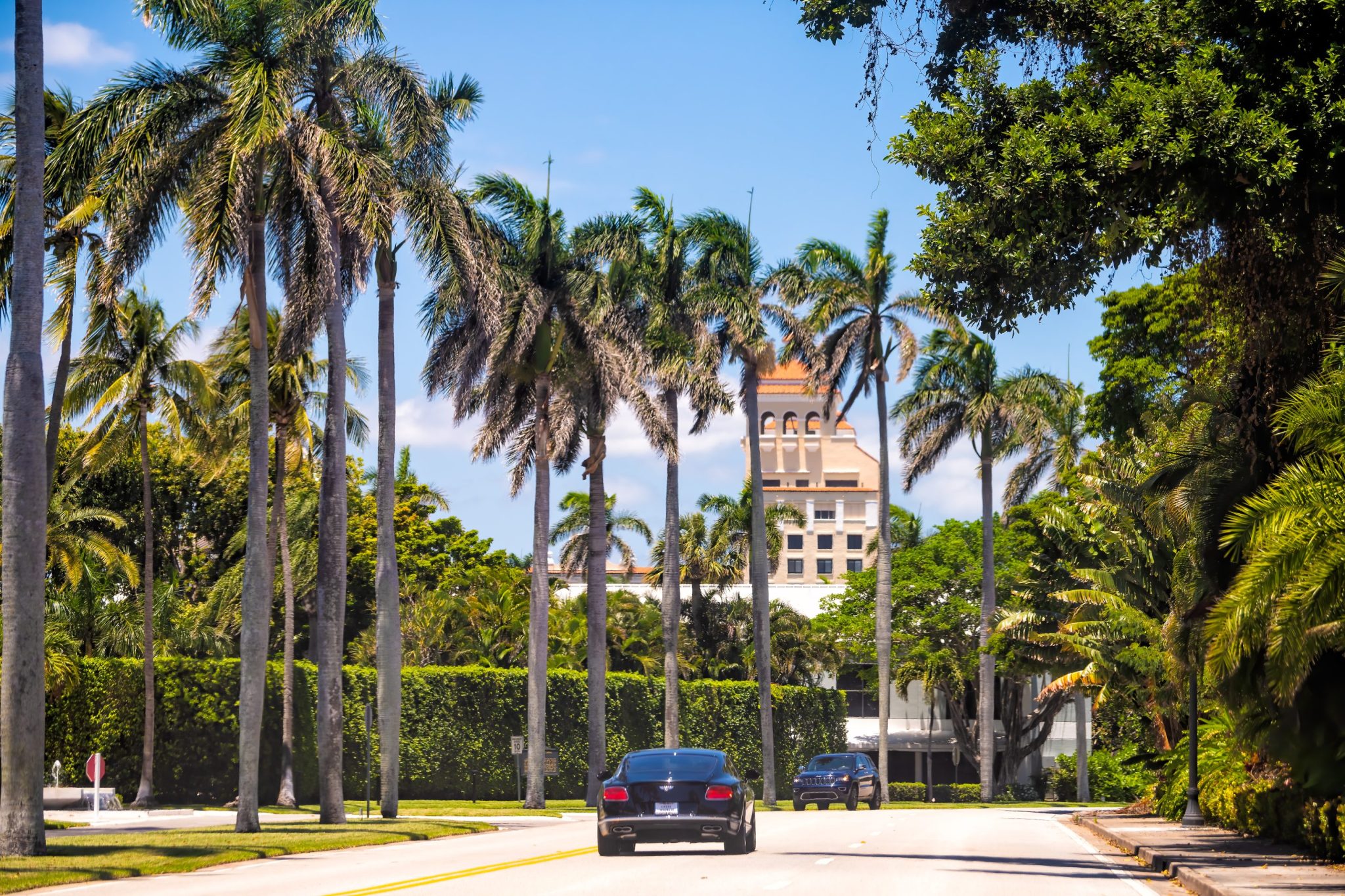
The indefinite closure of South Ocean Boulevard in Palm Beach marks a turning point for one of the most concentrated luxury real estate corridors in the United States. Following joint U.S. and Israeli strikes on Iran and a February 22 security breach involving an armed intruder at Mar-a-Lago, the Palm Beach County Sheriff's Office and the Secret Service have implemented what officials describe as "enhanced security measures." Unlike previous temporary closures tied to presidential motorcades — a familiar inconvenience for Palm Beach residents since 2017 — this shutdown has no scheduled end date, cordoning off a primary thoroughfare in Florida's most expensive zip code.
The road in question runs along the Atlantic coast of the barrier island, connecting estates valued in the tens of millions of dollars. Its closure effectively bisects the southern portion of Palm Beach, forcing residents, staff, and service providers onto detour routes through already narrow island roads. For a community built around exclusivity and discretion, the visible security apparatus — checkpoints, barriers, law enforcement vehicles — introduces a different kind of friction.
When security becomes a land-use decision
Presidential security perimeters are not new to American real estate. The designation of Mar-a-Lago as a de facto Winter White House during the first Trump administration created recurring disruptions to Palm Beach traffic, airspace, and waterway access. Local businesses and residents adapted to periodic closures around presidential visits. But those disruptions were episodic and predictable. An indefinite closure operates on a different logic: it transforms a security measure into something closer to a permanent land-use decision, reshaping access patterns, property desirability, and the daily calculus of living nearby.
The distinction matters for the luxury market. Palm Beach real estate has long traded on a combination of oceanfront access, privacy, and proximity to cultural and social institutions concentrated on the island. Properties south of Mar-a-Lago, now behind the security cordon, face a new variable: restricted access that may deter some buyers while, paradoxically, appealing to others who view the perimeter as an additional layer of exclusivity. The net effect on valuations is not straightforward. Historical precedent from other security-affected zones — diplomatic compounds in Washington, D.C., or gated sections near Camp David — suggests that prolonged restrictions tend to suppress transaction volume before they suppress price, as sellers wait and buyers recalculate.
The broader Palm Beach equation
The timing adds complexity. Palm Beach has experienced a sustained influx of wealth since 2020, driven by tax migration from high-tax states, the normalization of remote work among finance and technology executives, and Florida's broader positioning as a business-friendly jurisdiction. That demand wave pushed median sale prices on the island to levels that rival Manhattan and Beverly Hills. The security closure arrives at a moment when the market was already showing signs of cooling from its pandemic-era peak, with longer days on market and a modest increase in inventory.
The question facing Palm Beach is whether the security perimeter becomes a temporary irritant that the market absorbs — as it did with earlier, shorter closures — or a structural feature that permanently alters the geography of desirability on the island. If the geopolitical conditions that prompted the closure persist, the latter scenario becomes more plausible. Road closures that last months rather than days change how residents experience a neighborhood, how service economies function, and how prospective buyers evaluate comparable properties.
There is also a governance dimension. Palm Beach operates as a small, wealthy town with an outsized concentration of political influence among its residents. The tension between federal security imperatives and local autonomy over roads, zoning, and quality of life is not easily resolved. The town council has limited leverage over Secret Service protocols, and the geopolitical triggers — military strikes, security breaches — lie entirely outside local control.
What remains to be seen is whether the market treats the closure as a price signal or a temporary distortion. The answer likely depends less on real estate fundamentals than on events in Tehran, Washington, and the security briefings that determine whether South Ocean Boulevard reopens — and when.
With reporting from Fortune.
Source · Fortune