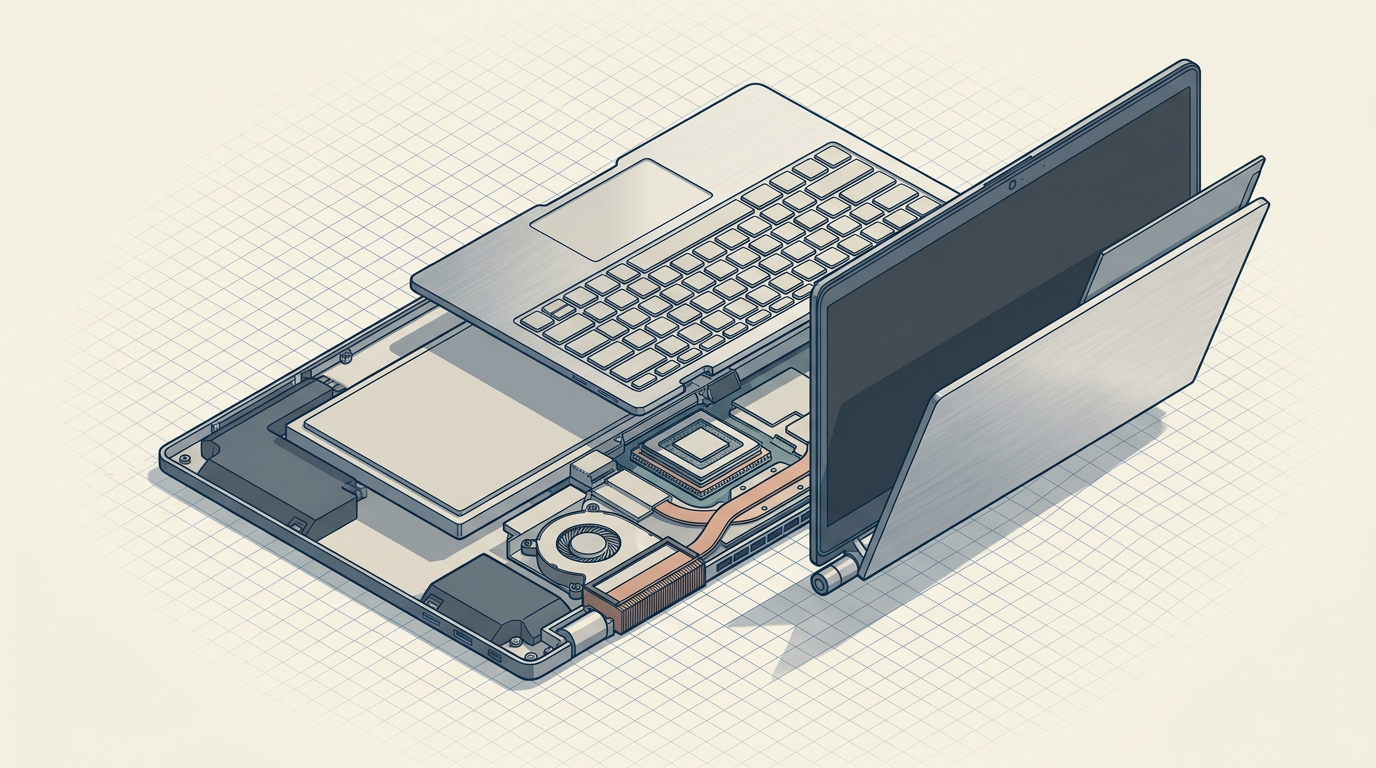
The personal computer market is not experiencing a revolution so much as a recalibration. The notebook form factor — a clamshell with a keyboard, a screen, and a battery — has remained essentially stable for over a decade. What is changing, and changing meaningfully, is the silicon underneath. The current generation of portable PCs, led by machines from ASUS, Lenovo, and their peers, reflects a market increasingly organized around Intel's Core Ultra processor family and the architectural assumptions embedded within it.
The shift is visible across price tiers. Entry-level notebooks powered by Intel Celeron or older Core-series chips continue to serve a clear purpose: lightweight browsing, document editing, and portable convenience at accessible price points. But the center of gravity in the market is moving upward, toward machines built around Core Ultra processors that integrate not just CPU and GPU cores but also neural processing units, or NPUs — dedicated hardware designed to accelerate machine learning tasks locally, without relying on cloud infrastructure.
The NPU as architectural signal
The inclusion of NPUs in mainstream consumer notebooks marks a structural bet by Intel and its OEM partners. Neural processing units are not new in the broader semiconductor landscape; Apple's Neural Engine has shipped in iPhones and Macs for years, and Qualcomm has embedded similar capabilities in its Snapdragon platform. What is notable about the current wave of Intel Core Ultra machines is the scale of adoption. Devices like the ASUS Vivobook S14 and the Lenovo Yoga Slim 7i are not niche workstations or developer machines — they are mid-range consumer notebooks positioned for general productivity.
This signals an industry-wide assumption: that the software ecosystem will, in the near term, begin to demand on-device inference capabilities as a baseline. Microsoft's push to define an "AI PC" category — a designation that requires a minimum NPU performance threshold alongside sufficient RAM and storage — has given OEMs a marketing framework and a hardware target simultaneously. Whether consumer software catches up to this hardware readiness remains an open question, but the silicon is being laid down regardless.
The move also reflects a broader trend away from the traditional CPU-GPU binary that defined PC architecture for decades. Integrated Intel Arc graphics, bundled into the same system-on-chip package as the CPU and NPU, reduce the need for discrete GPUs in all but the most demanding use cases. For the majority of portable PC buyers, this integration translates into thinner machines, longer battery life, and fewer thermal compromises — gains that matter more in daily use than raw benchmark scores.
The widening gap in "good enough"
For consumers, the practical consequence of this architectural shift is a widening gap between what constitutes a minimally viable notebook and what the industry considers a future-proof investment. A Celeron-based machine with modest RAM remains functional for basic tasks, but its useful lifespan in an ecosystem increasingly shaped by local AI workloads is likely shorter than it would have been five years ago. Conversely, a Core Ultra notebook with 16GB of RAM and an NPU offers technical headroom that may prove relevant as operating systems and applications begin to leverage on-device inference more aggressively.
This creates a tension familiar from previous platform transitions. When solid-state drives replaced spinning hard disks as the expected baseline, budget machines that shipped with HDDs quickly felt outdated regardless of their other specifications. The NPU may follow a similar trajectory — irrelevant today for most users, but a dividing line tomorrow between machines that can run emerging features and those that cannot.
The portable PC market, then, is not so much splitting into two categories as it is redefining the floor. The question is no longer whether a notebook is powerful enough for today's tasks, but whether its architecture is aligned with the computational assumptions being baked into tomorrow's software stack. Intel, Microsoft, and the major OEMs have placed their bets. Whether the software side of the equation validates those bets — or whether the NPU becomes another underutilized transistor budget — is the tension worth watching.
With reporting from Olhar Digital.
Source · Olhar Digital