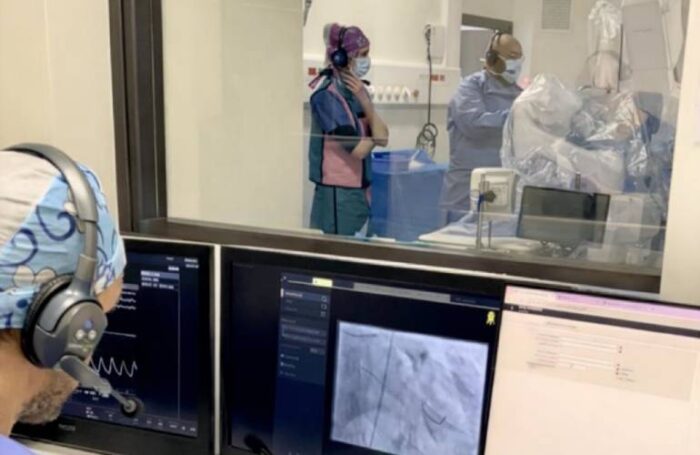
Stereotaxis, a St. Louis-based company known for its magnetic navigation technology in cardiac catheterization, has agreed to acquire Robocath, a French developer of robotic systems for endovascular procedures, in a deal valued at up to $45 million. The transaction is structured as an initial $20 million payment followed by $25 million in milestone-based payments tied to regulatory and commercial progress, including the critical hurdle of FDA clearance for Robocath's latest technology.
Robocath, headquartered in Rouen, France, has built its business around interventional cardiology and neurointervention. Its flagship R-One system is already deployed across Europe, Africa, and China, and a second-generation platform entered first-in-human trials earlier this year. By absorbing these assets, Stereotaxis aims to assemble a broader robotic ecosystem capable of addressing a wide spectrum of endovascular procedures — from coronary interventions to stroke treatment.
Complementary technologies, unified ambition
The strategic logic of the deal rests on the complementary nature of the two companies' approaches. Stereotaxis has long specialized in magnetic robotic navigation, a technique that uses externally generated magnetic fields to guide flexible catheters through blood vessels with precision. The technology has found its primary application in electrophysiology — the treatment of cardiac arrhythmias — where delicate catheter positioning is essential. Robocath, by contrast, has developed mechanically driven robotic systems designed to assist physicians during percutaneous coronary interventions and neurovascular procedures, where guidewires and stents must be advanced through narrow and tortuous vessels.
Combining these two modalities under a single corporate umbrella would, in principle, allow Stereotaxis to offer hospitals a more versatile robotic platform spanning multiple interventional specialties. The ambition is not merely additive — it reflects a broader industry pattern in which point-solution robotics companies seek to evolve into platform providers. The parallel to surgical robotics is instructive: Intuitive Surgical's dominance with the da Vinci system has long rested on its ability to serve multiple surgical disciplines from a single installed base, creating switching costs and workflow integration that competitors struggle to replicate.
For Stereotaxis, the acquisition also addresses a geographic and regulatory gap. Robocath's existing commercial footprint in Europe, Africa, and China provides immediate international reach, while the milestone structure of the deal — with a significant portion contingent on FDA clearance — limits Stereotaxis's downside if the U.S. regulatory pathway proves slower or more complex than anticipated.
A maturing market tests consolidation logic
The endovascular robotics market remains relatively early-stage compared to the more established surgical robotics sector. Adoption has been constrained by the high cost of robotic systems, limited clinical evidence demonstrating clear superiority over manual techniques, and the procedural learning curves involved. Hospitals evaluating robotic purchases increasingly favor platforms that can justify their capital expenditure across multiple departments and procedure types — a dynamic that favors consolidation.
Yet consolidation carries its own risks. Integrating two distinct engineering cultures and technology stacks — one magnetic, one mechanical — is a nontrivial undertaking. The history of medtech acquisitions includes numerous cases where the technical promise of combining platforms proved more difficult in practice than on paper. Whether Stereotaxis can deliver a genuinely unified system, rather than two parallel product lines sharing a corporate parent, will likely determine whether the deal creates lasting competitive advantage or merely adds complexity.
The milestone-heavy deal structure suggests both parties are aware of the execution risk. With $25 million of the total consideration dependent on regulatory and commercial benchmarks, the transaction is as much a bet on future integration as it is a purchase of existing assets.
The tension at the center of this deal — between the strategic appeal of a unified endovascular robotics platform and the engineering difficulty of actually building one — is the question that will define its outcome. Whether the combination accelerates Stereotaxis's position in interventional medicine or stretches its resources across too many fronts remains an open question, one that regulatory timelines and clinical adoption patterns will answer before any corporate strategy deck can.
With reporting from The Robot Report.
Source · The Robot Report


