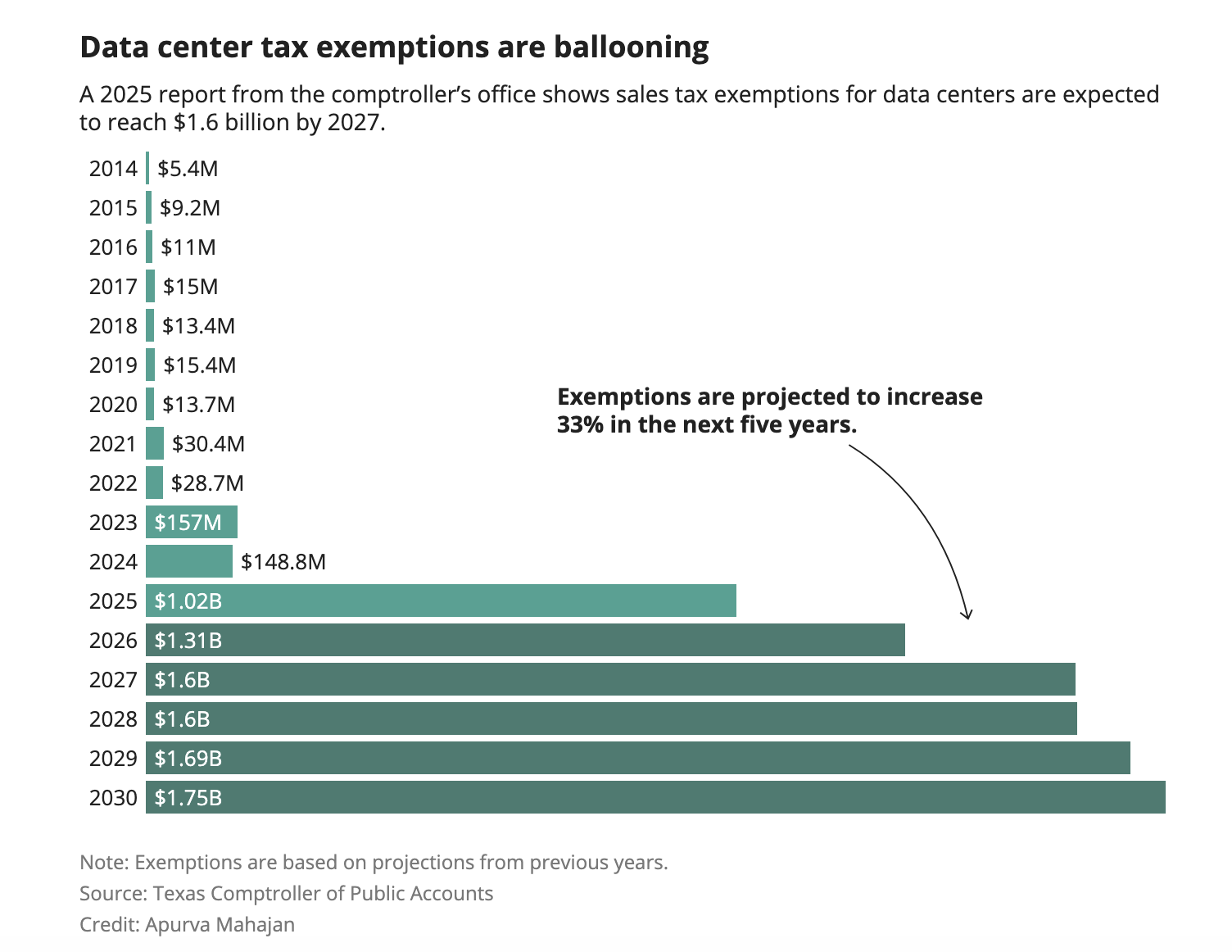
In the early 2010s, Texas lawmakers viewed data centers as modest, desirable additions to the state's industrial portfolio. To attract them, the state offered a sales tax exemption that, for years, cost a relatively negligible $5 million to $30 million annually. But as the digital economy shifted toward the resource-intensive demands of generative AI and massive cloud storage, these facilities evolved from quiet server farms into sprawling, power-hungry industrial hubs.
The fiscal consequences of that evolution have now arrived. According to the state comptroller's office, Texas is poised to lose $3.2 billion in tax revenue over the next two years due to the exemption. The annual cost of the program skyrocketed from $150 million in 2023 to at least $1.3 billion this year. These figures, while staggering, are likely underestimates; they do not fully account for the wave of new construction currently breaking across the state's outskirts.
The anatomy of a quiet subsidy
Sales tax exemptions for data centers are not unique to Texas. Across the United States, more than thirty states offer some form of fiscal incentive to attract the industry, typically structured as exemptions on the purchase of servers, cooling equipment, and electricity. The logic behind these programs has remained consistent for over a decade: data centers bring capital investment, construction jobs, and a modest permanent workforce, while placing relatively light demands on public services like schools and roads.
For most of that period, the math held. Data centers were comparatively small operations, and the foregone revenue was a rounding error in state budgets. What changed was not the policy but the industry itself. The emergence of large language models and generative AI applications beginning around 2022 triggered an unprecedented buildout of computing infrastructure. Hyperscale facilities — data centers exceeding 100,000 square feet of server space — began proliferating in regions with cheap land, permissive regulation, and abundant power. Texas, with all three attributes, became a primary destination.
The result is a classic case of incentive drift: a program designed for one economic reality persisting, unchanged, into a fundamentally different one. What once subsidized a handful of modest facilities now underwrites an industrial expansion of a different order of magnitude.
Grid pressure and the political calculus
The fiscal dimension is only part of the equation. Data centers are among the most electricity-intensive structures in operation, and the new generation of AI-focused facilities demands substantially more power than their predecessors. Texas already operates a deregulated electricity grid managed by ERCOT, which has faced scrutiny over reliability since widespread outages during a winter storm in February 2021. Adding gigawatts of new demand from data centers introduces a tension between the state's ambition to serve as a hub for the digital economy and its obligation to maintain grid stability for existing residents and businesses.
State Senator Joan Huffman, chair of the Senate Committee on Finance, has described the current trajectory as "unsustainable," indicating that the upcoming legislative session may see proposals to limit or entirely repeal the incentive. But any legislative action will encounter a familiar counterargument: that restricting incentives risks driving investment to competing states — Virginia, Georgia, and Ohio among them — where similar exemptions remain in place.
This dynamic illustrates a broader structural problem in American industrial policy. States compete for capital-intensive industries through tax concessions, and once an incentive is established, removing it carries the perceived risk of signaling hostility to business. The political cost of repeal often exceeds the fiscal cost of continuation — until the numbers become large enough to force the question.
Texas now sits at that threshold. The state must reconcile two competing imperatives: maintaining its reputation as a business-friendly jurisdiction that attracts major technology investment, and managing a budget in which a single exemption program has grown to rival the cost of significant public services. Whether lawmakers choose to cap, restructure, or eliminate the incentive, the decision will signal how states intend to negotiate with an industry whose physical footprint and resource appetite are expanding far faster than the policy frameworks designed to accommodate them.
With reporting from Grist.
Source · Grist