The modern movie theater has become a site of persistent social friction. As smartphones glow in darkened rooms and whispered conversations compete with dialogue on screen, the traditional compact between audience and film — silence, stillness, undivided attention — is under visible strain. Cinemas have responded with escalating enforcement: stern pre-show warnings, ejection policies, and, at London's Prince Charles Cinema, a pointed demand that attendees be "in the movie, not above it." The assumption underlying all of these measures is that monastic devotion remains the only legitimate way to experience film in public.
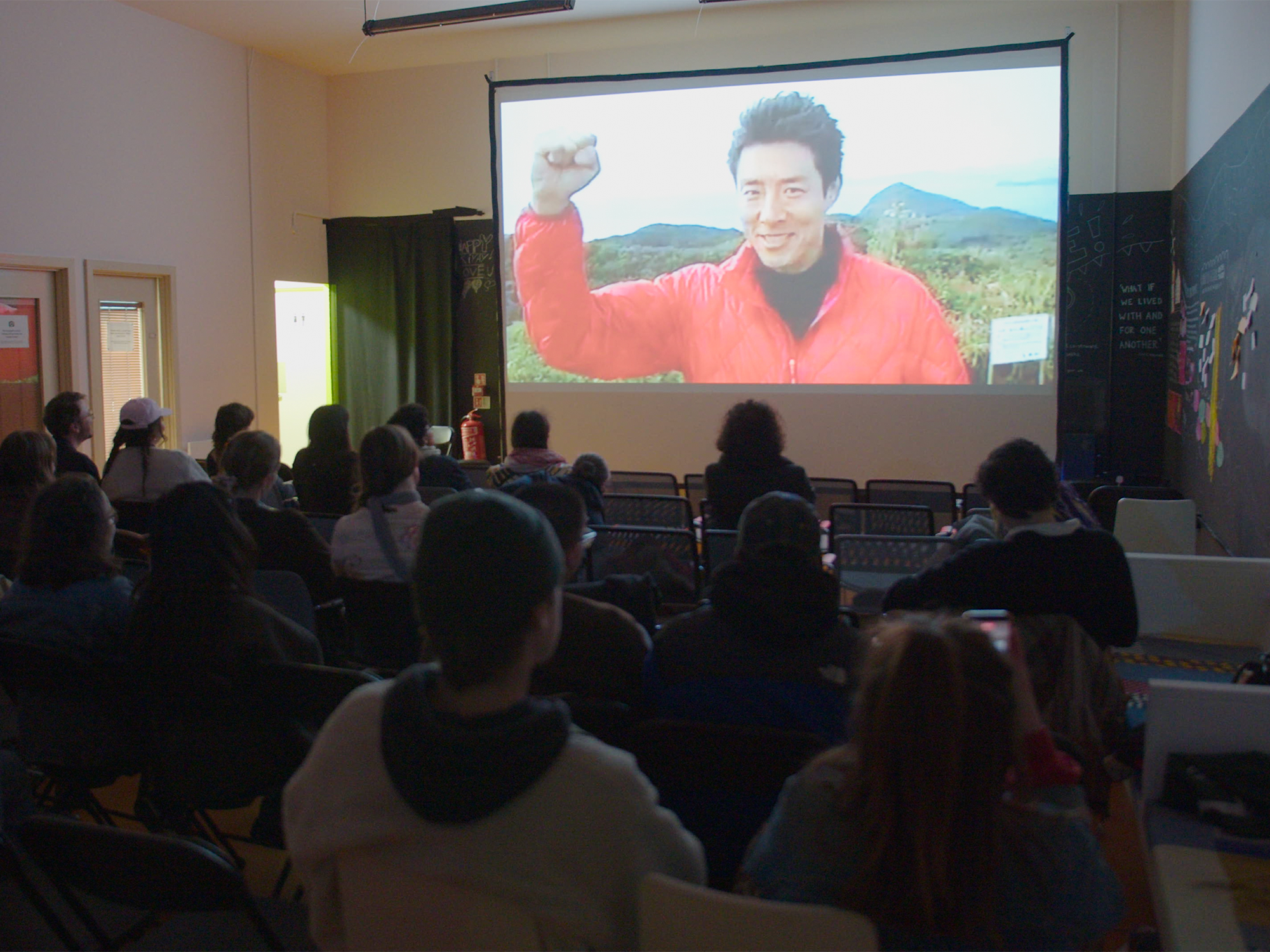
Dan Wilkinson, who runs the event program Double Wonderful, recently tested an alternative hypothesis. In a 24-hour cinema event staged in Kentish Town, north London, Wilkinson abandoned nearly every convention of traditional exhibition. The event was free. The titles were unannounced. Patrons were encouraged to come and go at will. Roughly 160 participants cycled through the space over the course of the day, some staying for minutes, others for hours, armed with cushions and coffee. The result was less a screening and more an open negotiation between a community and a screen.
From Temple to Living Room
The history of moviegoing etiquette is shorter and more contingent than most audiences assume. Early cinema was raucous — nickelodeons at the turn of the twentieth century were noisy, social environments where talking, eating, and entering mid-reel were standard behavior. The hush that contemporary audiences treat as sacred is largely a mid-century artifact, consolidated as cinema sought cultural legitimacy alongside theater and opera. The cathedral model of spectatorship — lights down, phones off, eyes forward — is not a natural law but a design choice, one that served an era of fewer competing screens and longer collective attention spans.
What Wilkinson's experiment surfaced is the tension between that inherited design and the reality of how people now relate to moving images. Streaming platforms have already restructured viewing into something fragmented and ambient: a show playing on a laptop while dinner is prepared, a film paused and resumed across multiple sittings. The 24-hour cinema format did not invent distracted viewing so much as acknowledge it, then ask whether communal space could be reorganized around that acknowledgment rather than against it.
By removing the pressure of the "proper" viewing experience, the event transformed the theater from a high-stakes cultural venue into something closer to a fluid, living-room-like environment. No one was obligated to arrive on time, stay until the credits, or perform reverence. The social contract shifted: rather than an audience collectively submitting to a film, individuals drifted through a space where film happened to be playing, engaging on their own terms.
The Economics and Limits of Radical Flexibility
The appeal of such a model is clear, but so are its constraints. Traditional cinema exhibition depends on a transactional structure — a ticket purchased for a specific title at a specific time — that funds everything from projection equipment to staff wages. A free, open-door, unannounced program is viable as an event or an art intervention, but it does not obviously scale into a sustainable business. The question is whether elements of its philosophy can migrate into commercial exhibition without collapsing the revenue model entirely.
There are partial precedents. Repertory cinemas and microcinemas have long experimented with flexible programming, marathon screenings, and communal atmospheres that tolerate more noise and movement than a multiplex would permit. Some newer venues have leaned into the social dimension of moviegoing — bars attached to screening rooms, second-run programming designed for casual attendance — without fully abandoning the ticketed model. Double Wonderful's experiment sits at the far end of this spectrum, but it occupies the same continuum.
What remains unresolved is whether the erosion of traditional etiquette represents a problem to be solved or a signal to be read. The cinema industry has largely treated distraction as a threat, something to be policed back into submission. Wilkinson's event proposed a different framing: that the audience has already changed, and the architecture of attention might need to change with it. Whether that means redesigning physical spaces, rethinking programming structures, or simply relaxing the social codes that govern public viewing is a question the industry has yet to seriously engage.
The 24-hour cinema in Kentish Town was small, temporary, and free — conditions that insulate it from the pressures facing commercial exhibitors. But the discomfort it provokes in defenders of traditional moviegoing may be more revealing than the event itself. If the only way to preserve the cinematic experience is to enforce it through rules and warnings, the experience may already be something other than what its guardians believe it to be.
With reporting from Little White Lies.
Source · Little White Lies