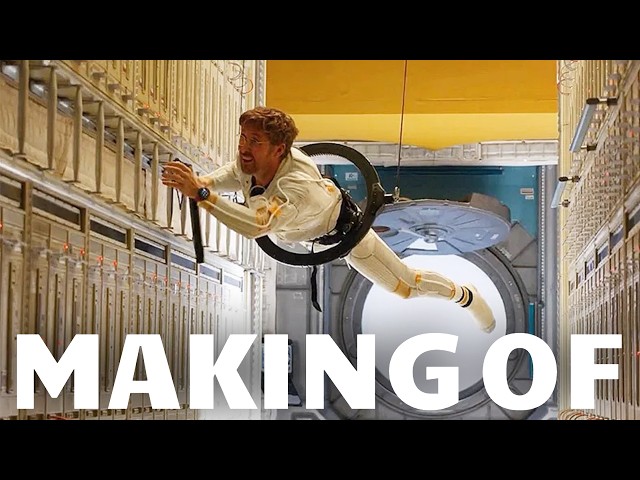
The central challenge of adapting Andy Weir’s Project Hail Mary lies in translating the solitary, mathematics-driven survivalism of its protagonist into the kinetic visual language of a $100 million blockbuster. When the 2021 novel transitions to the screen in 2026, it will merge two drastically different creative sensibilities. On one side is Weir’s rigid adherence to hard science—a narrative architecture built on orbital mechanics and the biological imperatives of an extraterrestrial microbe known as astrophage. On the other is the directorial duo of Phil Lord and Christopher Miller, whose previous work on Spider-Man: Into the Spider-Verse thrives on anarchic pacing. Bridging this gap is Ryan Gosling, whose recent turn toward charismatic vulnerability will be tested against the sterile confines of a deep-space laboratory.
The Calculus of Cinematic Survival
Weir’s literary framework presents a unique friction for Hollywood adaptation. Unlike the expansive space operas of Star Wars or the philosophical abstraction of Denis Villeneuve’s Arrival, Weir’s narratives function as procedural puzzle boxes. His protagonist, Ryland Grace, survives not through force of will, but by calculating the exact tensile strength of alien alloys and the reproductive rate of star-eating algae. This hyper-rationality made The Martian a massive success in 2015 under Ridley Scott's direction, but Project Hail Mary introduces a more complex variable: sustained isolation intertwined with a deeply technical form of interspecies communication.
The introduction of an alien co-pilot—a blind, heavily armored engineer from the Eridani star system—forces the narrative away from pure monologue and into a complex linguistic and structural translation. For Lord and Miller, the challenge is rendering this highly technical, frequency-based communication into a visual and auditory experience that engages a theater audience without abandoning Weir’s strict scientific logic. The directors must balance the claustrophobic reality of the spacecraft with the existential stakes of a dying solar system, ensuring the science remains an active, kinetic driver of tension rather than mere exposition.
Gosling and the Architecture of Isolation
Casting Ryan Gosling as Ryland Grace signals a deliberate tonal strategy for the 2026 release. Gosling’s post-2020 career trajectory has been defined by a specific brand of existential weariness masked by deadpan humor, visible in both Barbie and The Fall Guy. This is a stark departure from the earnest, hyper-competent optimism Matt Damon brought to Mark Watney in The Martian. Grace is a disgraced academic pushed into an impossible mission, waking from a coma with retrograde amnesia. Gosling’s ability to project profound isolation while maintaining an accessible cadence is critical for a film that relies heavily on a single human face to anchor its emotional weight.
Furthermore, Gosling’s physical presence must counterbalance the inherent sterility of a hard sci-fi environment. In the tradition of Duncan Jones’s Moon or Alfonso Cuarón’s Gravity, the protagonist’s psyche becomes the true landscape of the film. Lord and Miller are tasked with constructing a visual language for Grace’s recovering memory, integrating his past failures on Earth with his present crisis in the Tau Ceti system. The success of the adaptation hinges on whether the filmmakers can make the internal, cognitive process of scientific discovery as compelling as the external threat of an apocalyptic freeze.
Ultimately, Project Hail Mary represents a litmus test for the viability of hard science fiction in the current cinematic landscape. As studios increasingly rely on established IP and multiversal fantasy, a rigid, physics-bound narrative offers a stark counter-programming strategy. If Lord, Miller, and Gosling can successfully synthesize Weir’s thermodynamic equations with genuine human pathos, they will prove that intellectual rigor and blockbuster scale are not mutually exclusive. The unresolved question remains whether mass audiences are still willing to watch a protagonist calculate their way out of the apocalypse.
Source · The Frontier | Movies