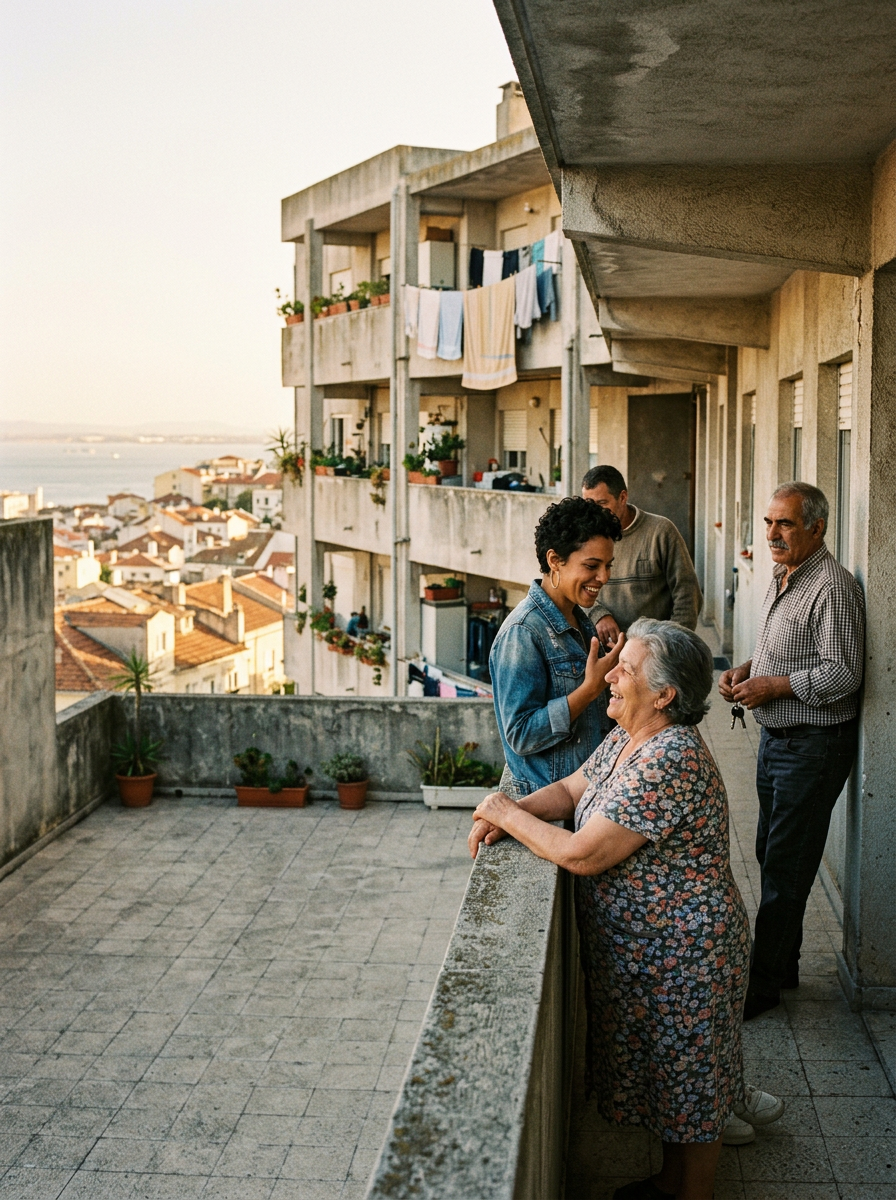
In Lisbon today, the friction of rapid urban change is palpable. In the city's more densely populated quarters, the influx of tourists and immigrants has outpaced the capacity of local infrastructure. Buses are perpetually overcrowded, garbage collection lags, and a strained healthcare system struggles to communicate with a globalized population. The result is a neighborhood that feels vibrant but increasingly hostile — a place where the absence of shared agency manifests as frustration and social division.
This tension is not unique to Lisbon. Cities across southern Europe and beyond face variants of the same problem: rapid demographic shifts colliding with infrastructure designed for a different era. What makes Lisbon a particularly instructive case is that it once hosted one of the most ambitious attempts to address precisely this kind of urban strain — not through technocratic planning, but through radical civic participation.
The SAAL experiment and the politics of co-construction
The Serviço de Apoio Ambulatório Local (SAAL) emerged in the mid-1970s, in the turbulent aftermath of Portugal's Carnation Revolution. The program was designed to support poorly housed populations in transforming their own neighborhoods. Rather than imposing top-down solutions, the state provided architects, engineers, and other technical experts to work alongside residents. Together, they planned, protested, and in some cases physically co-constructed the buildings they would inhabit. By the time the project was terminated in 1976, over 41,000 families were involved in a process that treated housing not as a commodity but as a collective civic act.
SAAL drew on a broader intellectual current that was gaining traction in architecture and urban theory during the 1960s and 1970s — the idea that the built environment is not a neutral container for social life but an active force that shapes it. Participatory design, as the approach came to be known, held that the people who live in a space are its most legitimate designers. The architect's role shifts from author to facilitator. The Portuguese experiment was notable for the scale at which it attempted to operationalize this principle, and for the political conditions that made it briefly possible: a revolutionary government willing to cede a measure of control over the urban fabric to its citizens.
The program's termination was itself instructive. As Portugal's political landscape stabilized and shifted rightward, SAAL was dismantled. Many of its projects were left incomplete. The episode illustrates a recurring pattern in participatory urbanism: such programs tend to flourish in moments of political rupture and wither when institutional normalcy reasserts itself. The question of whether civic participation in urban design can survive routine governance — rather than depending on crisis — remains largely unanswered.
Civic friendship as urban infrastructure
The legacy of SAAL points toward a concept that carries weight beyond architecture: civic friendship. The term, rooted in Aristotelian political philosophy, describes a form of solidarity among citizens that is neither intimate nor transactional. It is the disposition to regard fellow residents of a shared space as collaborators in a common project rather than as competitors for scarce resources. When that disposition is present, the inconveniences of dense urban life — the crowded bus, the delayed garbage collection — register differently. They become shared problems rather than individual grievances.
Public spaces, on this account, are most transformative when they function as sites where civic friendship can be practiced and reinforced. A plaza designed by its users carries a different social charge than one imposed by a municipal planning office. The distinction is not aesthetic but relational: the process of co-design creates bonds of mutual recognition that persist after the construction is finished.
Lisbon's current strain raises the question of whether such participatory frameworks can be revived under contemporary conditions — conditions defined not by revolutionary upheaval but by tourism-driven gentrification, global migration, and fiscal austerity. The obstacles are considerable. Participatory processes are slow, politically inconvenient, and difficult to scale. They require institutional patience that few elected governments possess. Yet the alternative — cities designed for consumption rather than collaboration — produces the very alienation that Lisbon's residents now experience.
The tension, then, is structural. The forces that make participatory urbanism most necessary — rapid change, demographic complexity, eroding trust — are the same forces that make it hardest to implement. Whether cities can find institutional forms capable of sustaining civic friendship outside moments of crisis is not a question with an obvious answer. It is, however, the question that SAAL's unfinished legacy continues to pose.
With reporting from Blog of the APA.
Source · Blog of the APA