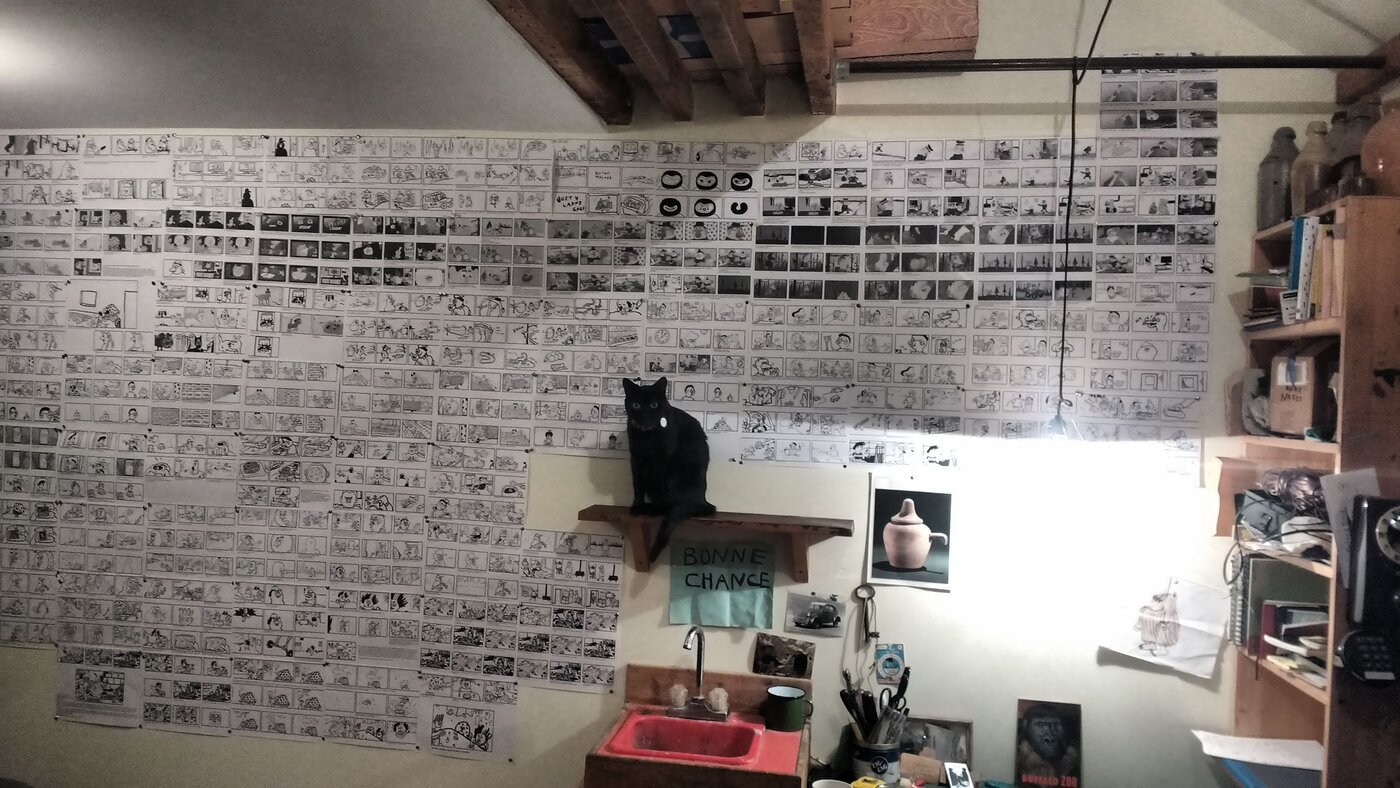
In the remote First Nations reserve of Shamattawa, northern Manitoba, the process of documenting history is rarely a solitary endeavor. When filmmaker Seth and his collaborator Peter Scriver set out to make Endless Cookie, the original mandate was modest and clear: record seven stories from Pete Scriver's life. The project was conceived as oral history — a structured act of preservation. But the logistical reality of the Scriver household, occupied by eight children inside and twenty-six dogs outside, quickly asserted itself over the production's formal ambitions. What followed was a nine-year process that turned a straightforward documentary concept into something far more textured: an animated portrait of domestic life built from the very disruptions that threatened to derail it.
Every attempt at a clean narrative take was punctured by the ambient noise of a crowded home — the groan of an aging refrigerator, the blare of video games through thin walls, the frequent and unscripted entrances of family members. For a conventional production, these would be problems to solve. For the Scrivers, they became the film's central discovery.
From oral history to domestic architecture
The shift that defines Endless Cookie is a familiar one in documentary practice, though it is rarely pursued with this degree of commitment. Many filmmakers encounter the gap between the story they intended to tell and the one that insists on being told. The difference here lies in duration and medium. Rather than editing around the interruptions or returning with better equipment, Seth and Peter Scriver spent nearly a decade folding those disruptions into the fabric of the work itself, using animation as the vehicle.
Animation, in this context, serves a specific structural purpose. It allows the filmmakers to reconstruct not just what was said, but the full sensory environment in which it was said — the overlapping voices, the spatial chaos of a household that never pauses for the camera. The medium grants a kind of editorial honesty that live-action footage, with its implicit claim to objectivity, sometimes obscures. In animation, every detail is a deliberate choice, which paradoxically can make the result feel more faithful to lived experience than a camera pointed at the same scene.
This approach places Endless Cookie in a lineage of animated documentaries that use the form to access registers of truth unavailable to conventional filmmaking. Works such as Ari Folman's Waltz with Bashir and the National Film Board of Canada's long tradition of animated nonfiction have demonstrated that drawing and rendering can capture interior states — memory, confusion, sensory overload — with a precision that observational footage cannot. The Scrivers' contribution to this tradition is distinctive in its domesticity. The subject is not war or trauma recalled at a distance, but the ongoing, unglamorous density of family life in a remote community.
The kitchen table as formal principle
The filmmakers have described the resulting work as an attempt to replicate the specific intimacy of sitting at a kitchen table. That image is worth taking seriously as a formal principle. A kitchen table conversation is not linear. It doubles back, gets derailed, absorbs the presence of whoever walks through the door. It is shaped by proximity and obligation rather than narrative arc. To build a film around that rhythm is to reject the conventions of documentary storytelling that prize coherence and resolution.
This rejection carries particular weight when the subjects are members of a First Nations community. Indigenous lives in Canada have been extensively documented — often by outsiders, often through frameworks of crisis, policy failure, or cultural loss. Endless Cookie sidesteps those frameworks not through explicit critique but through formal choice. By centering the texture of a single household over nearly a decade, the film offers something rarer than advocacy: specificity. The Scriver family is not presented as representative of anything beyond itself.
The tension the film leaves unresolved is worth noting. A nine-year animated documentary about domestic interruption is, by definition, a work of extraordinary patience and editorial discipline — qualities that exist in direct opposition to the chaos it depicts. Whether that tension enriches the portrait or occasionally aestheticizes it is a question the viewer must answer at the kitchen table.
With reporting from MUBI Notebook.
Source · MUBI Notebook