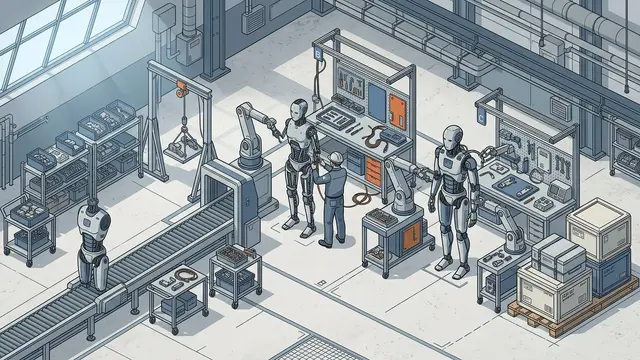
The pursuit of artificial general intelligence has largely been confined to server farms and chat interfaces, but the true frontier may be physical. At Figure’s San Jose campus, CEO Brett Adcock advances a provocative thesis: humanoid robots will achieve AGI before any disembodied form factor. This marks a radical departure from traditional robotics, pivoting from deterministic, hand-coded instructions toward end-to-end neural networks. The rapid iteration visible on the factory floor—from the rudimentary Figure 01 to the sleek, White House-visiting Figure 03—signals a shift in hardware development. Robotics is no longer moving at the sluggish pace of heavy machinery; it is adopting the aggressive cadence of consumer electronics.
The Neural Pivot and Physical Intelligence
For decades, the robotics industry relied on classical control theory. Companies like Boston Dynamics built agile machines using hand-coded kinematics, where every movement was mathematically pre-defined. Figure’s Helix AI team represents a hard pivot away from this legacy. By embedding a vision-language-action model directly onboard, Figure bets that complex physical interaction cannot be hardcoded. Instead, the robot navigates infinite poses through reinforcement learning.
The stakes of this neural approach are visible in the "Vulcan project" and its rigorous stability testing. In the system integration lab, robots face physical assaults and software faults to test their reinforcement-learning-trained balance. The ability to survive a lost knee mid-task—part of their "Never Fall" protocol—demonstrates robustness that deterministic systems struggle to achieve. When Figure 03 autonomously tidies a living room without teleoperation, it relies entirely on its neural network to interpret its surroundings.
This methodology underpins Adcock’s belief in physical AGI. The argument posits that true intelligence requires physical grounding—the ability to touch and manipulate the three-dimensional world. Text-based large language models lack this spatial intuition. By forcing neural networks to solve physics problems in real-time, Figure aims to bridge the gap between abstract reasoning and physical execution, turning the humanoid form into the ultimate data-gathering vessel for general intelligence.
Vertical Integration and Hardware Evolution
The ambition of physical AGI necessitates absolute control over the hardware stack. Inside Figure’s BotQ manufacturing facility, the company vertically integrates production, assembling heads, limbs, and custom battery lines under one roof. This approach echoes the early days of Tesla’s Fremont factory or Apple’s obsessive control over its supply chain. In the previously secret industrial design studio, the evolutionary tree of Figure’s hardware is on full display. The progression from Figure 01, with its "Frankenstein forearms," to the polished Figure 03 highlights an intense focus on manufacturability.
This rapid prototyping builds toward what Adcock teases as Figure 04, describing it as the company's "iPhone 1 moment." Historically, the iPhone did not invent the smartphone; it integrated existing technologies into a seamless package that altered consumer behavior. Figure 04 aims to be the equivalent inflection point for robotics—the moment a humanoid transitions from a fragile laboratory prototype to a scalable utility capable of operating 24/7.
The economic implications of this leap are profound. If a single humanoid architecture can be leased to build real cars on an automotive assembly line and later adapted for domestic chores, traditional boundaries of specialized labor dissolve. The challenge remains scaling this vertical integration. Manufacturing a few dozen prototypes in a California lab is a vastly different engineering problem than mass-producing millions of reliable, autonomous workers for global deployment.
The true test for Figure lies beyond the pristine confines of its San Jose testing bays. While the pivot to neural networks and the rapid iteration of hardware are impressive, the transition from campus demonstrations to chaotic real-world deployment remains fraught with edge cases. If Adcock’s thesis holds true, the fusion of vision-language-action models with a generalized humanoid chassis will redefine the labor economy. The race is no longer simply about building a robot that can walk; it is about deploying a scalable physical intelligence that fundamentally reshapes our interaction with the material world.
Source · The Frontier | Robotics