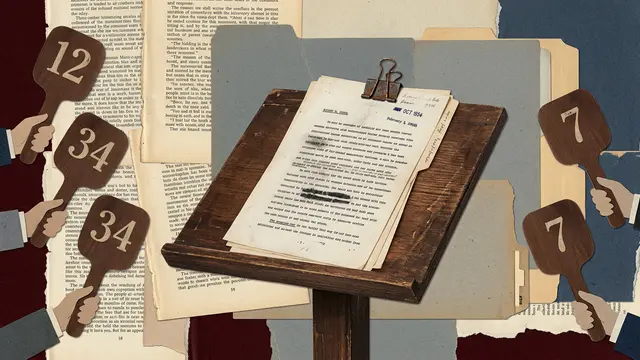
The courtroom in Washington, DC, in August 2022, felt like a stage set for a drama that was, at its heart, about the soul of the printed word. When Penguin Random House moved to acquire Simon & Schuster, the industry’s collective gaze shifted away from the traditional hubs of Manhattan publishing offices toward the cold, clinical reality of antitrust litigation. It was a moment that promised to reduce the storied “Big Five” to a “Big Four,” a numerical shift that carried heavy symbolic weight. Yet, as the arguments unfolded, the focus on market share and competitive pricing obscured a more profound, underlying transformation: the ways in which the structure of the industry itself dictates the content that reaches the reader's hands.
According to reporting from Public Books, this trial was not merely a dispute over corporate dominance, but a reflection of a long-standing tension between the editorial mission and the consolidation of power. While the legal proceedings centered on the mechanics of competition, the broader story involves the rise of the literary agent as the primary architect of contemporary taste. The consolidation of publishing houses has inadvertently strengthened the position of the middleman, creating a feedback loop where the aesthetic of the bestseller is increasingly defined by the very agents who negotiate the deals, rather than the editors who once nurtured the craft from the inside.
The Shift from Editorial Vision to Agency Curation
Historically, the publishing house was a bastion of editorial autonomy, where the editor-in-chief acted as the ultimate arbiter of literary merit. In this older model, the relationship between author and editor was often a multi-book commitment, a slow cultivation of a voice that might not find its audience for years. The consolidation of the industry, driven by the need for economies of scale and the pressures of quarterly earnings, has fundamentally eroded this model. As editorial teams have been downsized and resources centralized, the institutional memory and long-term vision that once defined major publishing houses have become increasingly precarious.
In this void, the literary agent has ascended to a position of unprecedented influence. No longer just a negotiator of contracts or a bridge between talent and acquisition, the agent has become a curator of the market. They are the ones who shape the initial manuscript, often suggesting structural changes based on current market trends before the work ever reaches an editor’s desk. This shift has turned the literary agent into a silent partner in the creative process, effectively standardizing the 'voice' of modern literature to fit the requirements of a consolidated distribution network that demands predictable, high-impact results.
The Mechanics of Market-Driven Aesthetics
How does this influence manifest in the prose itself? When the primary gatekeepers are incentivized by the efficiency of the deal, the literature they shepherd tends to follow established patterns of success. The mechanism here is one of risk mitigation; in a consolidated market, the cost of a 'flop' is significantly higher than it was in a decentralized era. Consequently, agents and publishers gravitate toward manuscripts that possess a high degree of 'marketability'—a term that often serves as a shorthand for familiarity, recognizable tropes, and a clear, easily marketable hook that can be pitched across multiple media platforms.
This is not a conspiracy of taste, but a byproduct of the economic realities of scale. When a publisher controls a vast share of the market, the pressure to produce 'tentpole' titles that can support the entire infrastructure becomes overwhelming. Agents, navigating this landscape, have learned to anticipate these needs, curating their lists to provide the exact type of content that corporate publishers are equipped to distribute at scale. The result is a subtle homogenization of the literary landscape, where the edges of experimentation are smoothed over to ensure the product fits into the streamlined, algorithm-driven machinery of modern retail.
The Stakeholders in a Narrowing Field
For the regulators, the focus remains on the tangible metrics of competition—price, access, and shelf space. Yet, the implications for the wider ecosystem are far more complex. For authors, the consolidation of agency power means that the path to publication is increasingly narrow, requiring a 'packaged' product that meets the specific, often rigid, expectations of a few powerful agencies. The diversity of voices, which is often touted as a goal of the modern publishing industry, is ironically threatened by this very concentration of power, as the gatekeepers tend to favor what has already succeeded rather than what is genuinely new.
Competitors, meanwhile, find themselves in a bind. Smaller, independent presses often act as the R&D labs of the industry, taking the risks that the giants cannot afford. However, they lack the resources to scale these successes, and as soon as a voice gains traction, the agents and the large houses are positioned to acquire the talent, effectively absorbing the risk-taking into the consolidated machine. This dynamic creates a cycle where the vibrancy of the literary world is constantly being harvested by the entities that have the least incentive to foster long-term, disruptive creative growth.
The Uncertain Horizon of Literary Value
What remains uncertain is whether this structure can sustain the very thing it seeks to monetize: the enduring power of literature. When we prioritize the efficiency of the deal over the slow, often messy process of editorial development, we risk creating a literary culture that is highly readable but ultimately ephemeral. The question is not whether the books of the future will be successful—they likely will be, given the sophisticated marketing engines behind them—but whether they will possess the depth required to resonate beyond the current moment.
As we look forward, the tension between the commercial imperative and the artistic impulse is unlikely to resolve in favor of the latter. The consolidation of the industry has created a system that is remarkably good at delivering what the market expects, but perhaps less capable of providing what the culture needs: the unexpected, the difficult, and the transformative. Whether this leads to a stagnation of form or a new, unforeseen reaction from the margins remains the most compelling narrative in the world of books today.
Ultimately, we are left to wonder if the architecture of our current literary landscape—built by the cautious hands of agents and the profit-driven mandates of corporate giants—will leave behind a body of work that defines our era, or merely one that satisfies its immediate demands. The story of the Big Four is not just about who owns the presses, but about who holds the pen, and what they are being incentivized to write.
With reporting from Public Books
Source · Public Books