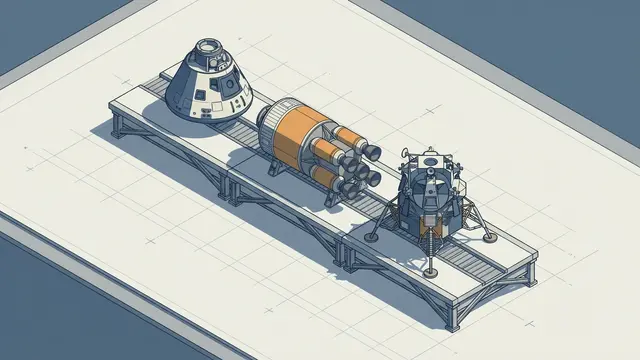
The transition from terrestrial to orbital computing has, until now, been a project of bespoke engineering and immense capital risk. For AI developers and government agencies looking to move processing power into the vacuum of space, the hardware requirements—managing thermal loads, power generation, and orbital mechanics—often overshadow the computational goals. Atomic-6, a Georgia-based composite manufacturer, is attempting to standardize this frontier with the launch of ODC.Space, a marketplace designed to treat orbital compute as a commodity rather than a custom-built anomaly.
By acting as a general contractor, Atomic-6 aims to simplify the procurement process to something resembling a standard enterprise "add to cart" experience. The platform aggregates various suppliers from the space ecosystem, allowing customers to select architectures that suit their specific needs without the burden of designing their own spacecraft. With a projected delivery timeline of two to three years, the platform represents a step toward making the "orbital cloud" a functional reality for both commercial AI workloads and government applications.
From Custom Engineering to Catalog Procurement
The logic behind ODC.Space follows a pattern familiar from other infrastructure markets that matured over the past two decades. Cloud computing itself underwent a similar transformation: what began as custom server deployments in co-located facilities eventually became an abstracted, on-demand service through platforms like Amazon Web Services, Microsoft Azure, and Google Cloud. The key inflection point in each case was the moment procurement shifted from engineering-led to procurement-led—when buyers stopped needing to understand the underlying hardware in order to purchase capacity.
Atomic-6 appears to be betting that orbital computing is approaching a comparable threshold. The marketplace model implies that enough standardization exists—or can be imposed—across launch providers, satellite bus manufacturers, and payload integrators to offer repeatable configurations. That assumption is not trivial. The space industry has historically resisted commoditization, with each mission carrying unique requirements driven by orbit selection, regulatory jurisdiction, and end-user specifications. Whether a marketplace can absorb that complexity without collapsing into a bespoke consulting operation remains an open question.
Still, the shift in framing matters. Presenting orbital data centers through enforceable contracts and predictable lead times, rather than speculative white papers, signals that at least one company sees sufficient demand to justify a transactional model. The target customers—AI developers hungry for compute and defense agencies seeking resilient, distributed infrastructure—represent sectors where procurement budgets are large and growing, and where the strategic rationale for space-based processing extends beyond performance into sovereignty and survivability.
The Physics Problem as Product Offering
While Atomic-6 facilitates the broader assembly, it also supplies the critical infrastructure necessary for high-density computing in orbit. The company is integrating its "Light Wing" solar arrays and its newly unveiled "Hot Wing" thermal radiators into the marketplace's offerings. These components address the primary bottleneck of orbital data centers: the need for massive power and the subsequent challenge of dissipating heat where there is no atmosphere.
On Earth, data centers consume enormous quantities of electricity and rely on air or liquid cooling systems to manage thermal output. In orbit, neither resource is available in conventional form. Solar arrays must generate sufficient wattage to power GPU-dense racks, and thermal radiators must reject waste heat through radiation alone—a far less efficient process than convective cooling. The naming convention Atomic-6 has chosen for its product lines ("Light Wing" for power, "Hot Wing" for thermal management) suggests a deliberate effort to make these engineering challenges legible to buyers who may not be spacecraft engineers.
The broader context reinforces why this matters. Demand for AI training and inference compute continues to strain terrestrial data center capacity, particularly in regions facing power grid constraints and permitting delays. Orbital computing offers a theoretical escape from those bottlenecks—unlimited solar energy, no land-use conflicts, no water consumption for cooling—but only if the engineering can be delivered at a cost and timeline that competes with building on the ground.
Atomic-6's marketplace sits at the intersection of two forces pulling in opposite directions: the accelerating demand for compute infrastructure and the stubborn physical complexity of operating in space. Whether ODC.Space becomes the procurement layer that bridges that gap, or whether it arrives ahead of the supply chain's actual readiness, will depend on variables that no marketplace interface can fully abstract away—launch costs, regulatory approvals, and the unforgiving thermodynamics of vacuum.
With reporting from Payload Space.
Source · Payload Space