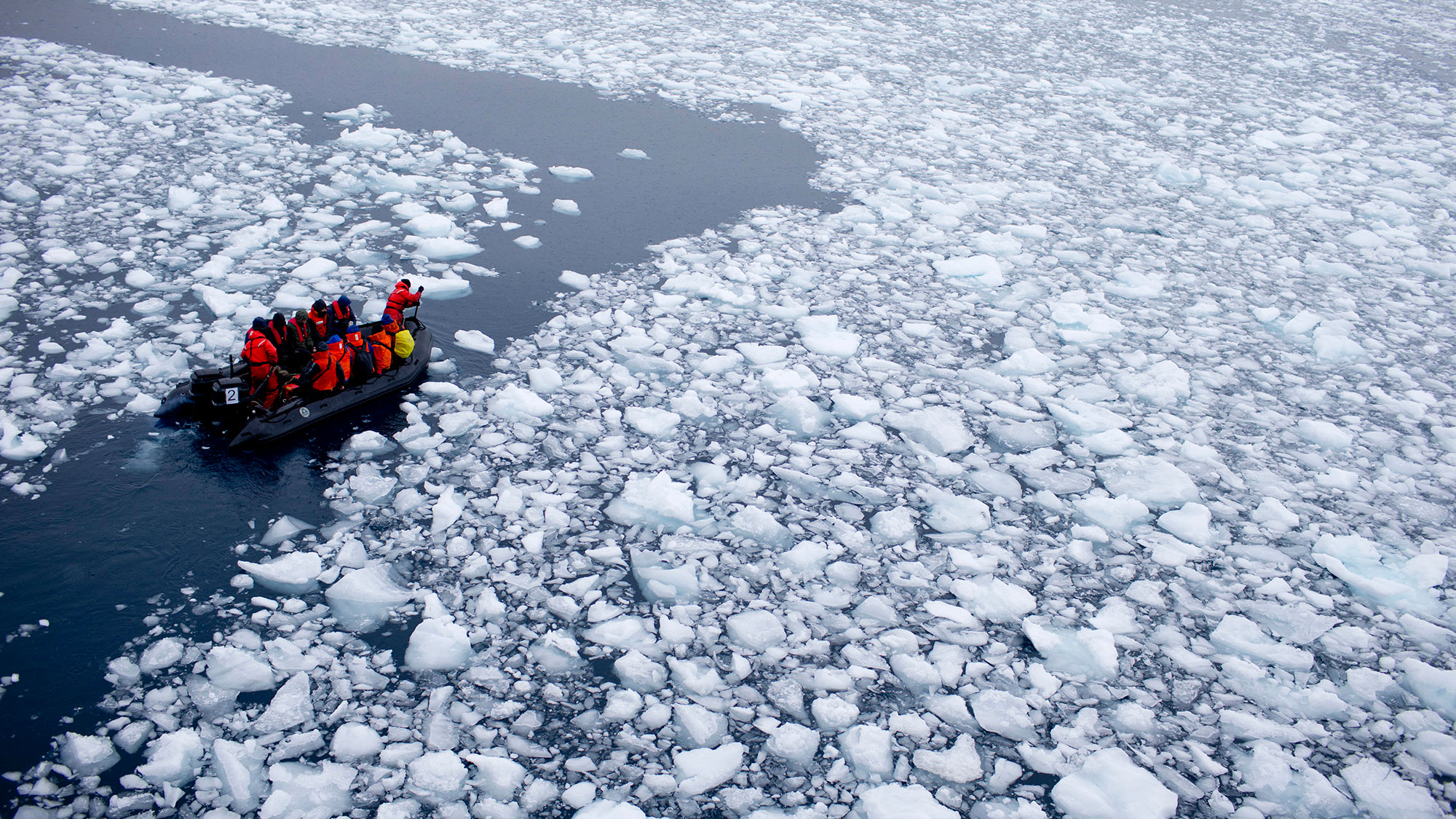
For decades, the sea ice surrounding Antarctica presented a stubborn paradox to climate scientists. While the rest of the planet warmed, the floating ice radiating from the frozen continent actually expanded, growing steadily from the 1970s until about 2016. Then the trend reversed with startling speed. The ice contracted and has failed to recover since, suggesting that the warming of the Southern Ocean may have crossed a threshold from which return is not straightforward. A new study led by Earle Wilson at Stanford University points to changes deep beneath the surface — mapped by autonomous robots — as the mechanism behind the shift.
The instruments in question are Argo floats, torpedo-shaped devices roughly two meters long that drift through the ocean's water column for years at a time. Each float follows a programmed cycle: sinking to depths of up to two thousand meters, sampling temperature and salinity as it descends and ascends, then surfacing briefly to transmit its data to satellites before diving again. The international Argo program, launched in the early 2000s, now maintains thousands of these floats across the world's oceans, forming what amounts to a persistent, distributed nervous system for oceanographic observation. In the Southern Ocean — remote, violent, and historically under-sampled — the floats fill a gap that crewed research vessels and satellite imagery cannot.
What the Robots Found
Wilson's research draws on the vertical profiles these floats collect to describe a process that unfolds far below the ice. The study suggests that shifts in wind patterns and changes in ocean salinity have altered the way the Southern Ocean's layers interact. Normally, a relatively fresh, cold layer of surface water acts as a lid, insulating the sea ice above from the warmer, saltier water that circulates at depth. When that stratification weakens — through changes in freshwater input, wind-driven mixing, or both — the warmer water rises and erodes the ice from beneath.
This bottom-up melting is largely invisible to satellites, which track ice extent from above. The Argo data reveal the mechanical process that satellite imagery misses: a reorganization of the ocean's internal structure that, once underway, can sustain ice loss even in the absence of dramatic surface warming. The implication is that Antarctic sea ice did not simply respond to rising air temperatures. It responded to a shift in the ocean's own circulation regime — one that had been building for years before manifesting abruptly at the surface.
The pattern echoes a broader principle in Earth system science. Large-scale environmental systems often absorb stress incrementally, showing little outward change, until internal conditions cross a threshold and the system reorganizes rapidly. The Southern Ocean, it appears, buffered decades of warming before its layered structure gave way.
Why the Buffer Matters
The practical significance extends well beyond the sea ice itself. Antarctic sea ice serves as a thermal and mechanical buffer for the continental ice sheet — the vast body of glacial ice sitting on land. The ice sheet holds enough frozen water to raise global sea levels dramatically; the sea ice surrounding it slows the flow of glaciers toward the coast and shields the ice shelves that buttress them. A sustained reduction in sea ice coverage removes part of that protective margin.
The Southern Ocean also plays an outsized role in global heat and carbon absorption. Changes in its mixing patterns affect not only local ice dynamics but the rate at which the ocean sequesters atmospheric carbon dioxide. A more turbulent, less stratified Southern Ocean may absorb heat differently, with consequences that ripple through global climate models.
What makes the Argo network valuable is its continuity. Unlike research cruises, which provide snapshots, the floats deliver unbroken time series from regions that are otherwise inaccessible for much of the year. As the dataset grows, it offers the possibility of distinguishing between natural variability and directional change — a distinction that remains contested in Southern Ocean science.
The tension, then, is between two readings of the same data. One holds that the post-2016 ice loss represents a permanent regime shift, a new baseline from which Antarctic sea ice will not recover on human-relevant timescales. The other allows for the possibility that the ocean's internal variability could, under certain conditions, restore the stratification that once protected the ice. The robots will keep diving. Which interpretation prevails depends on what they find next.
With reporting from Grist.
Source · Grist